Matt. 1:17 - Fishers of men

Wednesday 28 January 2004

This may be an allusion to Jer.16:16:

Behold, I am sending for many fishers, says the LORD, and they shall catch them; and afterwards I will send for many hunters, and they shall hunt them from every mountain and every hill, and out of the clefts of the rocks.

The parallel between ‘fishers’ and ‘hunters’ in this verse would appear to mean that these ‘fishers’ are an instrument of judgment (cf. Vermes, The Authentic Gospel of Jesus, 2). Jeremiah warns that Israel cannot hide her iniquity from God and will inevitably be punished (Jer.16:17-18). However, the preceding paragraph (14-15) speaks of God restoring the scattered people of Israel to the land, just as before he had brought them from Egypt. It may be, therefore, that Jesus associated the ‘fishers’ of Jeremiah’s prophecy with the gathering of the ‘elect’ from the nations of the world (cf. Mk.13:27). Alternatively, we may suppose that when he calls the disciples to be ‘fishers of men’, he has in mind the fact that the gospel of the kingdom is a message both of salvation and judgment for Israel.

If Jesus intended the allusion, the effect is to contextualize the call more clearly within the framework of the imminent eschatological transition and the restoration of Israel.

Critical-realism and postmodernism

Monday 19 January 2004

The ‘emerging church’ project is an experiment in new forms of church. The question of what ‘church’ is, however, cannot be resolved sociologically or experimentally. Ultimately, a theological answer is required. This page was written to provide some preliminary reflection for the Future of the People of God conference with Tom Wright. It is an attempt to address some of the more theoretical questions that arise when Wright’s retelling of the story of Jesus, constructed on the basis of a critical-realist hermeneutic, is considered from a postmodern perspective.

Transmillennialism™

Friday 02 January 2004

Paul Seburn referred in another post to the ‘transmillennial’ view on New Testament eschatology. I thought it might be worth examining this separately. There’s a lot of material on the two sites I looked at (www.presence.tv and www.transmillennial.com), but I have limited my superficial comments to one introductory essay. I would be interested to hear from anyone who has strong views on the subject. Oh, and while we’re wondering exactly what happened to the future, a happy new year to everyone!

Postmodernism and the Jesus of history

Friday 12 September 2003

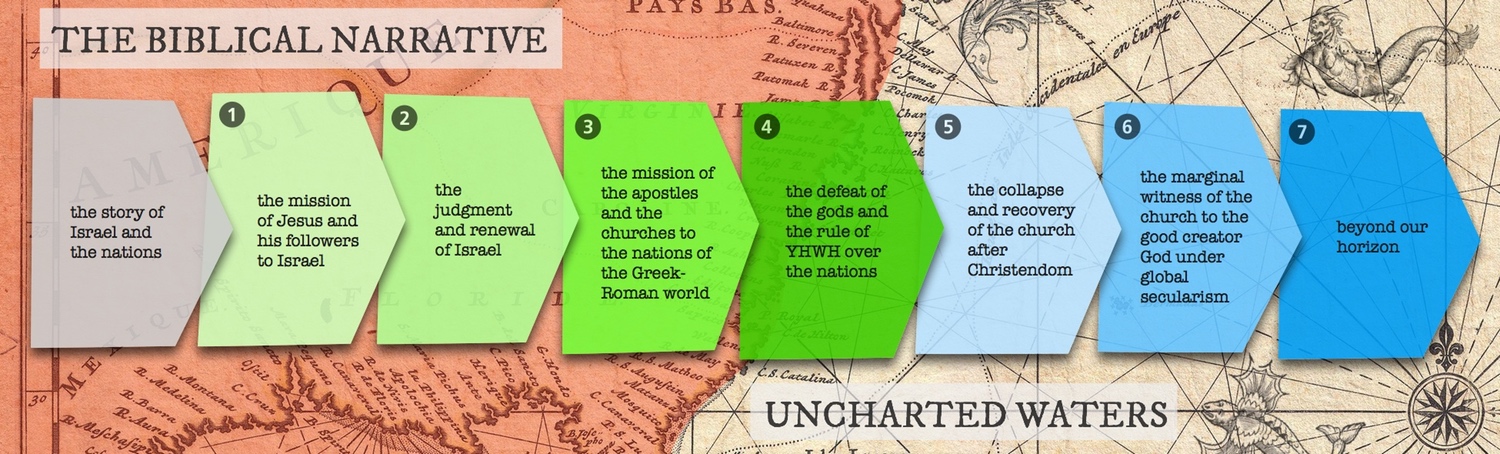
There is both a diachronic (historical) and a synchronic (a-historical, existential) dimension to the development of a theology for the emerging church. The argument has for the most part been developed synchronically in response to cultural and philosophical changes taking place both inside and outside the church. Biblical stories are treated as types and exemplars of general spiritual truths. The diachronic or historical dimension has been neglected. We do not understand well enough the historical-eschatological narrative that brings us to the point at which we may properly address the postmodern questions about identity, community, mission, truth, culture, and so on.

New book: The Future of the People of God

List by category

In particular

My books

Otherways: In Search of an Emerging Theology
The Future of the People of God
Re: Mission: Biblical Mission for a Post-Biblical Church
Faith, Health and Prosperity
Speaking of Women: Interpreting Paul
The Coming of the Son of Man

Syndicate

Syndicate content