The essay challenges Christopher and Richard Hays’s argument that biblical ethics should evolve through a progressive widening of God’s mercy. It contends that biblical change occurs not gradually but through disruptive historical events and civilisational transformations. Isaiah’s inclusion of foreigners, Jesus’ acceptance of sinners, and Paul’s mission to Gentiles each addressed particular historical circumstances. Paul’s condemnation of same-sex behaviour is interpreted as part of his critique of Greek idolatry and the impending end of pagan civilisation. With Western Christendom now disintegrating, the essay argues, the church must historically reassess biblical ethics and develop a new anthropology appropriate to contemporary conditions
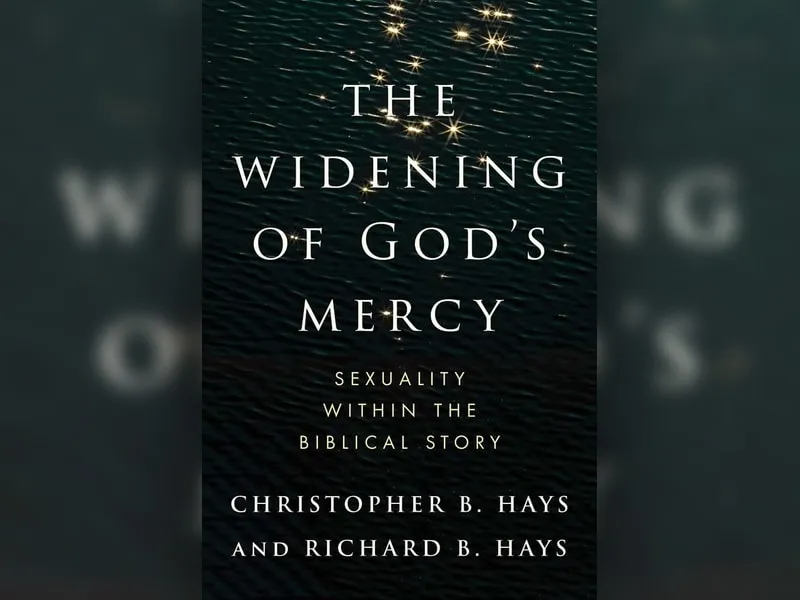
In their revision of Richard Hays’ formerly negative stance on same-sex relationships (see the chapter on homosexuality in The Moral Vision of the New Testament), Christopher Hays and his father claim to have found in scripture a progressive “widening” of the field of God’s mercy. “God repeatedly reveals an expansive mercy that embraces ever wider circles of people, including those previously deemed in some way alien or unworthy.”1
For example, before the exile, foreigners and eunuchs were, for different reasons, debarred from participation in Israelite temple worship (e.g., Lev. 21:17-23). In the context of the return from exile, however, Isaiah says that foreigners and eunuchs who have joined themselves to the Lord should not fear being separated from his people (Is. 56:3).
Eunuchs who keep the commandments and hold fast the covenant will at least have a commemorative “stela” or “hand” (yad) within the walls of the temple to compensate for the lack of offspring at this critical time of repopulating the land (56:4-5).
Foreigners who “join themselves to the LORD, to minister to him, to love the name of the LORD, and to be his servants” will bring sacrifices to the altar (56:6). In this way, the temple will be “called a house of prayer for all peoples”; God will gather to Israel “yet others… besides those already gathered” (56:7-8).
So we have to face up to the fact, Hays and Hays argue, that there are developments in—and sometimes plain corrections to—the revealed will of God.
They cite the problematic admission that YHWH gave Israel “statutes that were not good and rules by which they could not have life, and I defiled them through their very gifts in their offering up all their firstborn, that I might devastate them” (Ezek. 20:25-26).
In keeping with the prophet’s “courageous willingness to rethink old rules,” they suggest that biblical injunctions against same-sex sexual activity should now likewise be classified as “statutes that were not good and rules by which they could not have life.”
It’s not that simple
The question I have is whether the metaphor of the widening circle of God’s mercy is the best way to frame such a rethinking of the old rules. Does it do justice to the structures of the biblical narratives? Does it provide an adequate rationale for a reversal of policy today? The two questions are closely related.
The inclusion of foreigners and eunuchs at the time of the return from exile strikes me as a contingent—or context-dependent—provision in recognition of the fact that a number of such outsiders became intimately joined, through marriage or socialisation, to the deracinated Jewish community in Babylon. There is no reason to think that it resulted in a permanent change or set a precedent for a policy of inclusion once Israel was re-established in the land.
The Gospels hardly bear witness to a systemic widening of God’s mercy since the exile. Jesus’ embrace of the unclean and reprobate is officially judged reckless and unlawful, which itself points to the fact that courageous rethinking is bound up with dramatic shifts in historical conditions. Isaiah’s generous provision for the happy time of the return to the land has long been superseded by intense anxieties concerning the destabilising presence of unclean foreigners and other undesirables in Israel.
So the inclusion of (reformed) tax collectors and sinners in the new covenant community of Israel had its own contingent significance: it sharply signalled the failure of the current leadership and the renewal of the people from the margins. In other words, it was symptomatic of a much bigger shock to the system.
The inclusion of gentiles in the communities of the apostolic mission likewise represented something more than a generalised, humane widening of God’s mercy. It was a sign to both Israel and the peoples of the Greek and Roman world that God was God not of the Jews only but also of the nations (Rom. 3:29). The early deviant gatherings of believing Jews and Greeks prefigured and pre-empted an impending civilisational transformation—every knee would bow, every tongue would confess—which was the whole point of the movement.
So my argument here is that the interpretive metaphor or “hermeneutic” of a widening field of God’s mercy fails to take into account the major events that underpin historical change.
Or to reframe it positively: if we observe the close connection between Paul’s opposition to homo-erotic behaviour—as he understood it—and a quite narrowly conceived civilisational transition, we have good reason to do some courageous rethinking now that the wheel of history has abruptly turned again, undoing so much of what went before.
One damned civilisation after another
These are the general, hermeneutical observations that I would make.
1. The “deeper logic… narrative pattern” of a progressive “widening” of mercy is at odds with the epochal, catastrophe-driven, and “eschatological” nature of the biblical storyline.
The symbolism of Daniel’s great, four part statue or of the four beasts from the sea may strike us as crude and fantastical but it is a reading of history nevertheless, from the perspective of the community which bore witness to, and sometimes bore the brunt of, violent shifts in the landscape of power: empire succeeds empire until an indestructible kingdom of God is established on the earth.
2. The turbulent flood waters of this apocalyptic imaginary, unleashed by the clash with Hellenism, are still running deep when we get to the New Testament.
3. The model of “punctuated equilibrium” comes from evolutionary science. It has been adapted to account for social change: “The theory posits that most social systems exist in an extended period of stasis, which may be punctuated by sudden shifts leading to radical change.” The Hays and Hays paradigm conforms to an essentially gradualist account of historical change. The “punctuated equilibrium” paradigm allows for incremental change over long periods of relative stasis, punctuated by periods of intense disruption which result in more far-reaching change.
Conservative theologies prefer a “steady state” view: there is no evolution, nothing changes, at least from Jesus onwards. Progressive theologies incline to a steady change paradigm: a widening circle, an arcing, optimistic trajectory. The biblical narrative, especially in its prophetic and apocalyptic modes, embraces disruption and disorder and the end-of-the-age transformations that ensue.
4. Any dynamic of widening or expansion in the Bible is articulated not in general anthropological or ethical terms—a very modern rationalisation—but in geo-political terms.
Hays and Hays find in the key text Romans 1:16-17 a gospel that is “not just an idea or a proposition; instead, it is God’s power that transforms the human condition and brings new realities into being.” But Paul is not talking about the human condition; he is talking about Jews and Greeks—I will come back to this. Both the quotation of Habakkuk 2:4 and the immediate proposition that “the wrath of God is revealed from heaven” (1:18) bring a historical narrative into consideration.
5. The logic of widening runs through, in chapter sixteen of the book, “Mercy All the Way Down,” to Paul’s discussion of the “weak” and the “strong” in Romans 14. It is put to good analogical use:
The “strong” ones today are the liberated advocates of unconditional affirmation of same-sex unions; they are tempted to “despise” the “weak,” narrow-minded, rule-following conservatives who would impose limits on their freedom. And the “weak” ones today are the devout, strict followers of what they understand to be God’s law given in scripture; they are tempted to “pass judgment” on the sinful laxity of the “strong” who condone same-sex unions.
But there is no useful future aspect to the argument, beyond the bracketed expectation that God will eventually and mysteriously show mercy to all disobedient Israel.
The exclusion of the μαλακοὶ and ἀρσενοκοῖται—the catamites and sodomites for want of a better translation—along with the promiscuous, idolaters, adulterers, thieves, drunkards, swindlers, and revilers, is from inheritance in the future “kingdom of God” (1 Cor. 6:9). But if this is consigned to an ultimate and transcendent future—at a final resurrection of the dead, perhaps—any social or cultural or intellectual or scientific developments in the meantime, no matter how significant for humanity, whether good or bad, are elided.
6. The process of widening, as Hays and Hays present it, remains arbitrary and largely unaccounted for. The hermeneutic does not give cause to introduce the concrete, historical reasons for significant theological adjustment at any particular moment.
There is some recognition of this. Why should God’s mercy “override the Levitical laws about same-sex intercourse”? Hays and Hays suggest three tentative reasons. First, the church has abandoned other biblical teachings, notably regarding slave ownership and the subordination of women. Secondly, such change is driven by “careful and compassionate attention to human experience.” Thirdly, the widening of God’s mercy, specifically, is central to the biblical portrayal of God.
But that still doesn’t answer the question why now, in this day and age, under these circumstances? Why did it take so long for the church to give careful and compassionate attention to human experience? The broad attitudinal adjustment has come about, frankly, not as the consequence of a deeper theological “logic” but, again, because of tumultuous civilisational upheaval—what the Bible would call “judgment,” I think—a process in which the church has arguably been more obstructive than progressive.
What we need, then, is a hermeneutic that determines the proper historical horizons both for New Testament thought and for the “prophetic” outlook of the church in the West today.
The People of God, parts 1, 2, 3, and 4
There are well known narrative theologies that attempt to cram all of history after Pentecost into the last few scenes of a five act Shakespearean play. A better analogy, I think, would be Shakespeare’s tetralogies—the chronicling of history in four parts (Richard II, Henry IV parts 1 and 2, Henry V; Henry VI parts 1, 2 and 3, Richard III)—less entertaining, of course, than Hamlet or A Midsummer Night’s Dream, but the model allows for a partitioning of history that could be useful as we struggle to deal with change in properly biblical terms.
So Part 1 of the “People of God” tetralogy would be the story of Israel in the land, from Abraham through to the disaster of the war against Rome, which is the explicit narrative frame, as it happens, for the prohibition against male homosexual acts in Leviticus. A man lying with a man as with a woman is one of the “abominations” that will render the land unclean and lead to it vomiting out its inhabitants (Lev. 18:28).
Part 2 tells the story of the conversion of the nations of the Greek-Roman world—anticipated in the apostolic mission, completed in history. This is the controlling and limiting context for Paul’s identification of same-sex sexual activity as the epitomising consequence of Greek idolatry.
Part 3 takes us into the post-biblical era, covering the long age of western Christendom and its slow disintegration under the corrosive conditions of modernity.
Now in Part 4, the church struggles to come to terms with its marginalisation and the lurch into a post-modern, globalised, hyper-technological, ecocidal disorder.
This expansion of the narrative hermeneutic accommodates large-scale, civilisational shifts analogous to the clear political boundaries and transitions that mark out the history plays.
What will make it theoretically serviceable is the recognition that the eschatological outlook of the apostolic mission was at its core not universal and final but historical and contingent—and therefore potentially bounded.
To that tricky matter we now turn.
Paul in Athens
In Athens, Luke tells us, Paul carefully differentiated between, on the one hand, the rampant religiosity evidenced in the innumerable objects of worship that adorned the city’s streets and market places and, on the other, a slender counter-narrative found occasionally in the poets. Paul quotes (it is assumed) a line from Aratus’ poem Phainomena (Acts 17:28):
From Zeus let us begin; him do we mortals never leave unnamed; full of Zeus are all the streets and all the market-places of men…; always we all have need of Zeus. For we are also his offspring….
Embedded in the culture is the knowledge that all things in creation owe their existence to an invisible, transcendent, and sufficient god, who goes by the name of Zeus rather than YHWH. It is a profound error, therefore, Paul argues, to think that the “divine being is like gold or silver or stone, an image formed by the art and imagination of man” (17:29).
This state of affairs has gone on for a long time, as the Sibyl knew (2nd-1st century BC):
Greece, why… do you give vain gifts to the dead and sacrifice to idols? Who put error in your heart that you should abandon the face of the great God and do these things? Revere the name of the one who has begotten all, and do not forget it. It is a thousand years and five hundred more since the overbearing kings of the Greeks reigned, who began the first evils for mortals, setting up many idols of dead gods. On account of them you have been taught vain thinking. But when the wrath of the great God comes upon you, then indeed you will recognize the face of the great God. (Sib. Or. 3:545-557)
During this time, Paul says, God has treated such Greek “ignorance” with the contempt and disregard it deserves, but no longer. Now he commands people across the pagan world to repent of their idolatrous practices because he has fixed a day when he will judge this civilisation (oikoumenēn) by a man whom he has appointed (Acts 17:30-31).
We lazily assume, with Calvin, that this is a final judgment of all humanity: “He maketh mention of the last judgment, that he may awake them out of their dream.”2 But I would suggest—I can make only a limited case for it here—that the language points rather to an epochal moment that would mark the end specifically of the religious culture concretised in the architecture and iconography of Athens.
When Paul says “Greek,” he means “Greek”
Paul pursues a similar indictment of “Greek” religious culture in Romans 1:19-25. The gospel is the power of God for salvation for the believing Jew and for the believing Greek. The reference to the “Greek” is surprising, Beverley Gaventa acknowledges. She argues, however, that since Paul has already spoken of “all gentiles” (1:13), he has used the singular “Greek” for want of a suitable term for the individual gentile—any non-Jewish person.3
But Paul has just divided these “gentiles” between “Greeks” and “barbarians” (1:14)—between “those who participate in Greco-Roman culture and those who do not,” as Gaventa herself puts it. So there is no good reason not to take the “Greek”—and the critique of Greek idolatry—at face value. Nowhere in the extant literature of second temple Judaism , to the best of my knowledge, does Hellēn refer to non-Jewish humanity.
The “Greek” who needs salvation is the Greek who participates in Greco-Roman culture.
Salvation is needed because the wrath of God is revealed against “every impiety and unrighteous act of people who possess the truth in unrighteousness” (1:18*). What this meant for the Jew will be made clear enough: they possessed the Law and the truth revealed in it, but their actions were impious and unrighteous (cf. 2:17-24). But what about the Greek?
Again, commentators mostly assume that the critique developed in Romans 1:18-32 is aimed at humanity in general. N. T. Wright, for example, thinks that Paul’s account of idolatry introduces the reader to a major theme of his “indictment of the human race.”[fn N.T. Wright, The Letter to the Romans: Introduction, Commentary, and Reflection (2002), 431.]
But the language is more specific than that: what Paul has in mind is a characteristically Greek way of possessing the truth about God in impiety and unrighteousness.
So briefly, Aristotle says that Xenophanes first propounded the unity of all things, albeit rather imprecisely: “looking up into the broad heavens he said: The unity is god” (Aristotle, Metaphysics 1.5.986b12*). Xenophanes had learned from the oneness of the “whole heaven” above the truth that God is one, whereas created things exist in diversity. Philodemus records the opinion of the Socratic philosopher Antisthenes (4th-3rd century BC) that “according to custom (κατὰ νόμον), there are many gods, while, according to nature (κατὰ… φύσιν), only one” (Philodemus, On Piety col. 335 26-30).
That is more or less Paul’s point: even the Greeks knew from contemplation of the natural order that there is a fundamental difference between the oneness of God and the multiplicity of forms in which created objects existed.
They suppressed a knowledge of the one creator God latent in the culture and worshipped instead the material object, the stuff of creation, exchanging the truth about God for a lie. This was their original sin, so to speak.
For that reason, the Greeks as a civilisation have been handed over to the “uncleanness” associated peculiarly in the Jewish mind with same-sex sexual behaviour; and because they “did not think fit to have God in knowledge, God gave them up to an unfit mind” (1:28*) and a catalogue of social evils (1:29-31). It is the observable unlikeness of Greek civilisation to a Jewish ideal of piety and righteousness that marks it out as subject to the wrath of God and liable to a coming day of judgment.
The connection between Greek idolatry and the degeneracy of a civilisation is also found in Wisdom of Solomon. The handmade wooden object, the author says, is accursed if it is fashioned into the form of a god and “named a god”; and there will be a visitation upon the idols of the nations, because the “invention of idols was the beginning of sexual immorality (πορνείας), and the discovery of them the corruption of life.” Idols did not exist from the beginning—this is not an argument that goes back to Genesis 2-3; nor will they last forever—they will be eradicated in time, not at the end of it (Wis. 14:8-14).
This gives us a terminus ad quem, an eschaton: the judgment of a Greek civilisation characterised by idol-worship, a public and sometimes quite ostentatious gay culture, and all manner of social wickedness.
Much the same outlook holds for 1 Corinthians. The saints in Corinth need to settle their own disputes because they will judge the world, in which are found people who are sexually immoral, greedy, thieving, idol-worshipping, etc. (1 Cor. 5:9-6:2). This judgment would normally be understood in transcendent terms, but the argument is really very practical, and there is no reason to suppose that a final scenario is in view.
Let’s suppose, then, a more realistic account of this judgment.
The Corinthians should learn how to judge cases of sexual immorality within the community (5:1) because they will find themselves, in due course, entrusted with the responsibility of shaping the moral character and direction of a new post-pagan society in an age to come. This is the obvious, challenging “step up” in competency for the novice churches of the ancient world. Perhaps the thought is that it will be an arbitration of the martyrs alongside Christ in heaven, but it is still a judgment of real world social behaviour.
The “kingdom of God,” therefore, determines the character of the civilisation that will replace the world as it is described in Romans 1:18-32—cutting some long stories short, I realise. Either living or raised from the dead, the saints will participate in the religious and moral recalibration of a post-pagan society.
It is essential, therefore, that they rigorously embody the essentially Jewish counter-narrative: worship of the one God who made all things, sexual purity, and social rectitude. So, “neither the sexually immoral nor idolators nor adulterers nor catamites (μαλακοὶ) nor sodomites (ἀρσενοκοῖται) nor thieves nor the greedy, not drunkards, not revilers, not grasping (people) shall inherit the kingdom of God” (1 Cor 6:9-10*).
Closure
But as soon as we frame the teaching historically in this way, we have to reckon with the fact that history never settles, it keeps moving forwards. To go back to our Shakespearean tetralogy, Part 3 tells the story of the long fulfilment of the rule of the God of Israel over the once pagan nations of the European oikoumenē.
It ends with another massive civilisational upheaval—roughly speaking, the triumph of a rational, secular humanism over the universalising theological paradigm that had prevailed for a thousand years and five hundred years, or thereabouts.
In historical terms, we have been faced with the collapse of the worldview that was forged in the coming together of an apocalyptic Jewish-Christian kingdom movement and a suppressed Greek knowledge of the one God. The indestructible “kingdom of God” has proved destructible.
But in that closure would be the narrative-theological justification for making Paul’s identification of conspicuous same-sex sexual activity as a hallmark of a civilisation subject to the wrath of God.
We are now—and have been for some time—in the process of constructing a new biblical-theological grounding for the much more precarious subsistence of the church as a priestly community under vastly different civilisational conditions.
A revised anthropology that recognises the normalness of same-sex attraction and the consequences for social policy is merely one facet of a much larger rethinking of what it means, under the dramatic conditions that hold in Part 4 of our tetralogy, to be optimally human.
Recent comments