The parable of the rich man and Lazarus (Luke 16:19–31) may reflect the Egyptian tale of Khamwas and Si-Osire, adapted to Jewish concerns. Its imagery of conscious torment in Hades is probably popular folklore rather than teaching about heaven and hell. Luke frames the story within his recurring concern with wealth, justice, and Israel’s faithfulness. The rich man’s ostentatious wealth, rather than specific evil deeds, excludes him from Abraham’s future. “Moses and the prophets” already reveal the required path: love of God and neighbour, justice, repentance, and obedience. The parable therefore addresses Israel’s coming judgment and reversal, not universal teaching about the afterlife.
This is really just for fun. I was wondering whether to preach about wealth inequality next Sunday, but this is as far as I got.
Jesus tells a quite elaborate story about an unnamed rich man and a poor man called Lazarus. One early manuscript gives the rich man the name Neuēs.
There was a certain wealthy person, and he was wearing purple and fine linen, celebrating sumptuously every day. And a certain poor man with the name Lazarus had been laid at his gate, covered with sores and desiring to feed from the things that fell from the table of the wealthy man. But indeed, the dogs, coming, licked his sores.
It happened that the poor man died and that he was carried off by the angels to the side of Abraham. And also the wealthy man died and was buried, and in Hades, having lifted up his eyes, being in torments, he saw Abraham from far off and Lazarus at his sides. And calling out he said, “Father Abraham, have mercy on me and send Lazarus that he might dip the end of his finger in water and cool my tongue, for I am in pain in this flame.”
And Abraham said, “Child, remember that you received your good things in your life and Lazarus likewise the bad things…; and now he is comforted here, and you are in pain. And in all these things, between us and you a great chasm has been fixed in order that those wanting to cross over from here to you may not be able, nor may they pass over from there to us.”
And he said, “I beg you then, father, that you might send him to the house of my father, for I have five brothers, so that he might testify to them in order that they might not also come to this place of torment.” And Abraham says, “They have Moses and the prophets; let them hear them.”
And he said, “No, father Abraham, but if someone from the dead goes to them, they will repent.’” He said to him, “If they do not hear Moses and the prophets, neither if someone from the dead should rise will they be persuaded.” (Lk. 16:19-31*)
It is widely assumed that this draws on a popular literary tradition best represented by the Egyptian tale of Khamwas and Si-Osire.
Setne Khamwas is the son of Pharaoh Usermara. He has a son conceived somewhat miraculously called Si-Osire, and Setne has learned in a dream that the precocious boy will do many marvels in the land of Egypt.
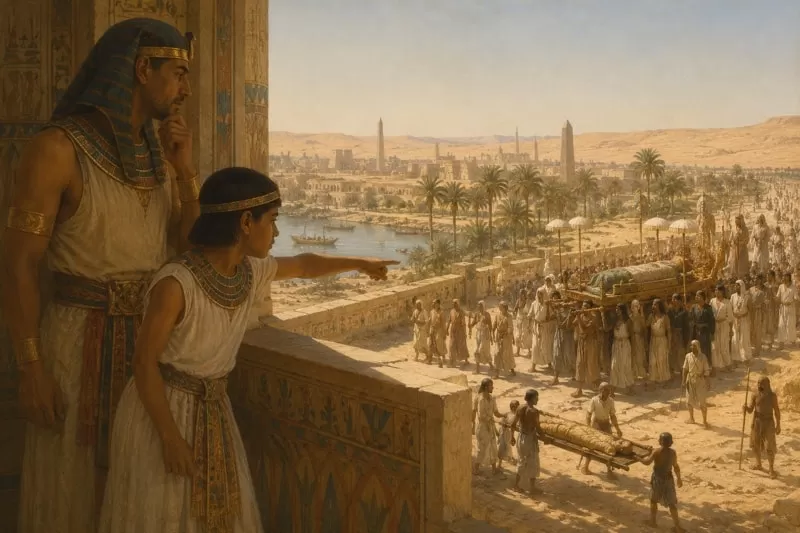
During a feast, Setne and the boy Si-Osire hear loud wailing coming from outside the palace. They look from a window and see the dead bodies of two men being carried to the “desert-necropolis.” One is a rich man, decked out in his finery with a great procession of mourners, lamenting noisily. The other is a poor man, wrapped in a mat, with no one in attendance.
Setne declares that it will be much better in Amenti for the rich man than for the poor man, but Si-Osire says to his father:
[There shall be done unto thee in Amenti] like [that which] shall be done to this poor man in Amenti; [there shall not be done unto thee that which shall be done to this rich man in Amenti].
Part of the story is missing at this point, but Si-Osire later leads his father through the underworld to see the fate of the dead. They pass through a succession of halls until they reach the seventh hall where the god Osiris is judging the dead according to their deeds.
Those whose evil deeds outweigh their good deeds are destroyed, soul and body, and are not permitted “to live again for ever” (cf. the “second death” in Rev. 20:6, 14).
The person whose good deeds are more numerous than the bad “is taken among the gods of the council of the Lord of Amenti, his soul going to heaven with the noble spirits.”
Their eyes then fall on a “great man clothed in raiment of byssus (sea silk),” standing in a place of honour close to Osires. Si-Osire explains to his father that this is the poor man whom they had seen being carried out from Memphis. Because his good deeds so outweighed his evil deeds, Osiris has commanded that
the burial outfit of that rich man, whom [you saw] carried forth from Memphis with great laudation, should be given to this same poor man, and that he should be taken among the noble spirits as a man of God that follows Sokaris Osiris, his place being near to the person of Osiris.
The rich man, on the other hand, has suffered a gruesome punishment. He is seen with the pivot of the door of the fifth hall fixed in his eye socket. He is praying and “uttering great lamentation.”
This is why Si-Osire had told his father that it will be done to him in death as to the poor man, not as to the rich man.
So what are we to make of this?
- It is remarkable that Jesus (or Luke) would draw upon a morality tale of this sort, one that is so remote conceptually from second temple Jewish thought. The nearest we get may be the vision of the separation of the souls of the righteous and unrighteous dead, in a cavernous place, as they wait for the day of judgment in 1 Enoch 22.
- That the dead experience conscious suffering or pleasure in Hades is not an Old Testament idea. In Jesus’ story, the modes of torment and the topography of Hades probably reflect popular thought, reconfigured for the Jews around the figure of Abraham. This is not a teaching about a real heaven and hell.
- There is little direct narrative framing for Jesus’ story. We have heard about the controversy with the Pharisees, who were “lovers of money” (16:14), and before that there is some teaching about the honest and dishonest management of wealth (16:1-13). It is perhaps best understood as the intersection of the wealth theme and the dispute provoked by his association with sinners and such like (15:1-2).
- In Jesus’ story it is not the evil deeds of the rich man that are the problem but his ostentatious wealth. This is a major Lucan theme: the rich are “sent away empty” (Lk. 1:53); the rich have received their consolation (6:24); the rich man gets no benefit from his wealth in death (12:16-21); it will be very difficult for the wealthy to enter the kingdom of God (18:24-25); the poor widow puts more into the offering box than the rich man (21:1-4).
- The rich man is in the position of those Jews who are thrown into the Gehenna of fire, which is the coming judgment of God against his people (Matt. 5:22; 18:9; Mk. 9:43), or who are cast into the outer darkness where “there will be weeping and gnashing of teeth, when you see Abraham and Isaac and Jacob and all the prophets in the kingdom of God but you yourselves cast out” (Lk. 13:28).
- He assumes that he is still in a position indirectly to order Lazarus either to relieve his anguish or take a message to his brothers.
- The parable is not about death but about life. It answers the question of who in Israel is a true child of Abraham—another characteristically Lucan theme. The crowds coming for baptism claim to have Abraham as their father (3:8-9); a disabled woman is a daughter of Abraham (13:16); Zacchaeus is declared a soon Abraham (19:9); and I have made the point before that the prodigal son is reconciled not to God but to father Abraham.
- What exactly should the rich man and his brothers have learned from Moses and the prophets? When a lawyer asks what he must do to inherit eternal life, Jesus directs him to the Law: “You shall love the Lord your God with all your heart and with all your soul and with all your strength and with all your mind, and your neighbour as yourself” (10:27). And Moses and the prophets reveal that the Christ must suffer and be raised from the dead, and that “repentance for the forgiveness of sins should be proclaimed in his name to all nations, beginning from Jerusalem” (24:24, 47).
- The story is told to Israel and about Israel. The nation will not be delivered from the sort of catastrophe predicted both in the Law and in the prophets if there is a top-down prioritisation of wealth over justice and obedience. Therefore, the future order, which will come about through the sovereign work of YHWH—the kingdom of God—will belong to the previously disenfranchised in Israel.
- There is no point sending Lazarus back to warn unrighteousness Israel: they will not be persuaded even if someone should be raised from the dead. We just about stay within the terms of the story. No doubt Luke intends an allusion to the resurrection of the Son of Man on the third day (24:7, 46), but the scope of the story has not thereby been extended to include gentiles.
Recent comments