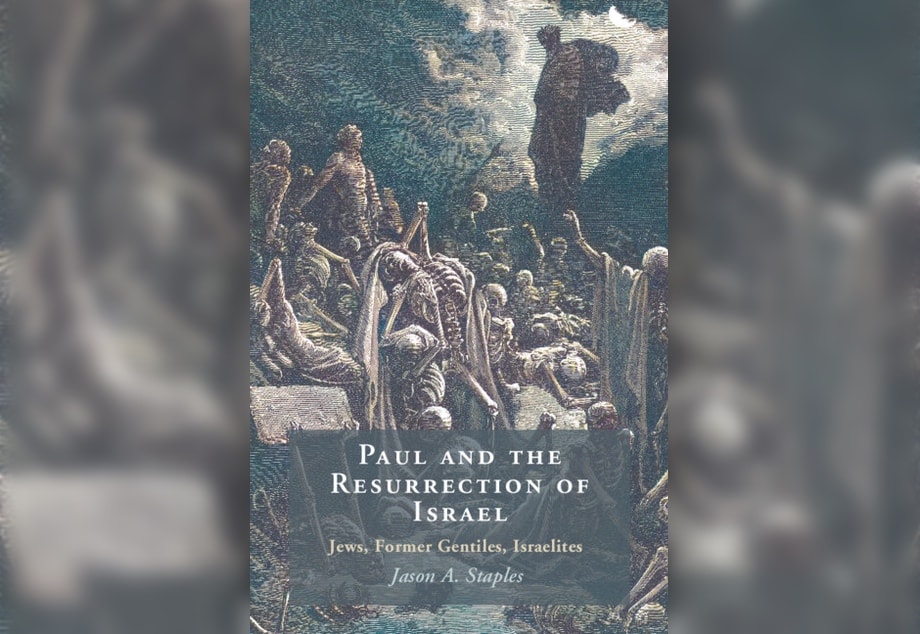
This is a rather technical examination of Jason Staples’ argument in Paul and the Resurrection of Israel: Jews, Former Gentiles, Israelites that when Paul speaks of Israel as “vessels of wrath,” he does not mean that the people are are the objects of God’s wrath; rather they are the instruments of God’s redemptive purposes. My view has been that Paul is saying that part of Israel really has become liable to destruction—much as Jesus foresaw destruction coming upon Jerusalem and the temple. But perhaps I’ve got it wrong.
The third “epiphany miracle,” after the two sea miracles, is the transfiguration or “metamorphoses” (metemorphēthē) of Jesus in the presence of Peter, James, and John, on the mountain. ()
The second “epiphany miracle” discussed by Brant Pitre in his book Jesus and Divine Christology is Jesus walking on the water (Matt. 14:22-33; Mk. 6:45-52; Jn. 6:16-21). ( | 3 comments)
Chapter two of Jesus and Divine Christology is about the “epiphany miracles.” Brant Pitre states the main purpose of the chapter quite bluntly: it is to “demolish the modern scholarly myth… that Jesus is not depicted as divine in the Synoptic Gospels” (40).There are three such miracles:… ()
I have just started reading Brant Pitre’s Jesus and Divine Christology (2024), in which he sets out to show that the earliest Jewish followers of Jesus believed he was divine because “Jesus himself spoke and acted as if he were divine during his lifetime”—only he did so in a very Jewish… ( | 5 comments)
According to Douglas Moo, the theological or conceptual “framework within which Paul expresses his key ideas in Romans can be called salvation history” (D. Moo, The Epistle to the Romans, 1996, 25). What he means by this is that “God has accomplished redemption as part of a historical… ()
I have been reading Tom Wright’s Into the Heart of Romans: A Deep Dive Into Paul’s Greatest Letter (2023), wondering whether I should make it recommended reading for a course on Romans. I probably will but with caveats.My view is that Wright’s assessment of the traditional Protestant… ()
I had a conversation last week with an old friend, Scott Lencke, about what I have been calling a “narrative-historical” approach to the reading of the Bible and of the New Testament in particular. Scott has made it available on his new podcast, or you can watch the whole thing on YouTube. ()
Recent comments