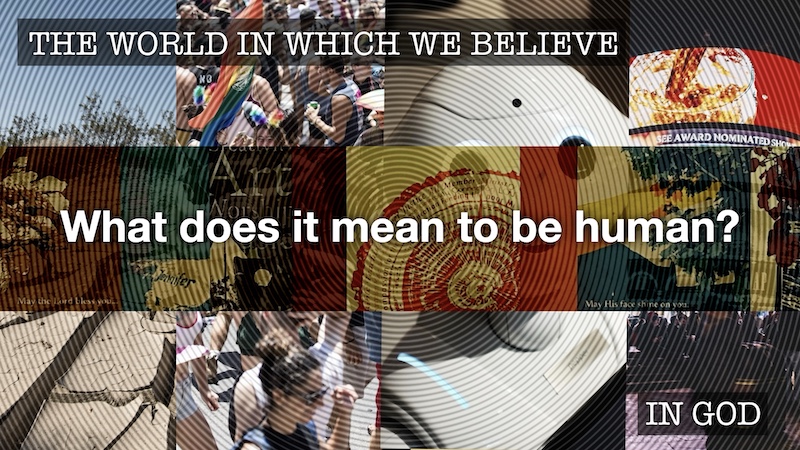
For most of us, subjectively, the everyday experience of being human probably hasn’t changed very much, but we may be aware of a storm of questions blowing furiously outside the house, rattling the windows and loosening tiles. What does it mean to be male and female? What is a “normal” state of mental health? Are ethnicity and nationality essential to our humanity? Are we anything more than compliant consumers of goods and services? Is AI making the human mind redundant? And as we enter the Anthropocene, are we—paradoxically—losing control of our destiny?

To be human is not just to be one thing. It is to be part of a story with a past, a present, and an imagined future.

Read more...
Scot McKnight has recently proposed three (or four) teachings in the Synoptic Gospels where Jesus may have had homosexual behaviour in mind. The discussions I’ve been involved in over the last few weeks have focused primarily on the prohibitive texts in Leviticus and Paul. It’s been… ( | 9 comments)
It was put to me in a comment on FaceBook this week that from time to time I “point out the weaknesses of the Trinity”. That’s true, but the statement needs careful qualification. I point out the weaknesses of the theological formulation of Trinitarian belief for hermeneutical reasons—I… ( | 8 comments)
The previous post (“Resurrection, judgment, and sexual immorality”) was an attempt to locate Paul’s condemnation of sexual immorality in general and homosexuality in particular in Romans 1:24-27 in the eschatological narrative that I think controls his thought in the letter. Here I will try to do… ( | 8 comments)
This week began with a class on Acts in Nottingham and ends with a three day theological forum in Glasgow on healthy sexuality and the LGBT debate. Here I attempt to track the route between the two topics—to show how Acts sets the eschatological frame for Paul’s condemnation of sexual immorality… ( | 8 comments)
As much as any other of Paul’s letters, Galatians is written with an eschatological narrative frame firmly in place. It’s not immediately obvious—it’s been squeezed to the periphery by the argument about faith and the Jewish Law which dominates the letter. But that does not mean that eschatology… ( | 3 comments)
Some more sketchy notes on the Synoptic narrative for my teaching at St Johns Nottingham before moving on—rather hesitantly—to John’s Gospel. The story told about Jesus and the coming kingdom of God in the Synoptic Gospels does not stand on its own; it is not a self-contained narrative. It is… ( | 4 comments)
Tomorrow in Nottingham we will be looking at the narrative skeleton of the Synoptic Gospels as an outworking of the history of second temple Judaism and as the ground for the emergence of the church in the third century. I shall quote Wright’s criterion of “double similarity”, though perhaps not… ( | 4 comments)