The passage argues that Matthew 28:16–20 should be read historically rather than through later Trinitarian theology. The disciples’ “worship” of the risen Jesus reflects recognition of his God-given authority as the Son of Man, not belief in his divinity. The “Great Commission” concerns proclaiming God’s coming judgment on second temple Judaism before Jerusalem’s destruction, within a defined historical horizon. Baptism “in the name of the Father, Son and Holy Spirit” is interpreted not as a proto-Trinitarian formula but as initiation into Jesus’ experience of suffering, faithfulness and Spirit-led sonship. The text reflects an apocalyptic, mission-oriented context rather than later doctrinal developments.
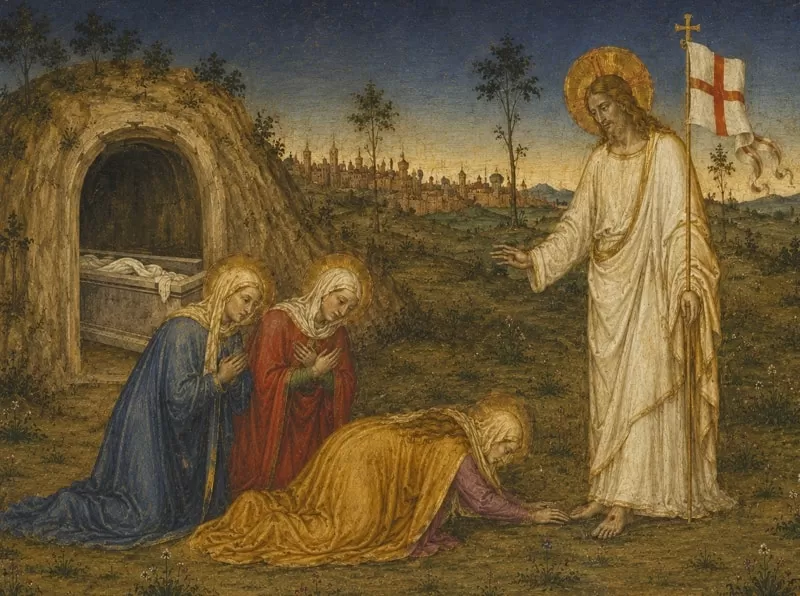
In the last paragraph of the Gospel of Matthew, the risen Jesus is “worshipped” by his disciples, whom he sends into the world to baptise new disciples “in the name of Father and of the Son and of the Holy Spirit” (Matt. 28:16-20). This has been a foundational text both for global mission (the “Great Commission”) and for the doctrine of the Trinity.
I think that the Greek church was bound to resolve the Father, Son and Spirit conundrum on Greek terms, and that the global mission was inevitable. But I don’t think that’s what’s happening here. The theological reinterpretation of scripture should not be done at the expense of the work of reconstructing historical perspectives.
They “worshipped” him
A little earlier, Jesus appeared to the women as they left the empty tomb. He greets them. They throw themselves to the ground, take hold of his feet, and do obeisance (prosekynēsan) to him. He then tells them to announce to his “brothers” that they should make the journey to Galilee, where they will see him (28:9-10).
This Jesus is a very human presence: the disciples are his brothers; and normally, if you do obeisance at a person’s feet, that person is a human, not a god.
A Shunammite woman fell at Elisha’s feet and “did obeisance (prosekynēsen) on the ground” (2 Kgdms. 4:37 LXX).
Achior “fell at the feet of Judith and did obeisance to her face” (Jdt. 14:7).
Rulers of the nations will “do obeisance to you, and they shall lick the dust of your feet” (Is. 49:23). The returning exiles will not be “put to shame.”
Psalm 98:5 LXX is not quite an exception because it is the footstool of YHWH’s throne that is in view: “Exalt the Lord our God, and do obeisance at the footstool of his feet, because holy is he!” Psalm 131:7 LXX also seems to presuppose the presence of God in his throne room: “We shall enter into his coverts; we shall do obeisance at the place where his feet stood” (Ps. 131:7 LXX), translating “Let us go to his dwelling place; let us worship at his footstool!” (Ps. 132:7)
There are a few other instances of people doing obeisance at a person’s feet in the New Testament.
When Peter arrived at the house of Cornelius, the Roman “met him and fell down at his feet and worshiped him” (Acts 10:25). Peter’s response is, “Stand up; I too am a man.” Cornelius knows this; moreover, he is “a devout man who feared God with all his household” (Acts 10:1-6). Pervo says that “the gesture—or its equivalent—served to show how ordinary people regarded outstanding persons,” and notes that many examples can be found in ancient novels.1 There is undoubtedly a clash of cultural-religious sensibilities here, but we can only really infer that Peter felt uncomfortable with this expression of pagan reverence.
Jesus assures the church in Philadelphia that the Davidic messiah will elevate the martyrs to a position of great authority in the new Jerusalem, and their persecutors in the synagogues will be made to come and “do obeisance (proskynēsousin) before your feet” (3:7-13). Like Jesus, they will receive “worship” from their enemies. This echoes Isaiah 49:23, quoted above.
On two occasions, an angel objects to John falling at his feet to do obeisance to him. In both cases, the reason given is not that the angel is not divine but that he is merely a “fellow servant” with John and the prophets.
The marriage of the Lamb has come, the “King of kings and Lord of lords” will soon come to judge and make war in righteousness, but John makes the mistake of falling at the feet of and offering “worship” to the angel who has shown him these things (19:7-16).
Jesus is the descendant of David, who has sent his angel to testify about future events; it is therefore, the Lord Jesus who is entitled to the act of physical prostration that is customarily offered to a ruler, not the servant angel (22:6-16).
It is the social distinction between the master and the servant that is determinative for “worship” here, not the ontological disjunction between God and the creature.
So when it is said that in Galilee the eleven disciples saw the resurrected Jesus and “did obeisance,” the point is that they recognised the authority that had been given to the Son of Man, as a representative of persecuted Israel, to judge and rule over Israel and the nations (cf. Matt. 9:6; cf. Dan. 7:13-14). The disciples “worship” their persecuted Lord freely, if hesitantly; the Jews in Philadelphia will be compelled to “worship” the martyrs who likewise overcome death.
The proclamation of the kingdom and instruction of the nations
Jesus has already said that the “good news of the kingdom will be proclaimed across the whole empire (oikoumenēi) as a witness to all the nations, and then will come the end” (Matt. 24:14*).
The “completion” (synteleia) or “end” (telos) of the “age” in Matthew is not open ended. The current age would be brought to an end with the destruction of Jerusalem and the temple by the Romans within a generation, as YHWH’s “final” judgment on a persistently stubborn, wicked, and faithless generation of Judeans.
Those of Jesus’ disciples—of that group whom he personally called and sent out, not later generations—who would survive the persecutions and endure to the end of the age would be “saved” (10:21; 24:13-14).
The end of the historical age of second temple Judaism was described in the parables of a violent judgment at the “end of the age”:
Just as the weeds are gathered and burned with fire, so will it be at the end of the age. The Son of Man will send his angels, and they will gather out of his kingdom all causes of sin and all law-breakers, and throw them into the fiery furnace. In that place there will be weeping and gnashing of teeth. Then the righteous will shine like the sun in the kingdom of their Father. He who has ears, let him hear. (Matt 13:40-43)
Again, the kingdom of heaven is like a net that was thrown into the sea and gathered fish of every kind. When it was full, men drew it ashore and sat down and sorted the good into containers but threw away the bad. So it will be at the end of the age. The angels will come out and separate the evil from the righteous and throw them into the fiery furnace. In that place there will be weeping and gnashing of teeth. (Matt 13:47-50)
- The parable of the weeds and the question of hell
- The historical meaning of Jesus’ parable of the dragnet
- Fishers of people and the judgment of Gehenna
- Two parables of a net: how Habakkuk helps us to understand Jesus
So naturally, it is when Jesus predicts the utter destruction of the temple that his disciples ask him, “Tell us, when will these things be, and what will be the sign of your coming and of the end of the age?” (24:3).
The frame of expectation is realistic and circumscribed: they will face severe harassment and hardship if they persist in proclaiming the “good news” of this coming divine intervention, in the period leading up to the catastrophe of the war against Rome. The assurance that he gives them is that he will be with them through to the end of the age of second temple Judaism.
In the name of the Father and of the Son and of the Holy Spirit
Jesus sends his disciples out to the nations to instruct them—I think probably, but not certainly, to make Jewish disciples in the diaspora who will also believe in the coming inauguration of a new kingdom, in which the Son of Man, and those who suffer with him and for him, will be “worshipped” as a new ruling class, so to speak, across the oikoumenē.
These disciples are to be baptised “in the name of the Father and of the Son and of the Holy Spirit” (Matt 28:19). This has commonly been understood in a proto-trinitarian sense:
And the fact that the three divine persons are spoken of as having a single “name” is a significant pointer toward the trinitarian doctrine of three persons in one God.2
Well, yes, perhaps in hindsight, but I can’t help thinking that it is precisely because Father, Son, and Spirit are subsumed under one name that this sounds suspiciously like a later church formulation—a pebble rounded and smoothed by “liturgical” usage over time.
In the Old Testament, it is customary to speak or act “in the name of” the Lord God in particular, or of other gods (Deut. 18:20; 2 Kgs. 5:11; Mic. 4:5), or of an authoritative person—David (1 Sam. 25:9), Mordecai (Esth. 2:22), or king Ahasuerus (3:12; 8:8, 10).
The invocation of multiple names is rare. The one example I came across is in Testament of Solomon (1st-3rd centuries AD?), where there is reference to pagan sacrifice “in the name of” the two distinct gods Raphan and Moloch (eis to onoma Raphan kaiMoloch: T. Sol. 26:4). As in Matthew’s formula, the two gods have one name, so we should probably not read too much into the syntax.
Apart from the ambiguous quotation of Psalm 118:26 in the Gospels (“Blessed is he who comes in the name of the Lord”), the only name invoked in the New Testament is that of the Lord Jesus. In Acts, believers are baptised “in the name of Jesus Christ” only (Acts 2:38; 8:16; 10:48; 19:5; also 1 Cor. 1:13).
I would suggest that, in effect, “in the name of the Father and of the Son and of the Holy Spirit” captures the dynamic of Paul’s argument in Galatians 4:4-6. God sent his Son to Israel at a time of crisis to redeem those under the Law so that “we might receive adoption as sons.” Therefore, “God has sent the Spirit of his Son into our hearts, crying, “Abba! Father!”
Those who have been baptised have received the Spirit of the Son who, in anticipation of suffering and death, cried out, “Abba! Father!” (Mk. 14:36). In other words, they are baptised into the concrete experience of Jesus, who had gone the way of martyrdom before them, inspired and sustained by the Spirit and trusting in the “heavenly Father” who watches over them (cf. Matt. 6:8, 26, 32; 7:11; 10:29; Rom. 8:15-17).
So what have in Matthew 28:19 is a baptismal formula for the traumatic end of the age of second temple Judaism.
Thank you Andrew.
Perhaps the tripartite “in the name of” formulation could be viewed as a hint of the theological themes of the Johannine Supper Discourse (as well as elsewhere in the 4th Gospel) —
“In the name of the Father, who sent the Son, who gave the Spirit”
Recent comments