The author critiques Brian Zahnd’s fourfold distinction between Jesus, the Church, the Bible, and Christianity. He argues that Zahnd’s definition of Jesus relies on later Nicene theology rather than the historically situated Jesus of the New Testament. Zahnd’s view of the Church overlooks its historical role within Israel’s story and its eschatological mission. His treatment of the Bible prioritises theology over history and raises unresolved questions about moral developments such as opposition to slavery. Finally, describing Christianity as a religion obscures its origins as a Jewish reform movement. The author instead advocates a historically grounded, prophetic movement responding to contemporary global and environmental challenges.
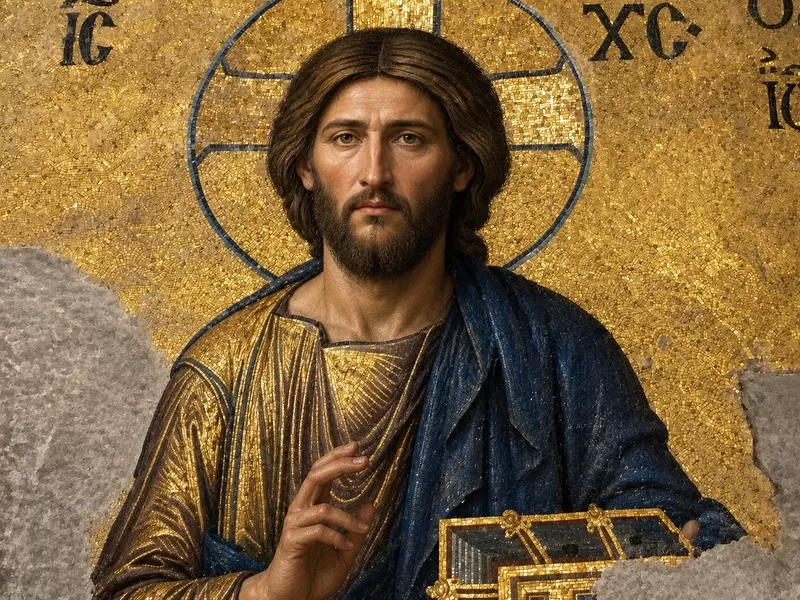
In a Substack post, Brian Zahnd looks at four key theological “entities” and warns of the “theological mischief” that happens when the “critical distinction” between them is not properly respected. The Church, the Bible, and the religion of Christianity are all good and important things, but not as good and important as Jesus. “The moment we try to nudge the Church or the Bible or Christianity toward equality with Christ we are headed down a theological path that leads to confusion and real-life trouble.”
My objection to this sort of analysis is two-fold. First, it relies on a flawed understanding of the categories if they are meant to be fundamentally biblical and not the product of later theological rationalisation. Secondly, it is an outdated analysis of “Christianity”: it deals with problems of the past, not of the future.
So here are some critical reflections on the sort of theology evidenced in Zahnd’s “working definitions” of these four “blessed entities.”
Jesus Christ is the eternal Logos of God incarnate in the crucified and resurrected Jesus of Nazareth.
This reflects the later perspective of the church fathers. Zahnd takes the Nicene Creed to be an adequate statement of the significance of Jesus. But the Nicene Creed is a very poor account of how Jesus presented himself or was understood by his followers and spokespersons in the New Testament.
The expression “eternal Logos of God incarnate” is a secondary theological formulation. I don’t think that this is what is going on in the prologue to John’s Gospel. There is a wisdom dynamic at work here that is missing from later christological formulations: the creative wisdom /word of God takes on flesh in the ministry of Jesus at his baptism.
But in any case, a Logos christology in these terms hardly does justice to the mainstream narrative centred on the person of Jesus.
The simple fact is that the Jesus of the modern church is not the Jesus of the New Testament. The modern church has no interest in history. The Jesus of the New Testament cannot be extracted from the dangerous mess of history like a downed American pilot behind enemy lines. He always belonged in that time and place as prophet, judge, messiah, son, lord, king, etc., on thoroughly Jewish terms.
The Church is the gathered community of the baptized who confess that Jesus Christ is Lord and seek to live in obedience to him.
This is not at fault in what it says. It is at fault in what it does not say.
Zahnd’s interest is in how we define the church synchronically—at any particular present moment: the church is always imperfect, there is no “one true church,” the “borders of orthodoxy are generous but not infinite,” and so on.
He has nothing to say about the essential diachronic or historical axis that accounts for the existence, character, and purpose of the churches in the New Testament.
In order to understand the church in the New Testament, we have to look both backwards and forwards.
First, we need to understand its connection with the story of Israel and the nations. Jesus was sent both to judge and to save a wicked and adulterous generation of Jews. Zahnd makes no mention of Israel except to say that the Church adopted the Hebrew Bible—really only as a treasury of proof-texts.
Secondly, after the resurrection of Jesus and his ascension to the right hand of God, his followers came to believe that he was the Davidic messiah who would rule not over Israel only but also over the hostile nations.
The future outcomes are critical for understanding the purpose of the churches in the New Testament, but in Zahnd’s account eschatology doesn’t get a mention—no judgment, no wrath, no war, no parousia, no vindication, no kingdom.
So the churches of the apostolic mission were part of a story about the salvation of first century Israel at a time of severe national crisis and—consequently—the foreseen conversion of the nations of the ancient pagan world to the worship of one God and the confession of Jesus Christ as sole Lord.
The Bible is the sacred, canonical text of the church, the scriptural witness to Jesus Christ, and the primary source for the theology of the church.
The argument here is that the Bible is the word of God “in a subordinate sense to the perfect Word of God who is Jesus Christ.” The Bible is perfect insofar as it portrays Jesus as the “perfect revelation of God.” But it is “far from perfect in providing a true moral ethic regarding the institution of slavery,” for example.
That’s a bold statement and should be applauded, but is it coherent? What reason do we have for thinking that Jesus, as the perfect revelation of God, would not have shared the presumption found in both the Old Testament and the New Testament that slavery was an “inevitable institution”?
The Bible does not present the perfect Word of God as one who would abolish the institution of slavery. So on what grounds do we go against that?
I would add that the language of “sacred, canonical text” and “source for the theology of the church” maintains the alienation of theology from history.
My preference would be to regard scripture as the multifarious documentary witness of a historical community to its covenant life over time. Not as a source for theology. That just calls a halt on history and prophetic narrative—and gives us no good grounds for deciding that slavery is not an inevitable institution.
Christianity is the religion of beliefs and practices developed over time by the church in response to Jesus Christ.
Christianity as we know it must, I suppose, be viewed as a religion, but that is not the best way to characterise the response to Jesus Christ that we see in the New Testament.
I agree with Zahnd’s disapproval of the tired evangelical platitude that Christianity is not a religion but a relationship. And I should draw attention to his argument that, being a religion, Christianity is “capable of growth, development, and change,” which is how he makes room for a different view on slavery. Fair enough.
But I am concerned that calling Christianity a religion reinforces the disconnection between the early Jesus movement and the whole story of Israel and the nations with which we are confronted in the Bible.
The New Testament depicts an intra-religious movement of reform within second temple Judaism. So successful was this internal revolution that it became a post-Jewish phenomenon. But there’s the point: the real break in the storyline occurs not between Pharisaic Judaism and the religion of Jesus, or between Jesus and Paul, depending on how you look at it, but—symbolically at least—at the parousia, when the ancient Greek-Roman world confessed Jesus as Lord and took over running the show.
We should then ask whether the “religion” that evolved under pre-modern, western Christendom is the best way to live out allegiance to Christ as Lord under the radically different conditions of a globalised post-modernity, as we endure the birth pains of the Anthropocene.
I might prefer to call it a protest movement on behalf of the God who created heaven and earth, at a time of environmental crisis. There are beliefs and practices that go with it, the whole being of the modern church must still be reckoned with, and the continuity with the biblical narrative must be stressed, but the prophetic stance is something less than a religion, I think.
Recent comments