The author argues that Jesus and Paul had distinct but complementary missions shaped by history rather than expectations of the world’s imminent end. Jesus focused on warning Israel of impending judgment through the Roman destruction of Jerusalem, calling for repentance and renewal. Paul accepted Jesus as the risen Messiah and extended this message to the Gentile world, expecting the eventual collapse of paganism and the rise of a monotheistic order under Christ. Rather than inventing Christianity, Paul developed the historical implications of Jesus’ mission. Together, they shared a biblical vision of God’s action in history, though applied to different audiences and historical crises.
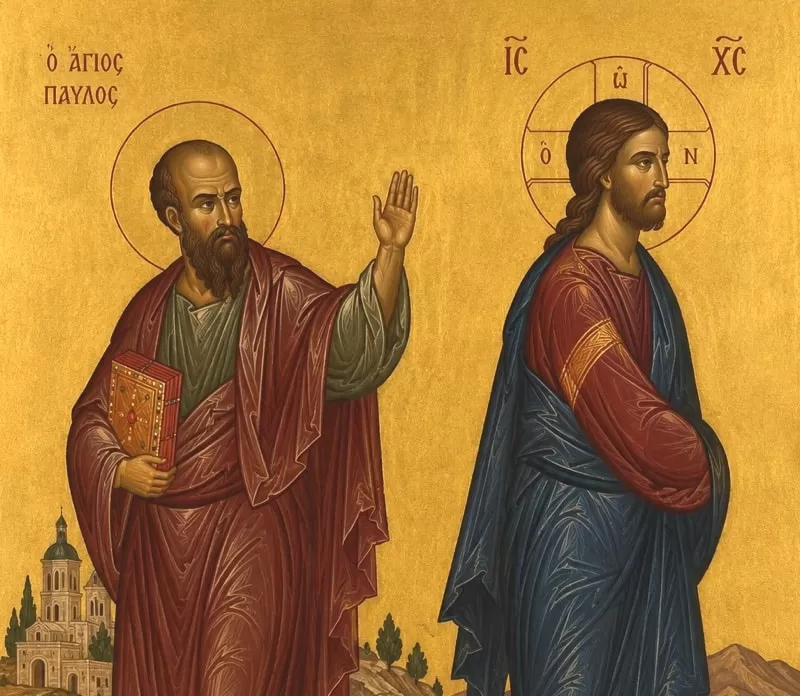
The relationship between Jesus and Paul is much disputed. You will often hear people say that Paul turned the generous, kind, and progressive religion of Jesus into a monstrous theological and ecclesiastical system from which we are still recovering. Or that Jesus died for our sins and Paul told everyone about it. And started churches. Or some other misconception.
I will argue here that the overlap between the two figures is slight, for good reason, but that they are nevertheless connected by a deeply biblical logic.
What prompted me to address the question was a blog post by James McGrath: “What Paul Knew About Jesus.” He is discussing an article in The New Yorker in which Adam Gopnik asks how Paul “remade human history.”
I don’t have access to Gopnik’s article, but I feel I should point out, before we go any further, that you can make history and you can rewrite history, but you cannot remake history. Once it’s made, it’s made.
That aside, history is very much the issue.
McGrath says this: “Paul did not think history would continue beyond his generation, before witnessing the final judgment and the arrival of God’s kingdom.”
I’m disappointed, James.
As I see it at least, neither Jesus nor Paul expected the world to end any time soon, if at all. Rather, they both expected history to play out with spectacular apocalyptic effect.
Jesus and history
For Jesus, history playing out meant that the Judeans or Jews would pursue a reckless course that would culminate, within a generation, in the disaster of the war against Rome.
There is nothing either historically or biblically remarkable about this. The Bible is, all the way through, the story of Israel’s troubled political existence in the midst of powerful nations through the ages. Or, as I put it recently: it is the “multifarious documentary witness of a historical community to its covenant life over time.”
Everything that Jesus says and does in the Synoptic Gospels presupposes the realistic historical horizon of the destruction of Jerusalem and the temple.
- He announces that the kingdom of God is at hand—in other words, that the time is fast approaching when the God of Israel will intervene in dramatic and devastating fashion to put right all that is wrong in Israel.
- Like John the Baptist—and a long line of prophets before him—he calls Israel to repent in view of this coming intervention.
- He pronounces judgment on an “evil and adulterous generation” of Jews. They will suffer the judgment of Gehenna, which is not “hell” as we understand it, but the horror of the siege of Jerusalem and the slaughter of its citizens.
- He blesses the righteous in the land who will inherit the life of the age to come.
- His controversial association with the sick, demon-possessed, poor, and ostracised signals the fact that repentance, salvation, and renewal will happen mostly on the margins of Israel’s social-political existence.
- The exorcisms represent a temporary restoration of sanity and order, but Jesus knows very well that the expelled spirit will eventually return with “seven other spirits more evil than itself,” and the later self-destructive madness of Israel will be far worse than anything Jesus has to deal with (Lk. 11:24-26). Josephus confirms this (War 2.13.6).
- He gathers a group of poorly qualified disciples who will continue his prophetic ministry to Israel, on much the same terms, after his death.
- He warns the rich and powerful in Israel that their wealth, even if justly gained, will not save them from the catastrophe of the war.
- He speaks in parables (Matt. 13:13-15) because Isaiah was sent to say to stubborn, unrepentant Israel: “Keep on hearing, but do not understand; keep on seeing, but do not perceive”—until “cities lie waste without inhabitant, and houses without people, and the land is a desolate waste, and the LORD removes people far away, and the forsaken places are many in the midst of the land” (Is. 6:9, 11-12).
- Jesus identifies with Daniel’s “one like a son of man,” who represents the persecuted righteous in Israel and who will be vindicated before the throne of God and elevated to a position of authority over the nations.
- He understands that his suffering and death will be the means by which some part of Israel will be saved.
- His disciples will share in this vindication, kingdom, and glory at the parousia, when the true status of Israel’s crucified messiah will be revealed not only to Israel but also to the nations. They will sit on twelve thrones judging the twelve tribes of Israel throughout the coming ages (Matt. 19:28). There will be no need to judge Israel after the end of history, when there is no more sin and error.
- That is really as far as it goes.
Paul and Jesus and history
We don’t know whether the Pharisee Paul knew Jesus personally when he was active in Galilee and Judea, but Luke has him present at the stoning of Stephen not long after the crucifixion. So presumably he had heard Stephen’s fierce denunciation of a “stiff-necked people,” which always persecutes the prophets, and his affirmation that the Son of Man was now “standing at the right hand of God” (Acts 7:51-52, 56).
Not long after, he “saw” this Son of Man for himself—the heavenly Jesus who identified with the disciples whom Paul was persecuting (Acts 9:4-5).
So he came to understand that the recently executed Jesus had been appointed “Son of God in power” on the basis of his resurrection from the dead, and then had chosen Paul to make this new state of affairs—the impending régime change—known among the nations (Rom. 1:1-5; Gal. 1:16; cf. Acts 9:15, 20).
For Paul, history playing out meant that the dominant religious culture of the Greeks, characterised by the ubiquitous statues of the gods, would be swept away.
It didn’t need the world to end for this to happen. It was the way of empires and civilisations to come and go.
So everything Paul said and did presupposed the eschatological horizon of a coming judgment on the Greek-Roman world—and, I would add, it is meaningful for us just for that reason.
- He shared Jesus’ pessimistic assessment of the fate of his people. They were “vessels of wrath set aside for destruction” (Rom. 9:22*). Paul’s God was not more angry about the current behaviour of the Jews than Jesus’ God was. Both of Paul and Jesus shared the stark perspective of the Old Testament prophets in this respect.
- Jesus’ practical programme was of little interest to Paul, however, because he was not doing what Jesus did.
- He proclaimed a heavenly Lord to Jews and pagans across the Greek-Roman world, one whose future reign was being anticipated in the shared faith and practice of Jewish and gentile believers. He was the prophetic herald—in the mould of Isaiah’s servant of YHWH—of this good news to the nations (cf. Acts 13:47; Is. 49:1-6).
- Paul believed that the proclamation of the name of Jesus among the gentiles would sooner or later bring about a profound political-religious realignment of the world encompassed by his mission. The nations from Syria to Spain would turn from their idols to “serve the living and true God” (1 Thess. 1:9-10) and would confess one Lord over their political lives in place of the “many lords” of the existing heavenly and earthly hierarchies.
- The proclamation was backed up by the dynamic activity of the eschatological Spirit of God. The Spirit gave them conviction and unity and inspired Christ-like endurance and hope.
- Paul understood that Jesus had died for the sins of Israel, with atoning effect, and that this had nullified the Jewish Law for the eschatological purpose. Jesus had not died for the sins of gentiles, in that regard; they were included on the strength of their belief and the subsequent experience of the same Spirit.
- Paul didn’t make followers of Jesus because Jesus was not there any more to be followed. You don’t follow an enthroned king, you are governed by him. Instead, he called people to be conformed for now to the image of the suffering and vindicated Christ. This was at the heart of what it meant to be church in this transitional moment. They were eschatological communities of hope that would bear the brunt of Jewish and pagan opposition until the new age dawned.
- The main difference between Jesus and Paul was this: Jesus lived and died for the renewal of Israel ahead of the catastrophe of the war against Rome; Paul believed that the renewal of Israel in this implausible and controversial manner—in the strange wisdom of God—would bring about the “conversion” of the dominant pagan civilisation (Rom. 15:8-12). It took longer than he would have liked, but it happened.
- Paul’s best hope for his own people was that the war would bring them to their senses (Rom. 11:25-27): in its aftermath, they would repent of their defiance and recognise the divine authority given to the messiah Jesus. As it turned out, the hope was misplaced.
Paul and the dominant religious and cultural architecture of the West
So I don’t share McGrath’s quite sharp objection to Gopnik’s assertion that “Paul turned the heresy of a tiny sect of Messianic Jews into the dominant religious and cultural architecture of the West for the next couple of thousand years.”
Yes, Paul’s mission involved “calling uncircumcised Gentiles to join that messianic sect and to submit to the God of Israel and the appointed and anointed Davidic king, Jesus.” But Paul had a decisive, controlling, “eschatological” outcome in view. The converts from paganism in Thessalonica now served the one God of Israel instead of the many gods of the ancient world, but they were also waiting for Jesus to deliver them “from the wrath to come” (1 Thess. 1:9-10).
That was the whole point of believing for these Greeks—to escape the judgment that was coming on their civilisation (cf. Acts 17:29-31).
But biblically speaking, God judges in order to put something new in its place, and in this case the something new is a monotheistic political-religious order in which Jesus is acclaimed as Lord by the nations qua nations:
And again Isaiah says, There will be the root of Jesse and the one arising to rule nations, in him nations will hope. May the God of the hope fill you with all joy and peace in believing, in order that you may abound in the hope in power of the Holy Spirit. (Rom. 15:12-13*)
The hope in which these believing gentiles abounded was precisely the hope, boldly communicated in the apostolic message, that they would at some future point be ruled by a crucified messiah from the Jews (cf. 9:4-5).
There we have the deeply biblical logic—and it doesn’t require a final judgment.
Given the vision of profound civilisational transformation, then, it does not seem to me so far-fetched to suppose that the “religious and cultural architecture” of western Christendom was the proper product of Paul’s mission, even if he didn’t think it through in detail—any more than Jesus thought through what would follow the destruction of Jerusalem and the temple.
But they knew that history would keep unfolding, as it continues to do today.
Thank you, Andrew.
I think one may be justified in reckoning that Paul was also, like Jesus, trying to save (some of) his countrymen from the coming catastrophe.
I have read that very few diaspora Jews returned to Judea to participate in the AD 66-73 war, while large numbers (so many that they could not be equipped by the Judean authorities) did in the AD 132-135 war. Perhaps this can in part be attributed to Paul’s influence. Perhaps he, like Jesus, was able to save some of his countrymen from the disaster.
@Samuel Conner:
A lot to think about. Any chance your book on the Son of Man will ever be released as an ebook/kindle?
@Juan C. Torres:
Hi. I think it’s unlikely that The Coming of the Son of Man will be released as an ebook now. Sorry.
@Samuel Conner:
That’s very interesting. We’ll never know, but it seems plausible. Do we know why there was such a difference between the two wars in that respect?
@Andrew Perriman:
What I have read suggests that the AD 132-135 rebellion was far better organized than the “nationalist” forces were in first war. Evidently some lessons were learned from the ways the first effort failed.
@Samuel Conner:
A bit more — it’s hard to accurately infer intent even in present-day live persons with whom one deals; speculation about the intentions of ancient figures is arguably a fool’s game.
It’s also highly entertaining.
I am intrigued by questions like “in Paul’s remark about ‘becoming all things to all men in order by any means to save some’, what was the threat that he perceived his hearers needed to be saved from? There seems to be some measure of urgency in him; what is the imminent problem?” and “in Paul’s self-description of resolving in his dealings with his hearers in Corinth to focus on ‘Messiah, crucified’ [when, arguably, the Messiah’s resurrection and exaltation to authority seems more in keeping with the proclamation of Jesus as judge and coming publicly acknowledged ruler], why was the crucifixion of Israel’s Messiah so important to focus on?”
Perhaps Paul was warning diaspora Jews and their God-fearing Gentile associates of the same “under-the-sun” dangers Jesus warned Israel of.
From a narrative-historical perspective, how are we to understand “but they were also waiting for Jesus to deliver them “from the wrath to come” (1 Thess. 1:9-10)”? Were these Gentile converts expecting for Rome the fate they were expecting for Judah? And if so, were they mistaken in this expectation (narratively speaking), insofar as there was to be no “wrath” against Rome to be “delivered” from, but rather a conversion of Rome to be celebrated? And if that wrath was something more proximate to their experience (and not decades or centuries in the future), what kind of “deliverance” were they expecting? Similar questions (I think) have to do with how to understand “who will inherit the life of the age to come” that Jesus spoke about. What is the nature of this imagined and hoped for life? And what does “inheriting” look like for this life? All of these questions are premised on two deeper, and related, questions. One is this: if a covenantal relationship with the divine is historical and political (i.e., it involves internal provision and external protection, as you’ve argued elsewhere in this blog), how do you understand the NT to imagine a relationship between a spiritual resurrection and rule (by Jesus and the martyrs) and ongoing historical and political life and existence? Was this a somehow transformed vision of “rule”—a human ruler, yes, but one who is not located and identified in time and space the way human rulers typically are located and identified? The second question is this: With regard to this historical political existence, is the imagined future socio-political existence (a people without a necessarily defined territory), geo-political existence (a people within a specified territory) or both? And if both, what is participating in both supposed to look like, in terms of values and practices?
@Tim Peebles:
It’s a good question to ask.
I don’t think Rome is the issue. I’m not sure Paul ever envisaged judgment against Rome—with the exception perhaps of 2 Thessalonians 2. Wrath is against the idolatrous Greek world, even when he is writing to the church in Rome.
What he thought that would look like in practice is hard to say, but the Old Testament prophets suggest a fairly realistic historical process. Pagan peoples stop worshipping the old gods and instead orient themselves towards a restored and glorious Zion, making pilgrimage to pay tribute to and learn from the one true God of Israel, etc.
I imagine that Paul simply thought that the old religions would die out and be replaced by the worship of one God instead of many gods and the confession of one Lord instead of many lords.
Deliverance would consist in being proleptically part of the new order—of the life of the age to come, indeed.
The rule of the martyrs with Christ throughout the coming ages is grounded in an apocalyptic worldview and not so easily reconciled with historical reality, I grant. But the vindication of those who suffered and lost their lives for the sake of the gospel was a matter of great historical significance.
Let’s say that there is at least a symbolic sense in which kings, etc., in this new world would be accountable to Christ and his brethren, who had demonstrated an ultimate obedience to the living God.
Finally, I would say that Paul in his apostolic activity claimed the whole of the Greek-Roman world—from Jerusalem to Spain—for the God of Israel and for his Son. I don’t think the New Testament has anything to say about life in the happy-ever-after, which of course was not so happy, this being history. In the transitional eschatological period, however, the churches were expected to establish a benchmark of righteousness by which the pagan world would be judged—something which the synagogues had failed to do.
In Christendom they formed a new priesthood in place of the old pagan priesthoods, but that’s not much more than implicit in the New Testament.
@Andrew Perriman:
Thanks for the reply, Andrew. Some follow up (and perhaps more precise) questions, separated as different posts for clarity. With regard to judgment of paganism: where do we see judgment against the pagan world in an historical-narrative sense—at least prior to Constantine? It seems like we have something more like the conversion of that pagan world and not the typical kind of socio-political consequences that typically come with divine judgment. Is judgment being reimagined by Paul? Is the typical OT pattern of severe historical and political consequences (wrath), followed byrepentance and conversion, being abandoned by Paul? Or did it just not play out the way he expected it to, with the wrath part sort of being eluded?
@Tim Peebles:
Right. I don’t think we see anywhere in the New Testament the prospect of a violent “judgment” of the pagan world through the agency of an invading army, for example. That was probably inconceivable if the old system was to be replaced by worship of the one true God and the confession of Jesus as Lord. The agent of judgment could only be the witnessing churches.
YHWH uses Cyrus to bring about the salvation of Israel and the rebuilding of Jerusalem (Is. 44:24-45:7), and the nations should recognise in this divine action that there is no god other than the God who made the heavens and the earth (45:14). Therefore, the makers of idols are confounded (45;15), and the gods are carried into exile on the backs of beasts of burden (46:1-2).
I would have thought this is pretty much how Paul envisaged judgment against Greek paganism. The nations hear that God has done something extraordinary to save his people, that he has made the crucified Jesus Lord above all other names, etc., so they confess as nations that Jesus Christ is Lord to the glory of the living God of Israel (Phil. 2:9-11; cf. Is. 45:23; Rom. 12:8-15).
It is an act of judgment insofar as it puts right an age-old error (cf. Acts 17:30). But it breaks the broader prophetic cycle of violent judgment against Israel by a foreign power followed by comparable judgment against that foreign power—as, for example, in Habakkuk.
@Andrew Perriman:
As a Neo-Anabaptist, my starting assumptions have been something like the following. Paul counts the substantive conversion of the Gentiles to the church as the judgment and conversion of the pagan world/nations. Converts are in the covenant/church, non-converts remain under judgment (in your historically and politically realist sense). This fulfills (in an unexpected way) the OT hope for the conversion of the nations. There is no need for a further symbolic “conversion” of culture and government. At most, there is a hope that culture and government will be (as in OT precedence) considerate of but not converted to Israel’s god, messiah, and people. But you are pushing me (it seems) to consider the possibility that Paul also hoped for a symbolic conversion of culture and Caesar—that the empire and its culture could become symbolically accountable to Christ without becoming participants in Christ’s covenant.
I agree that Paul hoped for a “realistic historical process” for transformation, but I’m tying to sort his vision or expectation for that process. On the one hand, I take the pagan “world” to be both socio-political (a matter of community and practice) and geo-political (a matter of circumscribed territory and governance). Though contemporary terminology, this seems implicit in the OT. There are occasional and rare covenantal (socio-political) conversions (Rahab and Ruth and the resident alien), who become part of Israel, as well as non- or differently-covenantal (geo-political) “conversions” (Ahaseurus, Cyrus and Darius, maybe early Pharaoh), where the “converts” don’t cease being kings and members of nations who remained other than Israel. So, it makes sense that Paul would have had a sense of hope for both substantive (socio-political) and symbolic (geo-political) conversions/”conversions”, with that hope being fairly modest in both respects, given OT precedence.
In the NT, the substantive and socio-political conversion of Gentiles to the covenant/church and accountability to Jesus Christ was a surprising expansion of OT precedence. Indeed, it’s the surprising volume of that that seems to drive so much of Paul’s thinking. And your claim that the geo-political conversion of the empire (with Constantine) can plausibly be narrated as a hope for “symbolic” accountability of government to Christ (the renunciation of idolatry and respect of Israel’s god as the true/or most high god, along with respect and care extended to that god’s people) is credible. This, too, can be construed as an expansion of OT precedence. But your claim about Paul’s hope for the conversion of paganism seems to introduce a third variable—a kind of cultural-political conversion that is neither the substantive conversion of community, or the symbolic conversion of government. And a hope that the nations themselves—their citizens and their culture—would become symbolically “Christianized” seems akin to the OT hoping for the nations to be “Israelized”, which doesn’t seem to be there in the OT. This seems to be an innovation by Paul of OT hopes.
Where might Paul display a distinction between pagan culture and pagan government? Did he imagine some kind of conversion for both? How might he articulate different kinds of “accountability to Christ,” substantive and symbolic, whether at the cultural level or the governmental level?
@Tim Peebles:
My previous comments raised questions about how to understand Paul’s hopes vis-a-vis what I’ve called socio- and geo-political dimensions or spheres. Related questions emerge with respect to the content of conversion within those spheres. Adapting later Christian theology (Aquinas, Luther, Calvin), I believe that the OT worldview includes religious, moral, and ritual dimensions, mutually implicated with one another. They can be conceptually distinguished but not separated or easily sorted. “Religion” has to do with worship, the recognition and reverence of the true (or most high) god. With regard to covenantal worship, this “religious” worship includes in it—or had alongside it—particular “moral” and “ritual” practice (torah). With regard to non-covenantal worship (the respect and reverence of foreign rulers), this is less explicit and apparent in the OT. It seems that “ritual” practice is omitted entirely. Showing respect and reverse to Israel’s god is not the same as doing so in the form of Israel’s sacrificial system, which does not seem to be expected or hoped for Israel’s neighbors. Similarly, with regard to covenantal worship, there are a whole set of neighborly practices—a “morality”— that is included in and expected of right worship of Israel’s god. With regard to non-covenantal worship, there might be (as some OT scholars have argued) something like a natural law torah available to and expected of other nations, which is less than the covenantal morality expected of Israel. But there is no clear demarcation of morality for all and morality for Israel; it is not a topic for explicit consideration or exposition.
I wonder how this maps on to your sense of Paul’s prophetic hopes. If the church, as you say, is to be the model for and criterion of judgment against paganism (culturally and governmentally), it would seem that some sort of “moral”, perhaps even “ritual,” values and practices would need to come along with the non-covenantal “conversion” of the pagan nations. So, insofar as Paul hoped for a conversion to some kind of symbolic accountability to Christ from pagan culture and government, what, if any “moral” and “ritual” expectations would Paul have hoped to see for this to count as pagan “conversion,” even if just symbolically? How, in general, was “symbolic” conversion of paganism different from substantive/church conversion of pagans?
And to be clear, moving into constructive theological considerations, I wouldn’t find it troubling if it is less than evident what Paul expected religiously, morally, and ritually from pagan cultural and governmental conversion. What is more theologically significant, it seems, is whether Paul did have a sense that there could be a kind of symbolic conversion of pagan culture and government, and that this conversion would involve some sort of religious, moral, and ritual practice, practice that accorded with the general creative purposes of Israel’s god, but was less than (or maybe different from) the religious, moral, and ritual demands placed on covenantal Israel and those who more substantively converted to it.
@Tim Peebles:
With regard to non-covenantal worship (the respect and reverence of foreign rulers), this is less explicit and apparent in the OT. It seems that “ritual” practice is omitted entirely.
Again, this strikes me as a very important perspective. The nations do not share the covenantal obligations that Israel has, but this seems a relevant passage:
It shall come to pass in the latter days that the mountain of the house of the LORD shall be established as the highest of the mountains, and shall be lifted up above the hills; and all the nations shall flow to it, and many peoples shall come, and say: “Come, let us go up to the mountain of the LORD, to the house of the God of Jacob, that he may teach us his ways and that we may walk in his paths.” For out of Zion shall go forth the law, and the word of the LORD from Jerusalem. He shall judge between the nations, and shall decide disputes for many peoples; and they shall beat their swords into plowshares, and their spears into pruning hooks; nation shall not lift up sword against nation, neither shall they learn war anymore. (Is. 2:2-4)
Here we see both a religious orientation and an ethical practice: the temple has pre-eminence, the nations flow to it, and visit the place where the cultus is practised. Herod’s temple had a massive courtyard in which the gentiles would pray, separated from the inner courtyards on pain of death. They would learn the ways of YHWH, and the God of peace would judge between the nations of this empire, bringing war to an end.
So there is a worship and ethic for Israel as a priestly people in the midst of the nations, and there is a worship and ethic for those nations which have come to recognise the rightness of YHWH.
I wonder how this maps on to your sense of Paul’s prophetic hopes.
Perhaps a key point to note is the distinction between the role of the churches in the eschatological transition, bearing witness as hybrid communities of Jews and gentiles to the coming transformation, and the subsequent role of the churches as a royal priesthood in the new political-religious order. Pretty much everything that Paul teaches relates to the first period; what happens in the second period is much more suppositional. But you would imagine that he would expect the conversion of the nations to be accompanied by the general practice of the sort of “righteousness” found in Torah.
So yes, finally, I think your closing paragraph gets it right. There is a high religious, moral and ritual practice appropriate for the churches as priestly institutions, and there is a lower and dependent religious, moral and ritual practice appropriate for the rest of the society. All good in theory, much harder to maintain in practice.
@Tim Peebles:
My previous comment addresses this, I think. Isaiah 45 has in view not just the conversion of a small number of Babylonians but a wholesale turning of the nations—probably in the sphere of Babylonian influence—to acknowledge that YHWH alone is God. So I would assume that Paul expected the cultus of the one God and loyalty to his Son to replace the many pagan cults. That puts a new pattern of worship at the centre of the social-political life of the diverse peoples who made up the Greek-Roman oikoumenē. It would have been expected to transform the social and cultural life of the nations to the same extent as the old arrangement with its many gods and many lords.
But yes, the churches remained distinct from the social and cultural life of the nations as a covenant people, as the pagan priesthoods—and for that matter the synagogues—had been distinct. The churches maintained the religious orientation and more or less effectively held societies accountable to the terms of the new political-religious settlement.
Agreed, in the Old Testament there is not the expectation that the nations would become “Israelized.” The idea is that Jerusalem would replace the old pagan centres of empire and in that way serve as the defining, hegemonic, political-religious hub for the nations—in keeping with the intention that Israel would be a distinct, chosen royal priesthood in the midst of the nations (Exod. 19:5-6). The kings and peoples would travel not to Nineveh or Babylon but to Jerusalem to honour the God of Israel, from his ways, and of course pay tribute.
The difference with Paul, I think, is that the eschatological paradigm has changed, reflecting a different geopolitical reality. His paradigm would be—if he had thought it through this far—not that restored Jerusalem would replace Athens or Rome but that the synagogues, in the first place, and the pagan temples dispersed across the empire would be replaced by the churches.. So we have a distributed priesthood, not a centralised, city and temple based, imperial one.
I think it’s helpful to look at his critique of the Jews in Romans 2:17-24. Paul would have expected the churches to succeed where the synagogues failed: they would know the will of God, approve what is excellent, be guides to the blind, a light to those in darkness, instructors of the foolish, etc., preaching against stealing, adultery, idolatry, and in that way elevating the reputation of God among the nations.
Recent comments