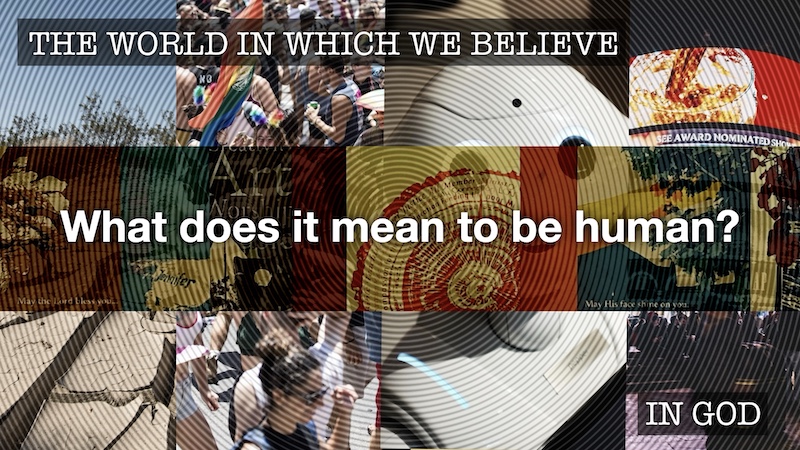
For most of us, subjectively, the everyday experience of being human probably hasn’t changed very much, but we may be aware of a storm of questions blowing furiously outside the house, rattling the windows and loosening tiles. What does it mean to be male and female? What is a “normal” state of mental health? Are ethnicity and nationality essential to our humanity? Are we anything more than compliant consumers of goods and services? Is AI making the human mind redundant? And as we enter the Anthropocene, are we—paradoxically—losing control of our destiny?

To be human is not just to be one thing. It is to be part of a story with a past, a present, and an imagined future.

Read more...
I said a couple of weeks back that I would post the document that Christian Associates, my favourite church-planting people, recently published on gender equality in leadership. It’s probably fair to say that we have held an egalitarian position in practice for years, without exciting much… ( | 7 comments)
In the last two posts I suggested that the claims put forward by Richard Hays for “divine identity” in the Synoptic Gospels are problematic less for what they affirm—I am not arguing against Trinitarianism—than for what they obscure. Matt Colvin had this comment to make, and I think it… ( | 6 comments)
Another questionable line of interpretation, if I may make so bold…. Jesus says to his disciples, “I will give you a mouth and a wisdom that none of those who oppose you will be able to stand against or contradict” (Lk. 21:14-15). Since his imminent death is in view, he must mean that he will have… ( | 9 comments)
People who read this blog regularly will know that I am generally rather sceptical about claims that the writers of the Synoptic Gospels—Matthew, Mark and Luke—intended to present Jesus as God. See, for example, “Jesus as Lord in Mark” or “Simon Gathercole’s argument about pre-existence and divine… ( | 9 comments)
I have been involved with Christian Associates in one capacity or another—as a pastor, inept church-planter, teacher—for the last twenty years or so. I love the people, I love the organization, I love its vision for starting imaginative new communities of faith in a difficult secular environment,… ()
Following on from the previous post on how to sing about the wrath of God, here are some simple diagrams to explain the hermeneutics involved. 1. There is a tension between two understandings of the cross. The rigorous conservative/Reformed folk want to sing about the wrath of God being satisfied… ( | 19 comments)
I started writing this on Sunday morning before going off to church. It’s a reflection on a piece by Roger Olson about the difficulties many Christians have in using the language of divine wrath. He had come across a revised version of the song “In Christ Alone”, by Getty and Townend, in which the… ( | 9 comments)