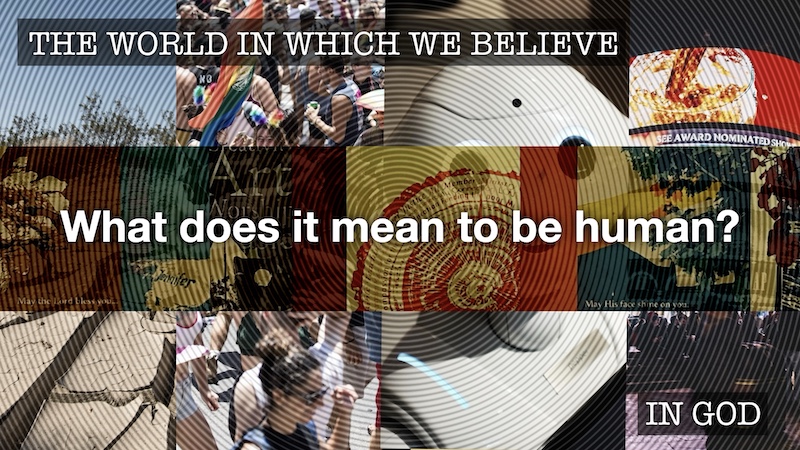
For most of us, subjectively, the everyday experience of being human probably hasn’t changed very much, but we may be aware of a storm of questions blowing furiously outside the house, rattling the windows and loosening tiles. What does it mean to be male and female? What is a “normal” state of mental health? Are ethnicity and nationality essential to our humanity? Are we anything more than compliant consumers of goods and services? Is AI making the human mind redundant? And as we enter the Anthropocene, are we—paradoxically—losing control of our destiny?

To be human is not just to be one thing. It is to be part of a story with a past, a present, and an imagined future.

Read more...
The question of whether God heals miraculously today—or, for that matter, ever has—is obviously a difficult and contentious one for the church in a rationalist secular context. A comment by James Mercer, however, in connection with my post on the narratives of mission highlights a different and… ( | 4 comments)
I suggested in passing in a recent post on mission and blessing that in The Mission of God: Unlocking the Bible’s Grand Narrative C.J.H. Wright (not to be confused with N.T. Wright) ‘has misconstrued the “grand narrative” of the Bible as oriented towards salvation rather than “… ( | 10 comments)
For the background to this see Ian Paul’s very interesting post “What do we do when the Bible is ‘wrong’?” Ian starts by discussing Peter LaRuffa’s (on the face of it) ludicrous statement: If, somewhere within the Bible, I were to find a passage that said 2+2=5, I would believe it, accept it as… ( | 13 comments)
I suggested recently that in their book What is the Mission of the Church? Making Sense of Social Justice, Shalom, and the Great Commission Kevin DeYoung and Greg Gilbert highlight some legitimate concerns regarding current “missional” thinking. There will be differences of opinion, but I… ( | 14 comments)
This is a further—and final—response to some productive comments made by Paul K. regarding my argument about the narrative-historical method and its implications for our understanding of the kingdom of God. He argues that the gospel deals with spiritual powers as well as “socio-political forces”—he… ( | 24 comments)
My last post dealt with some specific texts which Paul K. suggested do not fit the kingdom paradigm that I am proposing. A more general question raised in his comment has to do with the relation of the story about kingdom to the theme of creation. Paul agrees that “there is something bigger and… ( | 8 comments)
In a lengthy comment on my “The narrative-historical method—an outline” post Paul K. asks some thoughtful and probing questions about the relevance or prevalence of the notion of kingdom that I have been proposing. My argument is that the kingdom motif in the New Testament belongs not to a… ( | 8 comments)