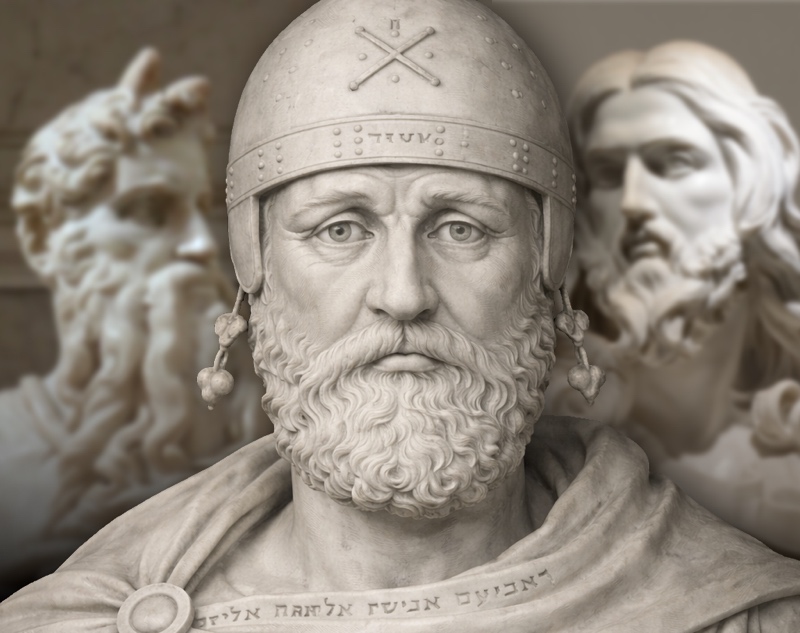
It looks like the next phase in the study of Paul, after the New Perspective on Paul and Paul within Judaism, will be Paul (within Judaism) within paganism. See, for example, Paul Within Paganism: Restoring the Mediterranean Context to the Apostle, edited by Chantziantoniou, Fredriksen, and Young (2025), which presents “a florilegium of essays tracing the various ways in which Paul’s Jewish religious program is native to the ancient Mediterranean” (xi). The British New Testament Society conference this year will have a session on the book and related themes, to which I will be contributing.
Just to be clear, there will be a final judgment of all the dead, a final renewal of heaven and earth, and a final destruction of all that is contrary to the goodness of God’s creation. “He will wipe away every tear from their eyes, and death shall be no more, neither shall there be… ( | 8 comments)
The "Son of Man" motif is central to Jesus' self-understanding and of critical importance for a narrative-historical reading of the New Testament. As J.D.G. Dunn says:After 'the kingdom of God/heaven' there is no phrase so common in the Jesus tradition as 'the son of man'. Its importance within the… ( | 8 comments)
One of the objections most forcefully raised against a consistent narrative-historical reading of the New Testament is that it makes the texts more or less irrelevant as a source of teaching and inspiration for the church today. Peter Wilkinson expressed this objection in a recent comment in no… ( | 7 comments)
This is one of the passages that is often put forward as “evidence” that the synoptic Gospel account already presents Jesus as both human and divine. The argument is that i) it is the prerogative of God to forgive sins, ii) in this story Jesus forgives sins, iii) therefore Jesus must be God. Added… ( | 5 comments)
For reasons which I won’t disclose, I have been working through a doctrine course of a distinctly Reformed hue. If the church is convinced that it needs such a thing as a “doctrine course”, Reformed or otherwise, then this is by no means a bad one. But for me it has highlighted again the fact… ( | 14 comments)
The history of biblical interpretation is a tale of two cities—not London and Paris (Dickens), or even Jerusalem and Athens (Tertullian), but Alexandria and Antioch. In the third and fourth centuries Alexandria stood for an allegorizing approach to interpretation that sought to maximize the… ( | 10 comments)
This is a much debated passage, a good part of the discussion having to do with the question of whether it reflects a “high christology”. Is Jesus presented here as a preexisting divine figure who becomes incarnate as man, who dies (for the sins of the world), and who then is re-identified with the… ( | 19 comments)
Recent comments