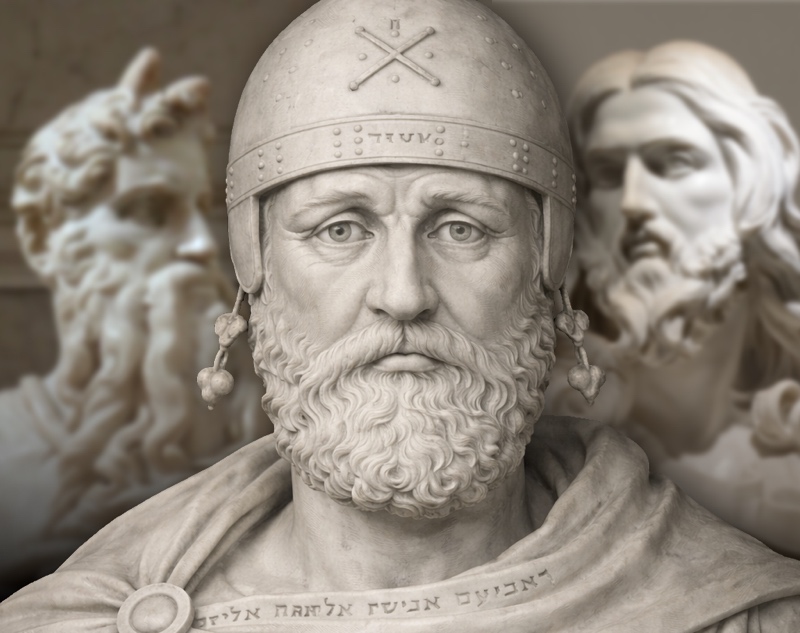
It looks like the next phase in the study of Paul, after the New Perspective on Paul and Paul within Judaism, will be Paul (within Judaism) within paganism. See, for example, Paul Within Paganism: Restoring the Mediterranean Context to the Apostle, edited by Chantziantoniou, Fredriksen, and Young (2025), which presents “a florilegium of essays tracing the various ways in which Paul’s Jewish religious program is native to the ancient Mediterranean” (xi). The British New Testament Society conference this year will have a session on the book and related themes, to which I will be contributing.
These rudimentary comments were prompted by a conversation with Andrew Jones in Amsterdam about the eschatological significance of Jesus’ saying about moving mountains as it is found in connection with the cursing of the fig tree in Jerusalem (Mk. 11:23; Matt. 21:21) and the failure of the… ()
Everything Must Change (see the synopsis in the first part of this review) will be read by many as a challenge to the modern church to exchange an ineffectual and theologically suspect notion of what it means to be Christian for an ‘emerging’ understanding that offers a credible hope of… ()
It’s three months now since Brian McLaren’s latest book Everything Must Change: Jesus, Global Crises, and a Revolution of Hope was released, and in the frenzied, web-driven world of emerging theology, three months is a long time. For all I know it’s not even his latest book any more… ()
I am pleased to say that my book has just been published by Paternoster in their ‘Faith in an Emerging Culture’ series. The book builds on the argument of The Coming of the Son of Man but broadens the scope of its historical-realist narrative to embrace an understanding of ‘mission’ that… ()
Jesus explicitly attaches a temporal limit to the validity of the Torah: ‘until all things take place (panta genētai)’. The allusion to the new heaven and earth imagery of Isaiah 65:17; 66:22 points to an eschatological-historical crisis of judgment and restoration that is imagined as a… ( | 1 comment)
When Jesus says that he has not come to bring peace to the land (not the ‘earth’ as in most translations) but a sword, he is speaking with the voice of the prophets. For example, Jeremiah 12:12:
Upon all the bare heights in the desert destroyers have come, for the sword of the LORD… ()
There has been some discussion of Jesus’ statement ‘It is finished’ (John 19:30) in a couple of threads on Open Source Theology (‘Tetelestai (devolved)’ and ‘Tetelestai’). It has raised some important questions, and I want to set out a bit more carefully how I think the passage needs to be read.
()
Recent comments