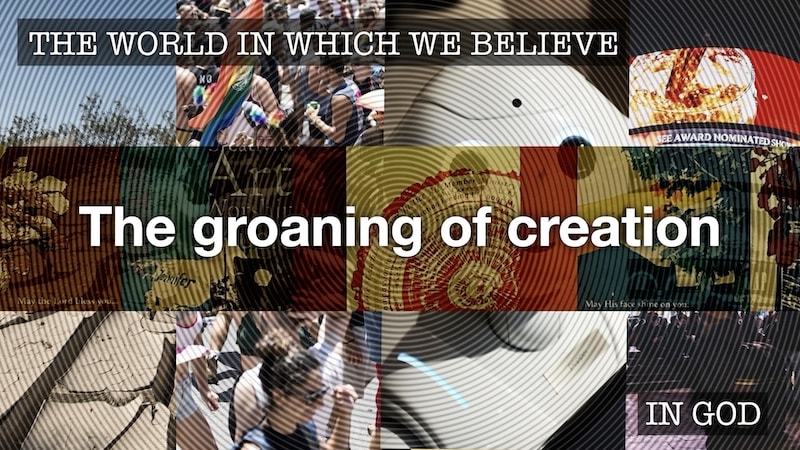
We screened the People’s Emergency Briefing film in the week before this message, so the climate crisis loomed menacingly. In the film, Jennifer Saunders of Absolutely Fabulous fame asks a good question: “What’s the matter with us?” What is the matter with us as a civilisation?

There is no eco-crisis in the New Testament, but we often read Romans 8:19-21 as an expression of Paul’s conviction that the whole of creation will eventually be set free from the consequences of the fall of humanity.

I think that misses the historical point.

Read more...
Jesus explicitly attaches a temporal limit to the validity of the Torah: ‘until all things take place (panta genētai)’. The allusion to the new heaven and earth imagery of Isaiah 65:17; 66:22 points to an eschatological-historical crisis of judgment and restoration that is imagined as a… ( | 1 comment)
When Jesus says that he has not come to bring peace to the land (not the ‘earth’ as in most translations) but a sword, he is speaking with the voice of the prophets. For example, Jeremiah 12:12: Upon all the bare heights in the desert destroyers have come, for the sword of the LORD… ()
There has been some discussion of Jesus’ statement ‘It is finished’ (John 19:30) in a couple of threads on Open Source Theology (‘Tetelestai (devolved)’ and ‘Tetelestai’). It has raised some important questions, and I want to set out a bit more carefully how I think the passage needs to be read. ()
Tim Leeson has initiated an interesting discussion about what the emerging church really stands for, which I think merits a stab at a more comprehensive and synthesizing response. The book Emerging Churches by Eddie Gibbs and Ryan Bolger lists nine characteristics of emerging churches:… ( | 2 comments)
This saying presupposes the threat to their lives that the disciples would face when they announced the coming of the reign of God to Israel (cf. Matt. 10:27). If they are killed by the Jewish authorities because of their witness, they have nothing more to fear because God will watch over them (12:… ( | 1 comment)
The idea that Israel, as the servant of the Lord, would be a ‘light for the nations’ is found in Isaiah (42:6; 49:6; 60:3). The argument in these chapters is that YHWH will act justly with respect to his alienated people, delivering them from oppression, restoring them to wholeness, and by virtue… ( | 2 comments)
In the context of Jesus’ address to the community of renewed Israel it makes more sense to translate as ‘land’ than ‘earth’. The issue here is the role of the disciples in the eschatological transition from second temple Judaism under judgment to a restored people of the Spirit. ()