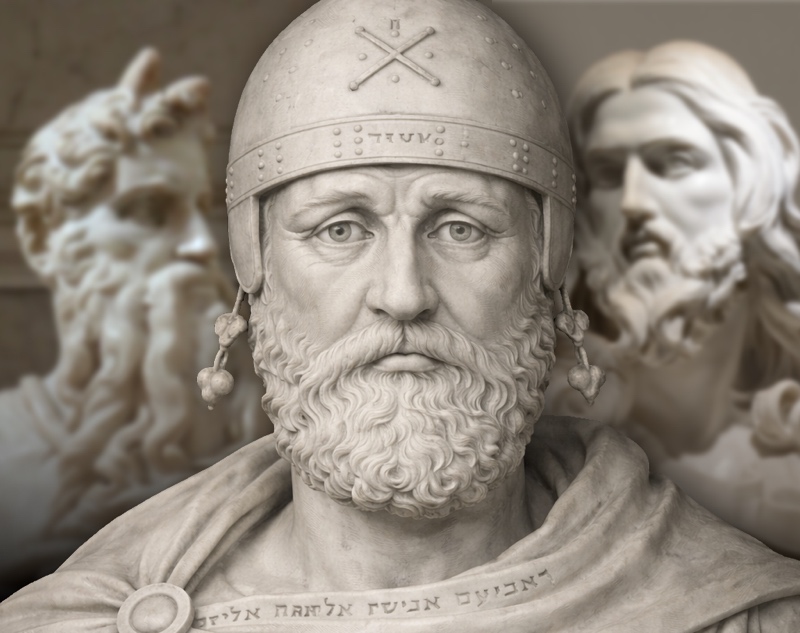
It looks like the next phase in the study of Paul, after the New Perspective on Paul and Paul within Judaism, will be Paul (within Judaism) within paganism. See, for example, Paul Within Paganism: Restoring the Mediterranean Context to the Apostle, edited by Chantziantoniou, Fredriksen, and Young (2025), which presents “a florilegium of essays tracing the various ways in which Paul’s Jewish religious program is native to the ancient Mediterranean” (xi). The British New Testament Society conference this year will have a session on the book and related themes, to which I will be contributing.
Jesus’ story about a poor widow who seeks vindication against her adversary is usually read as a model of Christian prayer in a quite general sense (see, for example, these commentaries collected at textweek). This approach certainly yields some important insights, but it also illustrates a… ( | 4 comments)
In response to Peter’s post about the Evangelical Alliance statement of faith, I would suggest that this sort of statement is designed for a particular purpose and does it admirably. An organization like the EA needs to define a doctrinal position that is acceptable across the spectrum of… ()
The ‘emerging church’ project is an experiment in new forms of church. The question of what ‘church’ is, however, cannot be resolved sociologically or experimentally. Ultimately, a theological answer is required. This page was written to provide some preliminary reflection for the Future of the… ()
Paul Seburn referred in another post to the ‘transmillennial’ view on New Testament eschatology. I thought it might be worth examining this separately. There’s a lot of material on the two sites I looked at (www.presence.tv and www.transmillennial.com), but I have limited my superficial… ()
There is both a diachronic (historical) and a synchronic (a-historical, existential) dimension to the development of a theology for the emerging church. The argument has for the most part been developed synchronically in response to cultural and philosophical changes taking place both inside and… ()
The analogy of the church as the temple of God is a familiar one (cf. 1 Cor.3:16-17; 1 Pet.2:5). It has usually been used, however, in an exclusivist sense: the church is the sanctuary at the heart of Herod’s temple, where legitimate Israel worships; everything outside the sanctuary is the… ()
Recent comments