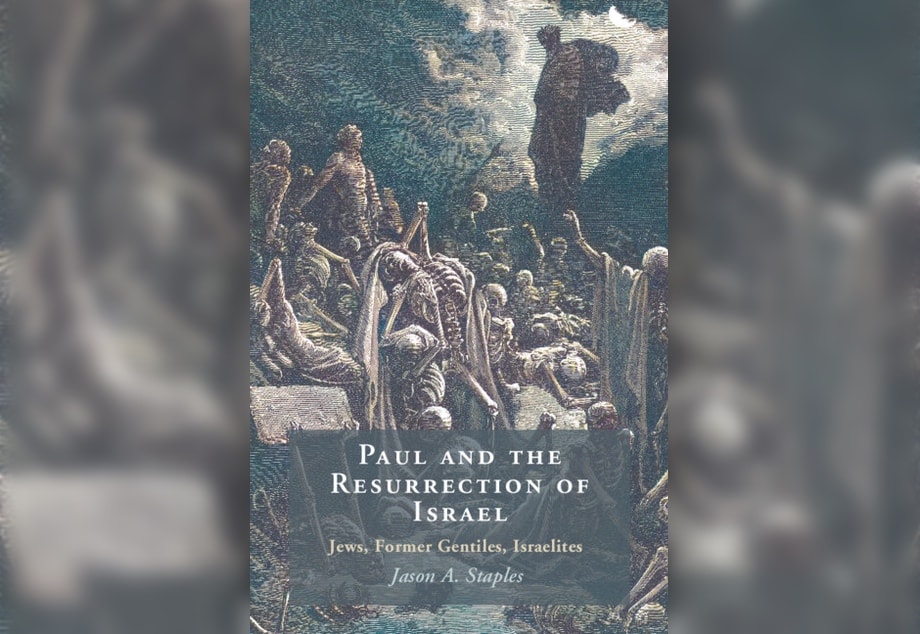
This is a rather technical examination of Jason Staples’ argument in Paul and the Resurrection of Israel: Jews, Former Gentiles, Israelites that when Paul speaks of Israel as “vessels of wrath,” he does not mean that the people are are the objects of God’s wrath; rather they are the instruments of God’s redemptive purposes. My view has been that Paul is saying that part of Israel really has become liable to destruction—much as Jesus foresaw destruction coming upon Jerusalem and the temple. But perhaps I’ve got it wrong.
I made some general comments on the relation of the coming of the Son of Man motif to historical events in my previous post on Tucker Ferda’s book Jesus and His Promised Second Coming: Jewish Eschatology and Christian Origins. I really don’t think he’s right to disconnect the disorder in… ( | 1 comment)
In an excellent interview on the Protestant Libertarian Podcast about his book Jesus and His Promised Second Coming: Jewish Eschatology and Christian Origins (2024), Tucker Ferda uses the expression “process eschatology” to register the fact that in Jewish apocalyptic writings the “end” is… ( | 6 comments)
I said I would come back to Matthew Thiessen’s “incoherent” account of Paul’s eschatology, so here we are. Chapter four of A Jewish Paul: The Messiah’s Herald to the Gentiles is about Paul the “End-Time Jew.” Thiessen begins: “Paul never wrote an autobiography. Why would he when he… ( | 1 comment)
I asked ChatGPT (Chat with Website) to summarise the “narrative-historical” approach to biblical interpretation that I pursue on this website. This is what it came up with. It’s not quite how I would have put it. I wouldn’t have said “empires like Rome,” for example; “historical… ()
In a lengthy Theopolis essay entitled “Pentecost and the Gift of a New Politics,” Alastair Roberts asks why Jesus had so little to say about the evil empire in their midst. “Jesus declares the coming of the kingdom of God: should not such a kingdom have involved, at a bare minimum, the defeat… ( | 4 comments)
Matthew Thiessen says that to understand the historical Paul we must relocate him in the world of first century Judaism, and here’s a book that does just that: Ben C. Blackwell, John K. Goodrich, and Jason Maston, eds. Reading Romans in Context: Paul and Second Temple Judaism (2015).… ()
Matthew Thiessen is keen to demonstrate that “Paul did not convert from an established religion called Judaism to a new religion called Christianity” (A Jewish Paul: The Messiah’s Herald to the Gentiles, 57). We can agree on that.
His conversion was to a radical allegiance… ( | 7 comments)
Recent comments