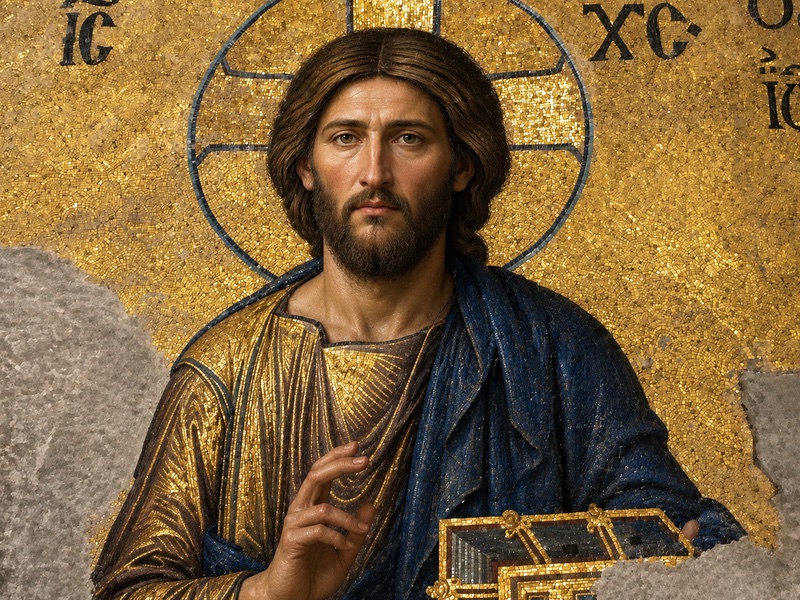
In a Substack post, Brian Zahnd looks at four key theological “entities” and warns of the “theological mischief” that happens when the “critical distinction” between them is not properly respected. The Church, the Bible, and the religion of Christianity are all good and important things, but not as good and important as Jesus. “The moment we try to nudge the Church or the Bible or Christianity toward equality with Christ we are headed down a theological path that leads to confusion and real-life trouble.”

My objection to this sort of analysis is two-fold. First, it relies on a flawed understanding of the categories if they are meant to be fundamentally biblical and not the product of later theological rationalisation. Secondly, it is an outdated analysis of “Christianity”: it deals with problems of the past, not of the future.

Read more...
I said I would come back to Matthew Thiessen’s “incoherent” account of Paul’s eschatology, so here we are. Chapter four of A Jewish Paul: The Messiah’s Herald to the Gentiles is about Paul the “End-Time Jew.” Thiessen begins: “Paul never wrote an autobiography. Why would he when he… ( | 1 comment)
I asked ChatGPT (Chat with Website) to summarise the “narrative-historical” approach to biblical interpretation that I pursue on this website. This is what it came up with. It’s not quite how I would have put it. I wouldn’t have said “empires like Rome,” for example; “historical… ()
In a lengthy Theopolis essay entitled “Pentecost and the Gift of a New Politics,” Alastair Roberts asks why Jesus had so little to say about the evil empire in their midst. “Jesus declares the coming of the kingdom of God: should not such a kingdom have involved, at a bare minimum, the defeat… ( | 4 comments)
Matthew Thiessen says that to understand the historical Paul we must relocate him in the world of first century Judaism, and here’s a book that does just that: Ben C. Blackwell, John K. Goodrich, and Jason Maston, eds. Reading Romans in Context: Paul and Second Temple Judaism (2015).… ()
Matthew Thiessen is keen to demonstrate that “Paul did not convert from an established religion called Judaism to a new religion called Christianity” (A Jewish Paul: The Messiah’s Herald to the Gentiles, 57). We can agree on that. His conversion was to a radical allegiance… ( | 7 comments)
In the introduction to his book A Jewish Paul: The Messiah’s Herald to the Gentiles (2023), Matthew Thiessen says that his broad aim is to present a reading of Paul that does not perpetuate an old “Christian” or “Lutheran” view of Judaism as “inferior or even pernicious, something left… ( | 1 comment)
Jesus’ parable of the net in Matthew 13:47-50 is commonly read as a parable of indiscriminate inclusion: both good and bad people may come into the kingdom. For example, Hagner writes with respect to the phrase “fish of every kind”: The exaggerated inclusiveness of this… ()