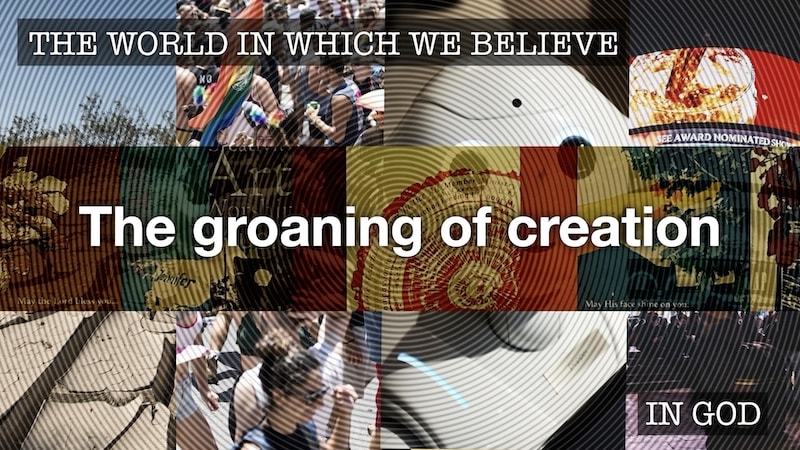
We screened the People’s Emergency Briefing film in the week before this message, so the climate crisis loomed menacingly. In the film, Jennifer Saunders of Absolutely Fabulous fame asks a good question: “What’s the matter with us?” What is the matter with us as a civilisation?

There is no eco-crisis in the New Testament, but we often read Romans 8:19-21 as an expression of Paul’s conviction that the whole of creation will eventually be set free from the consequences of the fall of humanity.

I think that misses the point.

Read more...
I’ve been engaged in a little exercise with some friends rewriting a mission organization’s statement of faith. What I have presented below is my reworking of a rough, more cautious, but actually rather effective first attempt to make “a bit of a narrative out of our core beliefs, rather than… ( | 2 comments)
Rob got in touch with a couple of questions about my post on the unbiblical doctrine of hell. My argument is roughly that the language of painful judgment in the New Testament—Gehenna, wailing and gnashing of teeth, violent destruction, etc.—refers not to what happens to individuals after death… ( | 5 comments)
I’ve been reading David Neville’s book A Peaceable Hope: Contesting Violent Eschatology in New Testament Narratives in order to review it for the Evangelical Quarterly. Neville sets out the problem he means to address in the opening paragraph:There is a discrepancy at the heart… ( | 3 comments)
According to Mark’s Gospel, Jesus tells his disciples that, as the apocalyptic storyline reaches its climax and the lights start going out over Jerusalem, “they” will see the Son of man coming in clouds (Mk. 13:24-26). But who—or what—are “they”? In A Peaceable Hope: Contesting Violent… ( | 7 comments)
Paul Dean is troubled by the inclusion of the word “triumphantly” in the closing sentence of the previous post on The end of narrative for Christians and Jews: “For the church, narrative came to an end triumphantly in the conversion of the empire and was replaced by theology.” He asks: “Why is… ()
The New Testament is an eschatological text. It tells a story, which is essentially a Jewish story about the fulfilment of age-old, deeply held hopes expressed in the Psalms and the prophets. The death and resurrection of Jesus brings that story to some sort of climax, but not to an end. There is… ( | 4 comments)
Preparing some lectures on Revelation, I came across Ian Paul’s very helpful introduction to the book in [amazon:978-0830825400:inline]. With Revelation, probably more than with any other New Testament text, it is difficult to deal with its meaning apart from its form. How we… ( | 7 comments)