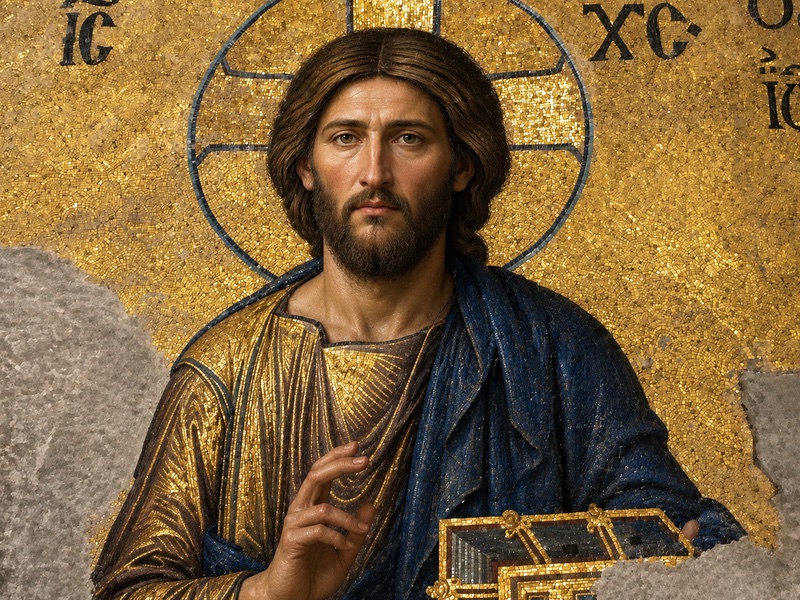
In a Substack post, Brian Zahnd looks at four key theological “entities” and warns of the “theological mischief” that happens when the “critical distinction” between them is not properly respected. The Church, the Bible, and the religion of Christianity are all good and important things, but not as good and important as Jesus. “The moment we try to nudge the Church or the Bible or Christianity toward equality with Christ we are headed down a theological path that leads to confusion and real-life trouble.”

My objection to this sort of analysis is two-fold. First, it relies on a flawed understanding of the categories if they are meant to be fundamentally biblical and not the product of later theological rationalisation. Secondly, it is an outdated analysis of “Christianity”: it deals with problems of the past, not of the future.

Read more...
This is a brief re-examination of Thomas’ famous declaration “My Lord and my God” in John 20:28. I looked at this some years ago, noting the common argument that the wording of the confession reflects the “custom,” recorded in Suetonius and Dio Cassius, of addressing the emperor Domitian (AD 81-96… ( | 17 comments)
Probably, for most people interested in biblical studies, “historicism” is a bad word, associated either with a positivist historical-critical methodology that hammers the theological life out of a text or with a certain mode of nineteenth century German historical idealism that culminated in the… ( | 4 comments)
I did a couple of podcast episodes recently with David Capes for The Stone Chapel Podcasts, talking about my book In the Form of a God: The Pre-existence of the Exalted Christ in Paul. ()
It is easy to visualise the traditional interpretation of Philippians 2:6-11 as a downward parabola or u-bend: Christ existed in heaven from eternity “in the form of God”; he descended into the world, becoming man and dying on the cross; then he is raised from the dead and restored to his position… ( | 13 comments)
This is a dull, and frankly unnecessary, technical note on the genitive construction with a preposition en morphēi theou (ἐν μορφῇ θεοῦ) in Philippians 2:6. I’ve had to look at this a bit more closely following a rather disjointed conversation with someone on Twitter who had different… ( | 12 comments)
John Baumberger has a question about my translation of en morphē theou in Philippians 2:6 as “in the form of a god.” He takes issue with the indefinite construction on a couple of grounds:1. The word theos ‘without the definite article almost always refers to God himself (and not… ( | 10 comments)
The famous passage about Christ in Philippians 2:6-11 is usually described as a “hymn,” and is usually taken to celebrate the inverted parabola of Christ’s descent from heaven, his incarnation as man, the nadir of his death on the cross, followed by his return to heaven and exaltation to a position… ( | 15 comments)