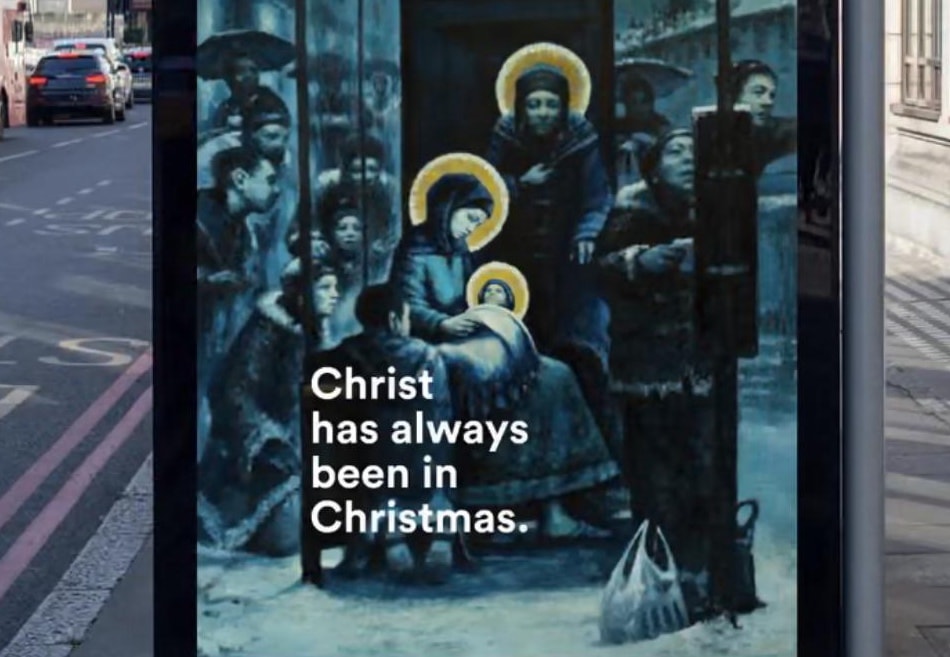
There has been a lot of scrambling for the moral high ground in response to the “far right activist” Tommy Robinson’s campaign to put “Christ back into Christmas.”

One UK based network of churches states: “Christ is self-sacrificial love. Christmas is a celebration of the moment that love entered into the world as a vulnerable human child.”

This is a sentimentalisation of the stories in Matthew and Luke. The birth of Jesus has no doubt been co-opted by the hard right as part of a strategy of resistance to what the Trump administration has called “civilisational erasure.” But it has also been co-opted by the soft religious left in support of a moral agenda that fails to grasp the complexity and seriousness of the crisis.

Read more...
The Christ encomium in Philippians 2:6-11 is usually divided into two parts: humbling in 2:6-8 and exaltation in 2:9-11. But here I want to suggest that once it has become apparent to onlooking Greeks that Christ Jesus, for all his god-like wisdom and powers, was human, no more remarkable than a… ()
The last time I wrote about Crispin Fletcher-Louis’ “monster book” The Divine Heartset: Paul’s Philippians Christ Hymn, Metaphysical Affections, and Civic Virtues I got a ticking off for not having read the whole book. I have since ordered the whole book—all 954 pages of it—but it… ( | 3 comments)
There are three main interpretive paradigms for understanding Paul’s writings available today within mainstream, predominantly Protestant, scholarship. The diagram below names the paradigms, briefly notes the defining characteristics, and mentions some of the major exponents. It also highlights the… ()
Here is the question. When Paul says, “for us one God the Father…, and one Lord Jesus Christ” (1 Cor. 8:6), are the terms “God… Lord” between them a reference to the shemaʿ: “Hear, Israel: the Lord our God, the Lord is one” (Deut. 8:6 LXX*)? It has become a stock argument of… ( | 7 comments)
The NIV is unusual in translating en morphēi theou hyparchōn in Philippians 2:6 as “being in very nature God,” but the translation nevertheless reflects a widespread and longstanding assumption that to be “in the form of God” means to share in his nature or essence or being. ( | 7 comments)
My argument about the other encomium, in Colossians 1:15-20, is that it makes Christ Jesus the beginning of a new political-religious order, in which government in heaven and government on earth have been reconciled. Hitherto the rule of God and rule over the nations of the… ( | 4 comments)
Crispin Fletcher-Louis has written a monster book—nearly a thousand pages—about the Christ encomium in Philippians 2:6-11: The Divine Heartset: Paul’s Philippians Christ Hymn, Metaphysical Affections, and Civic Virtues (Wipf & Stock, 2023). About 20% is available on Google Books. We… ( | 2 comments)