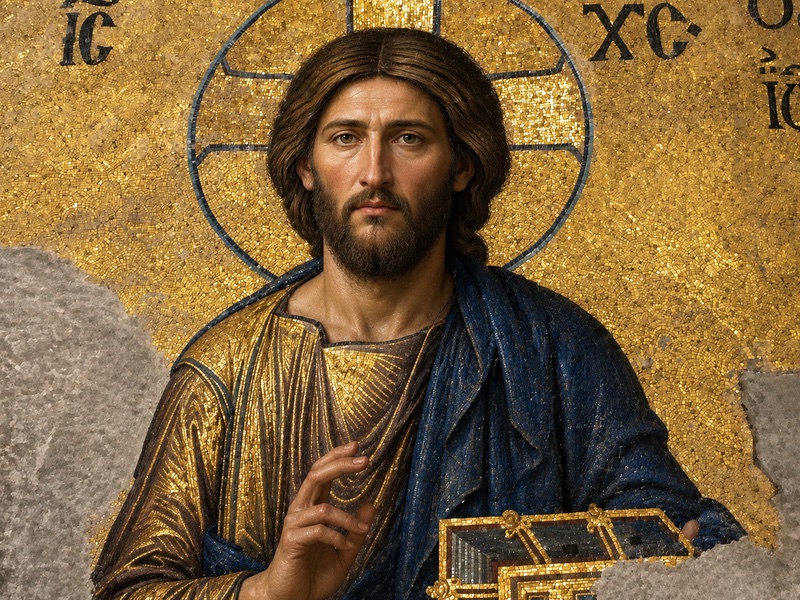
In a Substack post, Brian Zahnd looks at four key theological “entities” and warns of the “theological mischief” that happens when the “critical distinction” between them is not properly respected. The Church, the Bible, and the religion of Christianity are all good and important things, but not as good and important as Jesus. “The moment we try to nudge the Church or the Bible or Christianity toward equality with Christ we are headed down a theological path that leads to confusion and real-life trouble.”

My objection to this sort of analysis is two-fold. First, it relies on a flawed understanding of the categories if they are meant to be fundamentally biblical and not the product of later theological rationalisation. Secondly, it is an outdated analysis of “Christianity”: it deals with problems of the past, not of the future.

Read more...
I was at a fairly mainstream but non-traditional Anglican Church in east London on Sunday—mostly singles and young families. We had a good, thoughtful, and well presented sermon about the offence taken by the people of Nazareth at the wisdom and mighty works of Jesus (Matt. 13:53-58). I tried… ()
Ever wondered why the Jerusalem crowds turned against Jesus so abruptly—cheering him into the city at the start of the week, yelling for him to be crucified at the end of it? Lots of scholars think it all very improbable. We’ll get to that in a moment, but first some reflections on a hermeneutic… ()
I saw this book in the Al-Faisal Museum for Arab-Islamic Art in Riyadh. It is described as a manuscript that sheds light on the “most important teaching methods employed by scholars and educators of Arab-Islamic civilization.” It’s not dated, but it’s going to be pretty old. The notice with it… ()
Did Paul proclaim a universal gospel? “Of course he did,” you mutter. Or: “Of course he did, you nutter!” What use is a non-universal gospel?Well, on the train from Jeddah to Medina, I came across this paragraph in Neil Elliott’s Paul the Jew under Roman Rule: Collected Essays (2024): ( | 2 comments)
According to the classic definition, an “evangelical” is a person who believes in and acts upon the “gospel”—in New Testament Greek the euangelion. As understood by evangelicals, the gospel is a statement about the significance of Jesus’ death on the cross: by his “blood” he made atonement… ( | 1 comment)
In his encomium in praise of the exalted Christ in Philippians 2:6-11, Paul says that “in the name of Jesus every knee should bow… and every tongue acknowledge (exomologēsētai) that Jesus Christ is Lord” (Phil. 2:10-11*). Interpreters of the Early High Christology school often point… ()
I have dealt with this question a few times, most recently in “How Paul can proclaim one Lord Jesus Christ and not compromise Jewish monotheism,” and in a chapter in In the Form of a God: The Pre-existence of the Exalted Christ in Paul. But it has come up again: ( | 2 comments)