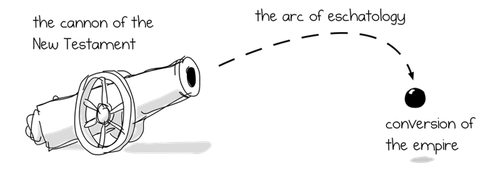
Christendom: fulfilment or false start?

In a perceptive comment in which he recommends consideration of Abraham Heschel’s “theology of Pathos”, Mark Nieweg draws attention to what he sees as a fundamental dilemma or paradox at the heart of the consistent narrative-historical approach to reading the New Testament.

I have actually been more accepting of your challenges in the Trinitarian posts than those that see the triumph of Christ over paganism in the empire and therefore allowing the “success of the apocalyptic narrative.” I see this more as a “false start” with tremendous consequences to the understanding of the church in the world than anything else.

This is important because in my view, as far as understanding the New Testament is concerned, the apocalyptic question is much more significant than the question of whether Jesus was God. The Trinitarian question is an engagement with philosophy. The apocalyptic question is an engagement with history.

Read time: 6 minutes

Jesus as Lord in Mark

Ed Dingess, who appears to be a Reformed apologist, has taken the trouble to add some polite and thoughtful comments to my post “Kenton Sparks: historical criticism and the virgin birth”. He makes some good points and raises some good questions about the narrative-historical approach to reading the New Testament, recognizing that it cuts across the grain of more traditional theological readings. He takes issue, however, with my suggestion that it is “difficult to maintain the view that the Jesus of the synoptic Gospels claimed to be God”:

The theme of the divinity of Christ is obvious, not only in the initial launch of Mark’s project which points us up to the coming of Israel’s God in the person of Jesus Christ, but also in the fact that it is carried on throughout the entire project itself.

I will address some of the broader issues relating to method and traditional theological readings in another post—I don’t want my approach to be understood as anti-trinitarian; I don’t think it is, fundamentally, anti-trinitarian. Here I want to consider the claim that the Old Testament quotations in Mark 1:2-4 introduce the theme of the divinity of Jesus. The theoretical discussion should not be pursued apart from a careful and unprejudiced reading of the texts.

Read time: 8 minutes

What about 1 Corinthians 1:30? Nope, no imputation of righteousness here either. So where is it then?

John Piper thinks that 1 Corinthians 1:30 “stands as a signal pointing to the righteousness of Christ that becomes ours when we are united to him by God through faith”. He is pleased to be able to quote Tom Wright’s “concession” to the Reformed view regarding this text:

It is the only passage I know where something called ‘the imputed righteousness of Christ,’ a phrase more often found in post-Reformation theology and piety than in the New Testament, finds any basis in the text.

In fact, in his response to Piper, Wright strongly refutes the argument that we have here “something called ‘the righteousness of Christ’ imputed to them, in the full sixteenth- and seventeenth-century sense so emphasised by John Piper”. Wright’s view is that those who are “in Christ” share in his vindication but not in a perfect moral righteousness that is somehow “credited” to their account. I agree, but I think the case becomes much stronger—and Paul’s argument more coherent—when we take the narrative-historical-eschatological context into consideration.

Read time: 5 minutes

More on the righteousness of God and the justification of believers

Some pertinent questions were asked by Jon and Geoff in the comments in response to my last post on Wright and White on the “righteousness of God” in 2 Corinthians 5:21. This is an extended answer to them. The questions overlap a little, so I may be repeating myself in a couple of places.

It may help before we start, though, to clarify two assumptions that I make.

First, I think that the underlying correlation in 2 Corinthians 5:21 is practical rather than than abstract, historical rather than theological. The lived realities would have been much more alive to Paul’s mind than they are to ours. On the one hand, Jesus, despite being God’s son, was forced to suffer as a “sinner”—to be condemned by the Pharisees as a lawbreaker, by the high priest as a blasphemer. On the other, the apostles are ambassadors, servants, co-workers with God, agents of the righteousness of God.

The language is certainly condensed, to the point of abstraction: “sin” is set against “righteousness”. But I would argue that this is a rhetorical encapsulation of the realistic historical account.

Secondly, as will become clear in my answer to the first question, I think that it is misleading to discuss righteousness and justification in Paul apart from a pressing eschatological framework shaped by Old Testament narratives of judgment and vindication. Reformed theology struggles to give a coherent account of Paul not least because it tries to make his argumentation work in a post-eschatological—indeed, Christendom—setting.

So, to the questions….

Read time: 9 minutes

Wright and White on the “righteousness of God” in 2 Corinthians 5:21

Driving back from visiting my mother yesterday I listened to a Premier Radio podcast of Tom Wright and James White debating the meaning of “justification” in Paul. It’s a difficult and rather disjointed conversation—Justin Brierley was clearly struggling to keep his head above water—but it’s worth listening to.

Wright has been enormously helpful in bringing into focus the Jewish-biblical—rather than Latin-medieval—background to Paul’s argument about justification and righteousness. But it seems to me that, in his reconstruction, the end of Israel’s exile is effectively the end of narrative—the end of theology as an engagement with the narrative of God’s people.

Read time: 6 minutes

He is near, at the doors

Ian Paul wonders whether it’s not the besieging Roman army that will be at the closed gates of Jerusalem rather than the Son of Man, who will be “coming on the clouds of heaven” rather than entering by the gates. His interpretation would fit the historical thesis well, but I’m not sure the limited exegetical evidence we have points in this direction.

Perhaps the first thing to note is that Jesus says “at the doors” (epi thurais) rather than “at the gates” (epi pulais). The distinction can be illustrated: the high priest Eliashib and his brothers the priests built the sheep gate (pulēn) and set up its doors (thuras) (Neh. 3:1 LXX). It doesn’t make much difference to the immediate sense of the passage but it may have a bearing on its relation to other texts.

Read time: 4 minutes

The coming of the Son of Man: theology or history?

Here’s another example of how we can let theology or dogma get in the way of good biblical interpretation. Bill Mounce, whose mostly excellent exegetical notes I read from time to time, discusses the translation of Mark 13:29, which in the ESV reads:

So also, when you see these things taking place, you know that he is near, at the very gates.

The problem that Mounce addresses is the translation of the phrase engus estin (“is near”). There is no pronoun in the Greek. If we supply “he”, as in the ESV, it appears to make Jesus say that the Son of Man will return within a single generation, which “of course, he didn’t”. This would leave us with what Mounce calls “one of the great conundrums” in the Gospels. 

Read time: 6 minutes