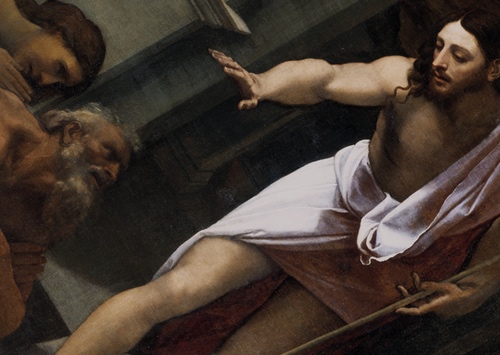
We all are being transformed into the same image—a correction (of sorts)

In the previous piece on being transformed into the image of Christ, I included 2 Corinthians 3:18 in a wider pattern in Paul whereby conformity to the image of Christ means specifically sharing in his suffering and resurrection:

And we all, with unveiled face, beholding (or reflecting) the glory of the Lord, are being transformed into the same image, from glory to glory, as from the Lord, the Spirit.

This view needs modifying (after a fashion).

Read time: 5 minutes

Who is being transformed into the image of Christ? Not me

I’ve just got back from a missions conference at which the idea that believers in general and “missionaries” in particular are being—or should be—transformed into the “image of Christ” got a lot of airtime.

I can see what people are getting at. The assumption is that Jesus represents either an ideal way of being human or an ideal way of doing ministry. He’s Jesus, after all! Therefore, to grow towards spiritual maturity is to be conformed to his image.

It’s a central plank of evangelical piety. Tim Challies quotes Jerry Bridges: “Christlikeness is God’s goal for all who trust in Christ, and that should be our goal also.”

Read time: 9 minutes

A pragmatic non-theory of the atonement

The title of the previous piece (“The death of Jesus: not as difficult to understand as you might think”) was perhaps a mistake. I suspect that many people found my narrative-historical reinterpretation as baffling as the classical theories of the atonement, if not more so.

In my defence I would say that the difficulty lies not in the narrative-historical account itself but in the amount of unthinking that we need to do—the mental effort involved in discounting a mountain of redundant conceptuality in order to see the narrative for what it was.

It’s a case of not being able to see the wood for the wall that has been built in front of it.

Read time: 9 minutes

The death of Jesus: not as difficult to understand as you might think

Peter Enns has written in his characteristically provocative style about two issues in the Bible that are really important but not at all clear.

The first has to do with Israelite origins. We can be reasonably confident about the broad outline of Israelite history back to the reign of David, but earlier than that things are decidedly murky. “Historically speaking,” Enns writes, “we really don’t know where the Israelites came from, and the exodus and conquest stories, which are so central to the biblical account, are particularly problematic.”

The second issue is of a very different type: “Why did Jesus die?”

Read time: 8 minutes

Theology and history: is the dam about to break?

Here’s one way of framing my “thesis” at the hermeneutical level—that is, at the level of how we interpret the Bible and make use of it as church.

For various complex reasons the church is coming under pressure to switch from a theological way of thinking to a narrative-historical way of thinking. In my view that is a good thing. It should be encouraged. It may even, in the long run, save the church in the secular West from obsolescence.

It comes down to the question of how we explain or talk about or define the new state of affairs that began with Jesus—the phenomenon that we call Christianity.

Read time: 6 minutes

A new Dead Sea Scrolls Cave and the narrative-historical method

It appears that a new Scrolls Cave has been discovered at Qumran—the first new cave in sixty years. All that was found in the cave, sadly, were the remains of six broken jars, some fragments of parchment and papyrus, and a piece of linen. Any scrolls that might have been preserved in the jars were looted in the mid-20th century.

Read time: 2 minutes