Paul’s phrase “in form of god” (en morphē theou, Phil. 2:6) may evoke a pagan rather than Jewish understanding of divine appearance, since the Jewish God has no physical “form.” Acts 12 provides a parallel: Herod appears godlike, is acclaimed as a god, but is exposed as mortal and dies because he accepts divine honours. Paul’s Christ, by contrast, possesses the “form of a god” but rejects the opportunity for divine kingship and empties himself, giving glory to God. The contrast between Herod and Jesus illuminates Philippians 2 as a political-religious narrative of divine kingship, humility, and faithful obedience.
I think that something quite straightforward is going on when Paul writes that Jesus was en morphē theou—literally, “in form of god” (Phil. 2:6). English translations usually render this “in the form of God” or perhaps something like “in the nature of God.” But if there’s one thing that the Jewish God does not have, it’s a “form.” Only pagan gods have forms; statues of the gods, idols, have forms. So I argue that the statement captures a pagan perspective on the baffling career of the earthly Jesus.
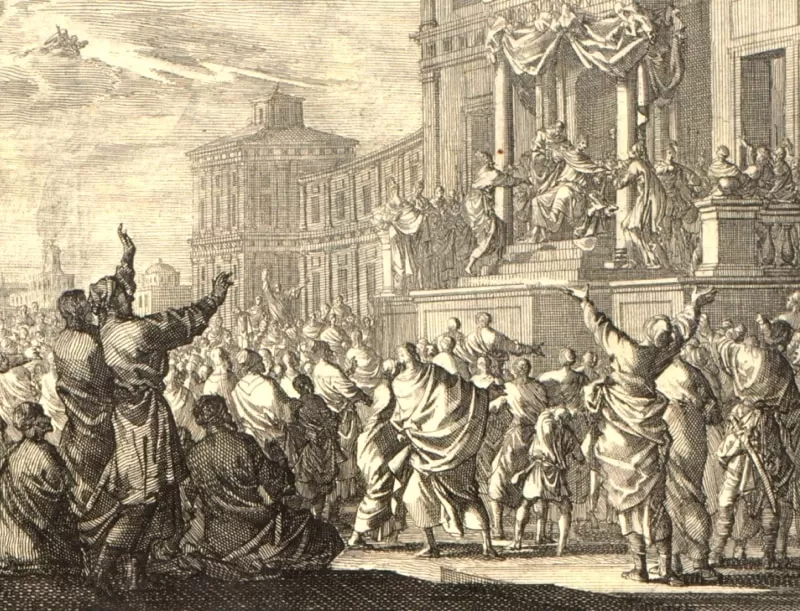
One piece of literary evidence in support of this reading comes from Luke’s account of the death of Herod Agrippa in Acts 12:20-23.
The incident follows on from the story of Herod’s persecution of the apostles in Jerusalem: he kills James, the brother of John, and arrests Peter (Acts 12:1-3); an angel of the Lord releases Peter from the prison, and when Herod learns that he has escaped, he has the luckless guards put to death and takes himself off to gentile Caesarea-by-the-Sea (12:19).
He then has to deal with a delegation of Phoenicians from Tyre and Sidon, who have come suing for peace (Acts 12:20-23), and what happens on that day clearly made an impression on the Jewish imagination.
Josephus tells us that it all takes place during a festival in honour of Caesar, and that Herod has dressed to dazzling effect: “the silver of his garment being illuminated by the fresh reflection of the sun’s rays upon it, shone out after a surprising manner, and was so resplendent as to spread a horror over those that looked intently upon him” (Ant. 19:344).
He looks like a god, and flatterers exclaim that he is a god, adding, “until now we feared you as a man, but henceforth we praise you as being superior to mortal nature” (19.345). It quickly becomes apparent, however, that Herod is not a god, and he realises as much: “I, who was by you called immortal, am immediately to be hurried away by death” (19.347). The people of Caesarea “besought God for the king’s recovery,” but to no avail (19.349). He dies in agony.
In Luke’s telling of the story, the pagan crowd cries out, “The voice of a god and not of a man!” So Herod is said to have the “voice of a god”—and indeed has the dramatic appearance of a god—but is found after all to have a mortal nature.
This royal morality tale is a staple of Jewish anti-pagan rhetoric. Antiochus Epiphanes suffered a similar fate to Herod and made a similar confession: “It is right to be subject to God and not to think that what is mortal is equal to God (isothea)” (2 Macc. 2:12*). The king of Babylon and the Prince of Tyre before him sought to rival the throne of God and were brought low (Is. 14:13-14; Ezek. 28:2). Nero was expected to “return, making himself equal (isazōn) to God, but God will rebuke him because he is not” (Sib. Or. 5:33-34).
If a person, therefore, does not “seize the opportunity to be honoured equal to a god,” there’s a strong likelihood that he has turned down the diabolical offer of divine kingship over the peoples of the empire (cf. Lk. 4:6-7).
So Jesus is imagined by the Greeks to have been in the “form of a god”—wise in speech, charismatic, performing godlike deeds—and I wonder if the description of Herod in his brilliant silver garment should make us think of the transfiguration. But he is found to be merely human in outward appearance (schēmati); and he dies in no less appalling circumstances on a Roman cross.
The simple genitive construction “voice of a god” (theou phōnē) is equivalent to Paul’s “form of a god” (morphēi theou). The crowds in Caesarea hear Herod’s divinity in his voice; Greeks hearing stories about the earthly Jesus “saw” his divinity in his form.
Herod welcomes the opportunity to be acclaimed as a god by the pagan world; Jesus rejects it.
An angel of the Lord strikes Herod down “because he did not give God the glory.” Jesus is in the form of a god, as Herod was, but he empties himself of all such vain ambition and instead gives God the glory: “It is written, ‘You shall worship the Lord your God, and him only shall you serve’” (Lk. 4:8).
For more along these lines, see my book In the Form of a God: The Pre-existence of the Exalted Christ in Paul.
Andrew, as I understand it, the phrase to eina isa theou in Phil 2:6c denotes a particular manner or being that is characterised by the being of God/a god. It seems to have a nature or ontological aspect here, where Christ does not reckon to seize at a god-equal being (or his being equal to that of a god), precluding a status interpretation. Instead, this references one of nature or ‘whatness’, perhaps referencing apotheosis of some kind. What do you think of this? Also, do you think it’s possible that Satan was offering a kind of apotheosis to Christ?
Thanks in advance,
Adam
@Adam:
Hi Adam. I know that Crispin Fletcher-Louis thinks that the emphasis on being precludes the status interpretation, but I find that difficult to understand. On the one hand, in Jewish thought it is, I think, always kings and emperors who seek equality with God or with a god. On the other, if a king is honoured or acclaimed as a god, then surely he is—within this political-religious context—equal to a god. The man of lawlessness in 2 Thessalonians proclaims that he “is” a god. The status is the existence.
I wouldn’t really call this an apotheosis because the terms of the offer can be satisfied in normal human Jewish—the king of Babylon, the prince of Tyre, Antiochus Epiphanes, Herod Agrippa, Caligula, Nero.
Recent comments