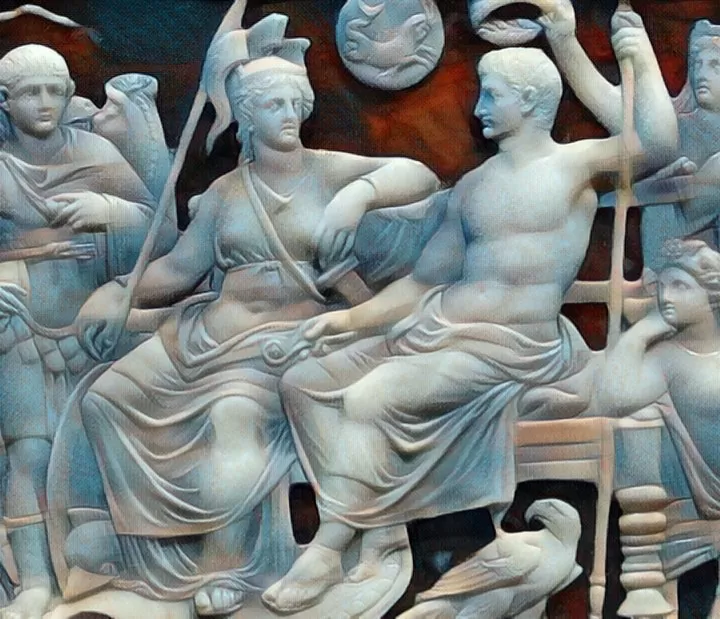
I happened to come across an article by Darrell Hannah called “The Throne of His Glory: The Divine Throne and Heavenly Mediators in Revelation and the Similitudes of Enoch.”1 Very interesting, I thought. A bit convoluted for a blog post, but very interesting. I won’t dwell too much on the Similitudes of Enoch part. The main question is: does Jesus sit on his own throne in heaven at the right hand of God or does he share God’s throne, and what difference, if any, does it make?
Jesus shares the throne of God
According to Hannah, the two clearest statements to the effect that the risen Christ shares the throne of God are to be found in the book of Revelation. At the end of the letter to the church at Laodicea Jesus says, “The one conquering, I will give to him to sit with me on my throne, as I also conquered and sat with my Father on his throne” (Rev. 3:21, my translation). Then in the new Jerusalem John sees “the throne of God and of the Lamb”—seemingly one throne for the two persons (Rev. 22:1, 3).
Also to be reckoned with are the statement that the “male child,” who is to rule the nations with a rod of iron, was “caught up to God and to his throne” (Rev. 12:5), and the description of the “Lamb in the midst (ana meson) of the throne” in heaven (Rev. 7:17).
It seems to me that we have three different “throne” ideas here.
1. The allusion to Psalm 2:7-8 in Revelation 12:5 suggests that the male child is caught up to heaven in order to rule as YHWH’s king at his right hand, either on the same throne or on a separate one. He will inherit the nations, he will “break them with a rod of iron”; he will rule in the midst of his enemies until the last of them is made his footstool (Ps. 110:1-2). This is the dominant enthronement motif in the New Testament.
2. The “throne of God and of the Lamb” in Revelation 20:1, 3 is not the throne of Christ’s kingly rule, along with the martyrs (cf. Rev. 20:4-6), but a proxy for the temple in the new Jerusalem in the thousand year period between the overthrow of pagan Rome and the final judgment. Perhaps God and the Lamb are imagined seated together on the ark of the covenant, with Ezekiel’s river of the water of life flowing from under it—or at least, where the ark would have stood if the city had had a temple.
3. The description of the Lamb “in the midst of the throne” in chapters 4-5 is part of a more elaborate and dramatic heavenly scene, in which the Lamb who was slain is found worthy to open the scrolls of judgment against both Israel and Rome.
Earlier John saw the Lamb standing “in the middle (en mesōi) of the throne and of the four living creatures and of the elders,” which suggests among these various entities (Rev. 5:6). God is seated on the throne, the twenty-four elders are seated on twenty-four thrones circling (kyklothen) the throne of God, and the living creatures are located “in the middle (en mesōi) of the throne and in a circle (kyklōi) of the throne” (Rev. 4:2-4, 6, my translation). The Lamb “came and took (the scroll) from the right hand of the one seated on the throne” (5:7).
In the vision of Revelation 7:9-17 a great multitude stands “before the throne and before the Lamb” (7:9, 15) and cries out, “Salvation belongs to our God who sits on the throne, and to the Lamb!” (7:10). Only God is said to sit “on the throne ” (epi tōi thronōi); the Lamb is set apart from him in these statements. The adverbial expression ana meson, which locates the Lamb, mostly means “between” or “in the midst of.” Mark says, for example, that Jesus “came through Sidon to the Sea of Galilee in the midst of (ana meson) the borders of Decapolis. It seems to me likely, therefore, that John is still seeing the Lamb within the circle defined by the twenty-four elders, perhaps among the living creatures who are “in the middle of the throne.”
Hannah suggests that the awkward positioning of the Lamb may be explained by the fact that the living creatures “were thought to be engraved or sculpted onto the throne itself.” But the scene seems too dynamic for this, and we have been told that the living creatures are “in the middle of the throne” (Rev. 4:6). Perhaps the whole space described by the circle of the elders constitutes the “throne” of God; but the Lamb must approach the throne in order to take the scroll, and it is not said that the Lamb sat on the throne.
One throne in Hebrews and Matthew?
A few other New Testament texts are thought to provide evidence for a shared throne. The writer to the Hebrews locates the enthronement of Jesus at the right hand of God in the heavenly temple (Heb. 8:1; 10:12-13). Since the earthly sanctuary contained only one throne, the cover of the ark of the covenant, there is presumably only one throne in the heavenly sanctuary, which God and Jesus must share. This can perhaps be correlated with Revelation 20:1-3: when the heavenly temple in the heaven city descends to earth, it becomes a non-temple, but the seating arrangement is preserved.
The writer to the Hebrew, however, conflates the enthronement imagery of Psalm 110:1 and the temple imagery, and the “throne” may still presuppose the setting of the royal court—note the reference to a “footstool” in Hebrews 10:13, which does not belong in the temple.
Hannah also suggests that the “throne of his glory,” on which the Son of Man will sit, is the throne of God (Matt. 19:28; 25:31). In the second temple period the phrase “throne of glory” was reserved for the throne of God. For example: “On that day my Elect One shall sit on the throne of glory” (1 En. 45:3; cf. 55:4). Jesus’ words should be understood in the same way.
I’m not so sure. Jesus says that the Son of Man will come and sit on the throne of his glory to judge Israel (Matt. 19:28) and the nations (Matt. 25:31). Hannah notes the reference to “the thrones of his glory” in 11Q17 10.7, but says nothing about the fact that Jesus speaks of the Son of Man’s own glory—the glory that he will receive at his vindication before the throne of God (cf. Dan. 7:13-14).
We read in Ben Sirach 47:11 that the Lord gave David “a covenant of kings and a throne of glory in Israel.” This is close to the idea that we find in Matthew, the difference being that the phrase is definite on Jesus’ lips (“the throne of his glory”) because he has in mind the particular glory that the Son of Man will acquire on account of his faithful suffering. Moreover, the Son of Man most likely will sit on his glorious throne not in heaven but on earth, “in the regeneration” (en tēi palingenesiai), when he will judge the tribes of Israel and the nations gathered before him.
This differs from the enthronement of Psalm 110:1 and really constitutes a fourth category: a throne is set up on earth for the glorified Son of Man to enact judgment in history.
Jesus has his own throne
Most commonly in the New Testament and nearly Christianity the enthronement of Jesus is described in the language of Psalm 110:1: the exalted Jesus has been seated “at the right hand of God,” which may have been taken to mean that the Son sat on a second throne. Polycarp says that God “raised our Lord Jesus Christ from the dead and gave him glory and a throne at his right hand” (Phil. 2:1)
Most of the “seated at the right hand” of God texts in the New Testament are ambiguous in this respect. Hannah thinks, however, that two thrones are implied in 1 Corinthians 15:23-28. The subordinationism of the passage and the prospect of Christ’s rule ending is difficult to square with an absolute “communality of throne between the Father and the Son,” as Hengel puts it. Hannah gets this right, I think: “Paul… appears to be visualising a temporary reign of Christ for the specific purpose of defeating the enemies of God” (77).
He concludes: “Some early Christians apparently believed that there were two thrones in heaven, one on which God sat and another, lesser throne at his right hand, occupied by the Risen Christ” (75).
Oddly, the author of the book of Revelation shows little awareness of this tradition, but Hannah thinks that two thrones are implied in Revelation 3:21: “The one conquering, I will give to him to sit with me on my throne, as I also conquered and sat with my Father on his throne.”
The assurance that believers who suffer with Christ will also reign with Christ is found at a number of points in the New Testament. When Israel is restored, the disciples, who will have to take up their own crosses in order to follow Jesus, will sit on twelve thrones alongside the glorious throne of the suffering Son of Man, judging the twelve tribes (Matt. 16:24; 19:28). Luke’s “I assign to you, as my Father assigned to me, a kingdom” (Lk. 22:29) looks like another way of saying, “The one conquering, I will give to him to sit with me on my throne, as I also conquered and sat with my Father on his throne” (Rev. 3:21).
It seems to me, then, that the thrones stand for the exercise of rule or kingdom. The meaning is not that Jesus switches between his own and his Father’s throne, but simply that he will share the authority which he received from God as firstborn from the dead with those who subsequently will emulate him in his faithfulness, suffering, and death.
Paul says that those who endure “will also reign with him” (2 Tim. 2:12). The martyrs killed by Rome will be raised in a “first resurrection” and will reign with Christ for a thousand years (Rev. 20:4-6). The point is that they will share in Christ’s rule over the nations, not that they will share his identity.
In a 3rd/2nd century BC text Moses has a dream of the throne of God on the summit of mount Sinai. The figure on the throne instructs him to take a sceptre and royal crown and sit on the throne in his place (Ezekiel the Tragedian 67-76). This does not mean that Moses becomes God in any sense. His father-in-law provides the interpretation: “you shall cause a mighty throne to rise, and you yourself shall rule and govern men” (85-86).
So whether one or two thrones is envisaged, the meaning of the image is that the authority to rule is shared with, or delegated to, another.
Some christological conclusions
First, the four different “throne” scenarios should not be confused. They draw on different biblical-apocalyptic motifs; they mean different things:
- the Davidic Son is enthroned at the right hand of God;
- God and the Lamb sit together as the source of life in the non-temple;
- approval of the Lamb’s right to inaugurate the process of judgment is acted out in the heavenly courtroom;
- and the Son of Man will come and take his seat—the throne of his glory—to judge both Israel and the nations in history.
Hannah makes the point that in the Similitudes of Enoch the Son of Man occupies the throne of glory only in order to fulfil his office: “he sits on the throne of glory to execute and only to execute the eschatological judgment.” But in Revelation, he says, the picture is different. “Here the eschatological judgment belongs primarily to God, not to Christ (cf. 20,11-15), and the throne of glory has become the dual thronos tou the kai tou arniou, which is clearly an ongoing reality and not limited to the single eschatological act of judgment” (87-88).
Here we see the failure to differentiate. The final judgment of all humanity in Revelation 20:11-15 is not the same as the judgments executed in history by the Son of Man, according to Matthew, when he comes to sit on the throne of his glory. The close association of God and the Lamb in the non-temple, which is effectively the continuing presence of God’s people on earth, has to do not with judgment and rule but with the source of life and healing.
All versions of the throne motif bring Jesus into the closest relationship with God—to the extent that the twenty-four elders sing a “new song” about the worthiness of the Lamb to “receive power and wealth and wisdom and might and honour and glory and blessing” (Rev. 5:12) and do obeisance before him (5:14).
But it seems to me too much to say that this creates some manner of unity of identity as is sometimes claimed. Jesus sits on the throne of God, or on a throne provided by God, without becoming God. As Hannah says, Christ’s right to share the throne of God derives from the fact that he conquered death; it is “not, or at least not necessarily, a consequence of his eternal divinity.”
The Lamb in the heavenly throne scene remains quite distinct from God as a dramatic actor, and Jesus sits on the throne in the non-temple as the Lamb who was slain, who ransomed a people for God by his blood.
Jesus is given authority to judge and rule, either as the Son of Man or as the “lord” seated at the right hand of YHWH. Even if the thought is that he sits on the same throne as God, there is no confusion of identity. The image of the bisellium or “double throne” was common in the ancient world. The famous cameo known as the Gemma Augustea depicts Augustus and the goddess Roma seated together on a single throne. The one does not share the identity of the other, they rule conjointly.
Finally, Paul is quite explicit that Jesus’ rule at the right hand of God is contingent and temporary: he rules because there are enemies and for as long as there are enemies.
As soon as the church in the Greek world began to translate these diverse apocalyptic dramas into a more philosophical language, the fine narrative distinctions collapsed into theological abstractions. The male child born to righteous Israel, who suffered, was raised, exalted, vindicated, who acted as an agent of divine judgment and rule in history, was introduced into the hall of mirror of Trinitarian theology. That was bound to happen, and I think that we are right to affirm it. But the convoluted apocalyptic narratives, to my mind, are far more interesting—and, frankly, more useful.
- 1Zeitschrift für die Neutestamentliche Wissenschaft 94 (2003), 68-96.
I lIke the study of this article for it is also my belief ,there is but one God and he gives authority to whom he chooses,as for trinity the word itself is not mentioned and not supported in the scriptures.
Jesus is not in the flesh . The flesh of the living God was only for a sacrifice. Jesus was God in the Flesh now his is God in the fullness. There is no 3 only one. The flesh of Jesus was transformed after he returned from the deep 3 days. Lets talk if you want to know the truth. [email protected]
The throne scenes of the NT are among the most concentrated loci of its Christology. Read in their intertextual texture and Greek detail, they do not depict a merely parallel or derivative royal seat for Christ, still less a temporary dais set beside the one divine throne; rather, they present the unique throne of God as the locus now shared by the Father and the Son. This sharing signals not a collapse of personal distinction but the Son’s inclusion within the one divine sovereignty. The alternative proposal—that Jesus either occupies a separate, lesser throne at God’s right hand or only intermittently approaches the throne as a servant—underestimates the grammar, the literary architecture, and the Second Temple monotheistic logic that Revelation, Hebrews, and the Gospels deploy.
Revelation is programmatic. The Epistle to Laodicea gives Jesus’ own hermeneutic for what follows: “I also conquered and sat down with my Father on his throne” (ἐκάθισα μετὰ τοῦ Πατρός μου ἐν τῷ θρόνῳ αὐτοῦ, Rev 3:21). The preposition μετὰ and the singular θρόνος are decisive. John does not say the Son sat on a throne adjacent to the Father’s or that he was granted a copy; he sat down with the Father on the Father’s throne. This anticipates the climactic description of the New Jerusalem: “the throne of God and of the Lamb” (ὁ θρόνος τοῦ Θεοῦ καὶ τοῦ Ἀρνίου, 22:1, 3). The coordinated genitives modify a single θρόνος, not two seats; and the following syntax underscores the unity of rule: “his servants will worship him” (οἱ δοῦλοι αὐτοῦ λατρεύσουσιν αὐτῷ, 22:3). Both the possessive αὐτοῦ and the dative αὐτῷ are singular though the immediately preceding subject is compound (“God and the Lamb”). John studiously avoids the plural that would be natural if he wished to keep two foci of sovereignty; the singular pronouns function as a grammatical “signal” of a single divine dominion in which Father and Son conjointly participate. A similar singular after a compound subject appears in 11:15 (“the kingdom of our Lord and of his Christ, and he shall reign”), cohering with this pattern of unity without confusion.
The claim that the Lamb is not portrayed as enthroned in Revelation 4–7 rests on a too timid handling of John’s prepositional language. In 5:6 the Lamb stands “in the midst of the throne” (ἐν μέσῳ τοῦ θρόνου), a phrase repeated programmatically in 7:17 where “the Lamb in the midst of the throne will shepherd them” (τὸ ἀρνίον τὸ ἀνὰ μέσον τοῦ θρόνου). The genitive construction “in the midst of the throne” does not mean “somewhere in the general vicinity of throne-room entities,” nor does it merely locate the Lamb between the living creatures; it places him at the very center of the throne’s space, the focal point of theophanic sovereignty. That he “came and took” the scroll “from the right hand of him who sat on the throne” (5:7) dramatizes role relations, not spatial exclusion. The ensuing doxology makes the theological point explicit. The sequence of hymns that crescendos from the living creatures and elders to “every creature” ascribes the same sevenfold acclamation to “the one seated on the throne and to the Lamb” (5:13), after which the elders “fell and worshiped” (5:14) without any textual demarcation that would restrict the prostration to the Father. Within a narrative that consistently rebukes misdirected proskynesis toward angels (19:10; 22:8–9), the Lamb’s reception of the identical worship coordinated with the Father’s is intelligible only if John understands him to share the unique divine identity centered on the one throne.
The “non-temple” reading of Revelation 21–22 also misfires. John says, “I saw no temple in it, for the Lord God the Almighty and the Lamb are its temple” (21:22). The absence of a building does not demote the throne to an architectural proxy; it elevates the personal presence of God and the Lamb as the eschatological sanctuary. Accordingly, the river of the water of life flows “from the throne of God and of the Lamb” (22:1). In Ezekiel 47 life-giving waters issue from the temple; in John’s consummation they issue from the jointly occupied throne because God and the Lamb are themselves the temple. The imagery is not a loosening of cultic categories but their concentration in the Father–Son communion.
Hebrews corroborates this reading rather than qualifying it. The epistle opens by locating the Son in the sphere of divine prerogatives: he is the “radiance of the glory of God and the exact imprint of his hypostasis,” and “he sat down at the right hand of the Majesty on high” (1:3). Immediately thereafter the Father addresses the Son as God: “Your throne, O God, is forever and ever” (1:8), and applies to him the YHWH-creator text of Psalm 102 (1:10–12). When Hebrews later speaks of the “throne of the Majesty” (8:1) and the Son seated “at the right hand of the throne of God” (12:2), it is not importing a second royal chair into the heavenly sanctum; it is interpreting Psalm 110:1’s right-hand imagery as the Son’s participation in the one divine kingship. The author can blend temple and court metaphors because they converge in the enthroned presence of God; what he will not do is reduce the Son’s session to a merely functional dais. The Son’s own throne is eternal (1:8), and his session at the right hand is the priest-kingly enactment of that truth, not a contradiction of it.
Matthew’s “throne of his glory” contributes along the same trajectory. The idiom “throne of glory” is indeed a divine title in Jewish literature, but Matthew’s christology already unites the Danielic Son of Man with the Psalm 110 Lord. Jesus tells the Sanhedrin that they will see “the Son of Man seated at the right hand of Power and coming on the clouds” (26:64), fusing the Psalm 110 session with Daniel 7’s theophanic advent. When, therefore, he says the Son of Man “will sit on his glorious throne” to judge Israel (19:28) and the nations (25:31), he is not positing a throne ontologically other than God’s. The “glory” he receives is “the glory of his Father” (16:27), and his judicial act is God’s own prerogative extended into history through the Son. To set that throne on earth “in the regeneration” does not back away from the heavenly identity of the throne; it dramatizes that identity in the arena of judgment.
The Pauline hand-over in 1 Corinthians 15 does not blunt this conclusion. Paul describes the mediatorial reign of the risen Christ “until he has put all his enemies under his feet,” after which the Son delivers the kingdom to the Father “that God may be all in all” (15:24–28). Nothing in the passage suggests the cessation of the Son’s reign in the absolute sense; the NT elsewhere affirms his endless kingship (Luke 1:33) and Revelation’s everlasting rule (11:15). Paul is narrating the telos of the redemptive economy: the Son who, as incarnate mediator, subdues every hostile power, presents the pacified cosmos to the Father without thereby forfeiting his participation in the one divine rule. The subordination is economic and eschatological, not ontological; it reveals the Father–Son relation, it does not demote the Son to a creaturely governor.
Nor will analogies from imperial bisellia bear exegetical weight. Roman art could picture two figures, human and divine, on a single throne because polytheism admits distributed sovereignties. John’s monotheism does not. In Revelation there is only one cosmic throne of God. That the Lamb is placed on it, receives the worship otherwise forbidden to all creatures, bears divine titles and functions, and is joined grammatically to the Father by singular pronouns, is John’s way—indeed the only way available within Jewish monotheistic discourse—to say that the Son shares the unique divine sovereignty while remaining personally distinct from the Father. The unity is not produced by a post-apostolic metaphysics retrojected on apocalyptic visions; the metaphysics is the church’s disciplined attempt to say, and safeguard, precisely what the visions show.
Finally, it is a false dichotomy to oppose the Lamb’s right to share the throne as a reward for conquering to his eternal divinity. Philippians 2 resolves the relation: existing “in the form of God” and not grasping at equality, the Son empties himself, obeys unto death, and is therefore “highly exalted” and given “the Name above every name,” so that every knee bows and every tongue confesses him Lord in the very language of Isaiah’s monotheistic oath (Isa 45:23). The exaltation is not a promotion from creature to deity; it is the public manifestation in history of who he eternally is. Revelation translates that hymn into vision: the slaughtered Lamb stands at the center of the throne, and the universe learns to name the one God as “the One who sits upon the throne and the Lamb.”
The NT bears a consistent witness, the Son does not hover near God’s throne, borrow it for a judicial session, or occupy a secondary seat that will later be vacated. He sits with the Father on the Father’s throne, he is located “in the midst of the throne,” he receives the worship that marks out the one God from all creatures, and he reigns eternally in the unity of the divine sovereignty. Precisely because John and his peers are jealous for monotheism, they make the strongest possible claim: the Lamb shares the throne of God. Any interpretation that separates the thrones, or attenuates the throne-sharing to a merely functional delegation, falls short of the grammar, the literary structure, and the theological horizon of the texts themselves.
@X. József:
@X. József Wow your post has too many errors to address in detail, but the biggest is your claim that Christ’s submission is merely “economic.” That doesn’t work. Any genuine submission of one divine being to another proves the Father is supreme over all; exactly as Paul affirms: “Now unto the King eternal, immortal, invisible, the only wise God, be honor and glory for ever and ever” (1 Tim. 1:17). Paul also says explicitly, “the head of Christ is God” (1 Cor. 11:3). And Jesus himself confirms it: “The Father is greater than I” (John 14:28).
Paul drives this home in 1 Corinthians 15:28: “When all things are subjected to him, then the Son himself will also be subjected to Him who put all things in subjection under him, that God may be all in all.” Notice carefully: Christ does not subject all things by his own independent power. It is God who gives him that authority and God who remains supreme even after the Son’s work is done. No apostle ever taught, proclaimed, or even hinted that God is a three-person being. They consistently confessed one God; the Father (1 Cor. 8:6). There is no “God the Son” and no “God the Holy Spirit”.
Your invented categories of “economic vs. ontological” are nothing but post-biblical jargon and human speculation. Paul never used them. He speaks plainly: the Son is subject to the Father, and the Father is the One who gave him everything in the first place.
And the nail in the coffin? The Holy Spirit is never even mentioned in these climactic passages. That silence is always the Achilles’ heel of the later Trinity dogma.
@David:
Thanks for the pushback—let’s deal with the texts and the logic, not caricatures. The Trinitarian claim is not that Christ’s submission is a mere rhetorical flourish, but that Scripture itself distinguishes between who the Son is by nature and how the Son acts in the economy of salvation. That distinction isn’t post-biblical embroidery; it’s the grammar of the New Testament. John speaks both ways in the same breath: the Son “does nothing of himself” because he is from the Father and sent by the Father, yet “whatever the Father does, the Son does likewise,” and the Father has willed that “all may honor the Son just as they honor the Father” (John 5:19, 23; cf. 8:42). If “honor… just as” means anything, it means equality of worship; and if the Son does “whatever” the Father does, we’re already beyond creaturely agency and into shared divine operation. The missions reveal an order of origin and role; they do not demote the Son to a lesser nature.
Your appeal to 1 Corinthians 15:28 only bites if “subjection” entails inferiority of essence. Paul is describing the mediatorial reign of the incarnate Son, who, having conquered every enemy, hands over the pacified kingdom “that God may be all in all.” The same Paul insists that the Son’s kingship is everlasting (Luke 1:33) and that the eschatological reign of “our Lord and his Christ” has no end (Rev 11:15). The “subjection” there is the filial act by which the incarnate Mediator—true God and true man—presents the renewed creation to the Father. It’s the terminus of the saving economy, not a downgrading of the Son’s divinity. Catholic theology simply gives names to what the text already displays: a real obedience according to Christ’s human will and office, with no diminution of what he is as consubstantial with the Father.
So too with John 14:28. Jesus says, “The Father is greater than I,” immediately explaining that the disciples should rejoice “because I go to the Father.” The contrast is not between a divine superior and a divine inferior, but between the Son in the state of humiliation and the Father not incarnate. In the same Gospel, the Son claims what belongs to God alone—pre-existent glory “before the world existed” (John 17:5), oneness of action with the Father (10:30; 5:19–23), and the right to receive the same honor as the Father (5:23). Read canonically, John 14:28 cannot be weaponized to cancel John 1:1 (“the Word was God”) or Thomas’s confession to the risen Christ, “My Lord and my God!” (John 20:28).
First Corinthians 11:3 likewise does not make your point. “Head” (kephalē) in Paul can denote source and order without implying a disparity of nature. The Father is the unoriginate source; the Son is eternally from the Father; the Spirit proceeds. That taxis is real, but it is an order among equals in the one nature, not a chain of ontological inferiors. This is why Paul can reshape the Shema in 1 Corinthians 8:6 without abandoning monotheism: “one God, the Father, from whom are all things…and one Lord, Jesus Christ, through whom are all things.” “Lord” is not a polite title there; it is the Greek name that renders the Tetragrammaton. Paul splits Israel’s confession between “God” and “Lord” to include the Son within the unique divine identity while preserving the Father as source. The result is not two gods, but one God named as Father and Lord together.
Your citation of 1 Timothy 1:17 is entirely compatible with this. Of course God is “the King eternal, immortal, invisible, the only God.” The Son in his divine nature is immortal and invisible; he becomes visible and passible by assuming our nature. The same Pauline corpus that exults in the one God also calls Jesus “our great God and Savior” (Titus 2:13), ascribes to him the divine prerogatives of creation and providence (Col 1:16–17), and places him on the receiving end of the Isaianic oath before which every knee bows and every tongue confesses YHWH (Phil 2:10–11). To pretend that the apostles “never even hinted” at God’s tri-personal being is to ignore the mountain because you dislike the label at its base camp. “Trinity,” “homoousios,” and “economic/ontological” are later terms; the realities they guard are the warp and woof of the text.
The Holy Spirit’s supposed “silence” is a mirage of selective reading. The NT repeatedly speaks of the Spirit with personal agency and divine predicates: the Spirit “searches even the depths of God” and knows God as only God knows himself (1 Cor 2:10–11); the Spirit distributes gifts “as he wills” (1 Cor 12:11); Peter can say that lying to the Holy Spirit is lying to God (Acts 5:3–4); and Paul blesses the churches with a triadic benediction—“the grace of the Lord Jesus Christ and the love of God and the fellowship of the Holy Spirit” (2 Cor 13:14). The baptismal mandate binds the Church to the single “name” of the Father and the Son and the Holy Spirit (Matt 28:19). Revelation presents the Spirit in the very throne room as the fullness of God’s sevenfold Spirit and ends with “the Spirit and the Bride” issuing the Lord’s own eschatological invitation (Rev 1:4; 4:5; 22:17). Doctrine is not built by isolating one pericope and demanding it say everything; it’s built by reading Scripture as Scripture reads itself.
Finally, your conclusion does not reckon with the plainest markers of divinity attached to the Son within Jewish monotheism: he shares the unique divine sovereignty (the one throne is “the throne of God and of the Lamb,” and “his servants will worship him,” Rev 22:1–3), he receives the worship otherwise forbidden to all creatures (Rev 5:13–14, against Rev 19:10; 22:8–9), he bears the divine Name publicly (Phil 2:9–11), and he is addressed as God (John 20:28; Heb 1:8). The Church’s distinction between who God is in himself and how God acts toward us is not a clever dodge; it is the only way to say all that Scripture says without tearing one set of texts to shreds to save another. The Father sends, the Son is begotten and sent, the Spirit proceeds and is sent; the Father is the fountainhead, the Son and Spirit are from the Father; and yet the three are one God in nature, glory, and worship. Call that “economic” and “ontological” if you like—or don’t. Either way, that is the New Testament’s own pattern, and it is why the Son’s filial obedience does not undermine his divinity but reveals it.
Recent comments