Despite its later centrality in Jewish and Christian theology, the Shema is rarely mentioned in Second Temple Jewish literature. Exceptionally, Jesus and a scribe discuss it in Mark 12:28–34. Jesus cites the Shema and the command to love one’s neighbour as the greatest commandments. The scribe affirms this, adding that love surpasses sacrifices—echoing prophetic critiques of the temple cult. Jesus praises him as near to God’s kingdom. This exchange, framed by Jesus’ prophetic actions and warnings of judgment, signals a coming eschatological crisis. The Shema’s enduring relevance is affirmed, not nostalgically, but as a standard by which Israel will soon be judged.
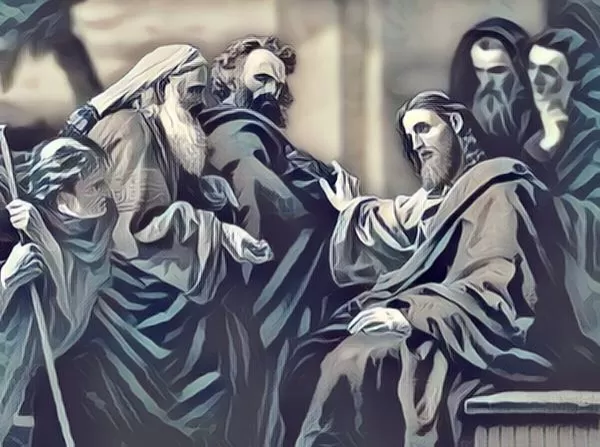
Given the importance that the Shema would acquire for Jewish religious practice in the rabbinic period and has had for christology among Pauline scholars in the last thirty years, it is remarkable that it is so rarely quoted or discussed, on its own terms, in the literature of second temple Judaism. In fact, the only Jews of the time who show any interest in it are Jesus and a certain scribe who came and asked him, “Which commandment is first of all?” (Mk. 12:28). Jesus answers the man by reciting the Shema. The first commandment is:
‘Hear, O Israel: The Lord our God, the Lord is one. And you shall love the Lord your God with all your heart and with all your soul and with all your mind and with all your strength.’ The second is this: ‘You shall love your neighbour as yourself.’ There is no other commandment greater than these. (12:29-31)
The scribe expresses his approval, somewhat paraphrases the Shema in turn, and adds a significant rider: the commands to love God and neighbour are “much more than all whole burnt offerings and sacrifices” (12:32-33). For that unexpected gloss he is commended: ‘when Jesus saw that he answered wisely, he said to him, “You are not far from the kingdom of God”’ (12:34).
Kim Huat Tan touches on the eschatological significance of this exchange but thinks that Jesus is really looking backwards rather than forwards:
When this is juxtaposed with Jesus’ announcement of the dawn of the eschaton, we can then infer that for Jesus the concept of Endzeit = Urzeit often operates…. The Endzeit recaptures and fulfils the intentions of the Urzeit. The key point is that the kingdom of God, i.e. the Endzeit recapturing the Urzeit and demonstrating that what endures through time is the fundamental belief and praxis of Israel, is summed up in the Shema and expressed through the loving of one’s neighbour. This is what it is meant when God is said to rule powerfully. Hence, Jesus’ ministry does not lead to an abandonment of Jewish fundamentals but it does call into question the use of the cult as a badge of identity. Loyalty to the essence of Torah is not the same as loyalty to the cult.1
It seems to me that this misses the critical prophetic import both of the scribe’s addition to the Shema and of Jesus’ comment about him being near to the kingdom of God.
First, the scribe adds prophecy to Torah, and in the prophets, the deprecation of temple sacrifices invariably bodes ill.
If the scribe has in mind Hosea’s “I desire steadfast love and not sacrifice, the knowledge of God rather than burnt offerings” (Hos. 6:6), then judgment looms: “Woe to them, for they have strayed from me! Destruction to them, for they have rebelled against me!” (7:13).
YHWH requires the violent oppressor in Israel “to do justice, and to love kindness, and to walk humbly with your God” (Mic. 6:8) rather than to bring sacrifices to absolve him of his sin—or he will “strike you with a grievous blow, making you desolate because of your sins” (6:13).
Secondly, Jesus’ teaching and actions in this final week have a disastrous outcome clearly in view. He has cursed the fruitless fig tree of Israel (Mk. 11:12-14, 20). He has denounced the temple system as corrupt, in language that must have been heard as prophetic of destruction (11:15-17). He has told a story about the uncooperative tenants of the vineyard of Israel, who will be destroyed (12:1-11). The dispute with the Sadducees over resurrection has a subversive edge to it (12:18-27). God is God of the living patriarchs, from whose company many in Israel will be excluded when judgment comes. Jesus is the Lord who will be made to sit at the right hand of God “until I put your enemies under your feet” (12:34). The hypocritical scribes “will receive the greater condemnation” (12:38-40). Finally, he predicts the catastrophe of the destruction of the temple (13:1-23).
This is the eschatological narrative that frames the conversation between Jesus and the scribe.
Jesus does not simply “call into question the use of the cult as a badge of identity.” The kingdom of God is not a reversion to an ideal, pre-temple state of innocence. When God “is said to rule powerfully,” a decisive future intervention is in prospect, when he will judge a rebellious people that substitutes “whole burnt offerings and sacrifices” for the love of the one God and of neighbour. The commandments endure for Israel not merely through time but through crisis. The scribe gets this and is applauded for it.
- 1
K. H. Tan, “The Shema and Early Christianity,” Tyndale Bulletin, 59.2 (2008), 188.
Recent comments