The prophetic church must offer a practical, historically rooted response to the crisis of modernity, embodying hope and imagination for the future. Unlike other church models—backward-looking traditionalism, inward-focused evangelicalism, or outward-reaching progressivism—the prophetic church moves forward, interpreting history in light of God’s ongoing purposes. It must engage deeply with scripture and contemporary reality, enacting symbolic and concrete practices that speak of past failures, present crises, and future hope. This church learns from diverse traditions, embraces marginal voices, and lives prophetically through art, space, justice, and vulnerability. Its role is not permanence but faithful presence through transition, disruption, and eventual renewal.
This is a half-baked response to someone who got in touch with some questions after reading Why the missional church must also be prophetic:
One thing I’ve noticed, not only in your writing but across much of the missional literature I read, is that the insights can often feel quite abstract or technical. They’re biblically and theologically grounded, but sometimes hard to translate into tangible action.
Two questions came to mind as I read: What are some concrete examples of how your missiological model is being/can be lived out today? And how might a small group of people longing to embody this vision begin in their own local context?
I’ll have another go at this, though it will fall short of a complete answer. Quite a lot of what I do directly relates to the practice of “missional” church—or what I will here call “prophetic” church for reasons which I hope will become clear. But I struggle to write in a way that merges theory and practice effectively, and there may be a good reason for that. It seems to me that churches and organisations often break out of their various traditions without really knowing why or whither they are supposed to be going.
So I want to say something like: what the missional or prophetic church does should be a concrete expression of the why and whither of its existence. Precisely that is the practical take-away.
Backwards, inwards, outwards, forwards
The church has collided with modernity—a complex, drawn-out train crash in slow motion; and it has reacted in four ways, has moved in four different directions, roughly speaking. This may be an inadequate schema, the boundaries are fuzzy, I may have overlooked something; but an imperfect, provisional framing is better than no framing.
1. The historic churches (Catholics and Orthodox; to a lesser extent Anglican and Reformed churches, naturally) represent continuity with the past and a movement backwards, a recoil, a retrospective. By all accounts, there is a lively interest in ancient spiritualities and traditional liturgies among post-evangelicals and Gen Z men, in particular. The old is the new new—disconcertingly for some of us who have been trying to keep up with the times.
2. Modern evangelical and charismatic churches have robust, reactionary models of vigorous faith, expressed in terms of doctrinal orthodoxy and personal experience and well-being at the expense of religious tradition and social relevance. This has been a move inwards for the sake of survival. I never know quite how to classify Pentecostalism. It probably best fits here, but with a stronger community focus.
3. Liberal and progressive churches have moved outwards, seeking a consensual engagement with modernity (and post-modernity), at the expense of doctrinal orthodoxy and perhaps of a credible Christian identity.
4. The “prophetic” church—the church as “eschatological community”—is oriented towards the future; it has endeavoured to move forwards. The term “prophetic” has been compromised by its association with the self-indulgent extremes of the charismatic movement, but biblically speaking “prophetic” and “apocalyptic” are precisely the categories of discourse by which the community of God’s people interpreted massive historical change. That’s where we are. It’s what we need. I take it that the “missional” church is instinctively or implicitly “prophetic” even if it doesn’t use that language.
The relationship of the prophetic church with the other three modalities is going to be difficult.
The prophetic church can affirm all that is good and deep in the historical churches, but it must resist the lure of nostalgia and the illusory securities of the past.
It can affirm the dynamism and appeal of the modern evangelical and charismatic churches, but it must remain forward-looking, vulnerable, risk-taking, frustrated by the biblical reductionism, the short-sightedness, the cultural complacency.
It can affirm the social conscience and intellectual candour of the liberal and progressive churches but cannot afford to lose touch with the transformative power of the God of history, to which both scripture and the Spirit bear witness.
Towards prophetic practice
Before we get to the prophetic function, we need to understand that the church is in the first place, and in general terms, a priestly people, mediating in diverse ways between the living God and the larger communities in which we are embedded, in history.
Since “history” always entails change, sometimes catastrophic change, part of the priestly function over time is the prophetic task: on the one hand, to give an account of the impact and significance of such change for the church or from the perspective of the church; on the other, to narrate unfolding future outcomes and ultimately to give hope.
It must, therefore, be a practical and determined part of the work of the church in “prophetic” mode today to write the collision with modernity into the whole story of the people of God and to “imagine” what comes next.
By “modernity” I mean the massive scientific, materialist, industrial, technological, corporatist, consumerist, progressivist enhancement of humanity that has taken place over the last two hundred years. It has forced a decisive break from the cultural conditions in which western Christendom emerged and flourished. It is having an impact on the global ecosystem that threatens to sever us from our assumed futures.
This has disenfranchised and disempowered the church. We have lost touch with our past, which was the rule of our Lord Jesus Christ over the nations, and we have a very uncertain future. The prophetic church embodies this powerlessness and anxiety and, therefore, must reconnect with a storyline that says that God remains constructively committed to his priestly, servant people whatever the circumstances.
This is where the practice of prophetic church begins. It is an act of the biblically-formed, Spirit-inspired imagination looking for concrete ways to express locally, in the first place, what it has come to discern and understand.
If the prophetic church is to be grounded in history, “biblically-formed” must be underpinned, to whatever extent is feasible, by a historical hermeneutic—something like the narrative-historical approach that I press for here. That means engaging with the historical Jesus and the historical mission of the apostles, not with the idealised, sentimentalised Jesus of much modern theologising, not with a Paul who has nothing more to proclaim to the world than an abbreviated gospel of personal salvation.
So prophetic churches should be learning communities that engage seriously with history at both ends of the story that is being told—the biblical front-end and the end-of-the-age that is upon us now.
Is the message clear?
The prophetic is evangelistic. Evangelism is the announcement, first to the people of God, then to the world, that God is doing something dramatic to rectify and exploit a crisis for his own glory, in the biblical idiom.
It is the announcement that he will bring his people back from exile and restore Jerusalem, to the amazement of the onlooking nations. It is the announcement that he will judge his rebellious people but bring out of the destruction something new, to the amazement of the onlooking gentiles. It is the announcement that he will annex the nations of the Greek-Roman world for the rule of his Son—and to the amazement and discomfort of Israel, many gentiles believe and become part of the eschatological community.
I suggest, therefore, that the messaging of the prophetic church today should begin with a similarly bold and far-reaching announcement about the action of God at a time of crisis both for the church and for the world. Personal salvation follows as a response to that good news. What does it mean for me—as a believer, as a non-believer?
This is still all too abstract and theoretical, of course, but we need to be able to define and justify and interpret the distinctive and perhaps quite novel behaviours of the prophetic church.
Formal worship in one of the old cathedrals of Europe carries a clear message: you have entered that ancient stream of religious life that sustained western Christendom for fifteen hundred years or more; find refuge here from the shallow, soulless materialism of modernity.
The business of successful, contemporary Protestant churches carries a clear message: the powerful corporate experience of worship, etc., sustains your personal relationship with God in the context of family, work, and friendships.
When progressive Christians protest against slavery or in support of Palestinians, the message is clear: the church must recover a credible moral conscience.
We do things that carry a message, and if the message is unclear, behaviour becomes messy, misleading, meaningless. Or worse, it says loudly to the world, “We don’t know what we’re doing.”
Past, present, and future
In the Bible the prophetic message is always a story about past, present, and future, so behaviours could be categorised in the same terms.
In Luke’s Gospel we see Jesus almost programmatically restoring the sick and lost to Abraham—Lazarus, the woman with the disabling spirit, Zacchaeus, the prodigal son.
He told stories which connected the current crisis with a long history of religious and social dereliction. The parable of the tenants of the vineyard, which is only a retelling of Isaiah’s parable of the vineyard, is an obvious example. Speaking in parables so that Israel would not understand was itself a prophetic action.
The intimate association with tax collectors and sinners, so offensive the elites, was a clear sign that God was renewing his people not from the centre but from the disreputable margins.
Much of Jesus’ prophetic practice was a fierce and dangerous confrontation with those ruling over Israel. Take note.
Jesus’ action in the temple was an enactment of the devastating judgment that would come upon a corrupt religious and political system within a generation.
Baptism was, among other things, a prophetic action that signalled the willingness of the early church to imitate Christ in his suffering and death.
Paul called believers to a pattern of ethical behaviour, undistorted by idolatry (cf. Rom. 1:18-32), that would become the norm in the age to come.
The problematic association of Jews and gentiles in the churches was a sign that the God worshipped exclusively by Israel for so long would sooner or later be worshipped by the nations.
In each case, we can see how the action, which may be realistic or symbolic, is interpreted in a way that explains the present crisis—the failure of historic vocation, the disappointment, the outcry, the disruption, the novelty, the suffering, the the renewal of life, and the future hope.
Acting out…
So would it help to think of the practices of the prophetic church as a similar embodiment of past, present, and future?
Imitation of the life of the primitive New Testament church is more meaningful now, at the turn of the ages, at the nadir of the curve, than it has been for two thousand years. There is some point to the call back to origins.
The prophetic church may do things that acknowledge—perhaps with some ambivalence, with shame, with regret—that it belongs to the long troubled history of Christianity in Europe and globally.
The prophetic church may associate with and learn from heterodox and dissenting movements—the anabaptists, for example.
The prophetic church should get beyond the historic, infant-adult controversy and make baptism a sign of costly engagement in the story of what God is doing in history.
The prophetic church, at least in my context, needs to resist the privatisation of faith and find new ways to exist in the world.
The prophetic imagination may be explored and expressed through the arts, but also through the use of space, the repurposing of buildings, the development of income streams, friendship with unrighteous mammon, collaborative projects.
Perhaps an interpreting community should be built around action rather than action added to community as an afterthought
But even just prioritising local community life over programming and institutional structures signals a way forward for the church in its collision with modernity.
The diversification of activities will bring new skill sets into consideration. I understand why the missional church movement worked hard to reinstate the apostolic role, but prophetic churches may find that the ascended Christ is gifting them with competencies that don’t easily fit the APEST categorisation.
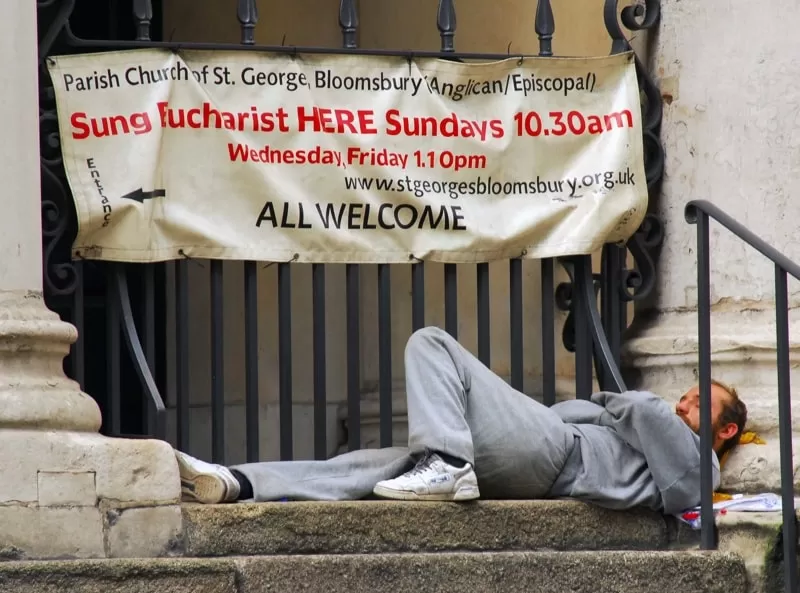
There is a “justice” part to this, but the prophetic church must act and speak on behalf of the living God, in recognisable continuity with the prophetic voice in scripture. If prophetic churches are open to the presence of the homeless, the poor, the oppressed, the mentally ill, the neuro-divergent, the deviants, and so on, there is a story to be told that speaks of the past, present, and future of God’s people in a changing world. This is not just a matter of social justice or humanitarian concern; it has to be explained otherwise.
Living alongside helplessness, pain, displacement, homelessness, trauma, the prophetic church learns to resist narcissism, distraction, entitlement, consumption, becomes an implicit benchmark for judgment, is prepared for whatever greater challenges are to come.
Because the form of the ancient world was passing away, Paul recommended that people in the churches stay in their lane: “let each person lead the life that the Lord has assigned to him, and to which God has called him. This is my rule in all the churches” (1 Cor. 7:17). In his view, it was the best way to deal with the disruption and “distress” that believers in Jesus would face until finally he was confessed as Lord by the nations.
The prophetic church also needs to learn, on behalf of the whole church, the sort of community practices and habits of mind that will sustain it as the form of our own world passes away.
In many ways, the prophetic church is likely to be a fragmented and volatile phenomenon. Small communities will come and go. But the voice needs to be sustainable and resilient, however it is embodied, until a new, settled order appears, and history teaches us that that could take decades, if not centuries.
Recent comments