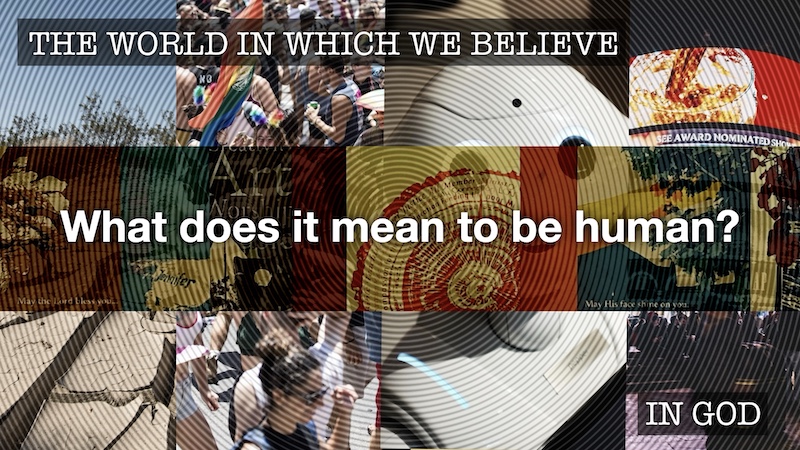
For most of us, subjectively, the everyday experience of being human probably hasn’t changed very much, but we may be aware of a storm of questions blowing furiously outside the house, rattling the windows and loosening tiles. What does it mean to be male and female? What is a “normal” state of mental health? Are ethnicity and nationality essential to our humanity? Are we anything more than compliant consumers of goods and services? Is AI making the human mind redundant? And as we enter the Anthropocene, are we—paradoxically—losing control of our destiny?

To be human is not just to be one thing. It is to be part of a story with a past, a present, and an imagined future.

Read more...
In my view, the missional-incarnational movement needs to engage constructively with the sort of narrative-historical reading of the New Testament that is emerging from biblical studies. And vice versa. I think that both mission and New Testament studies would be served by the dialogue. For example… ()
As you will be aware if you are not a complete stranger to this blog, I strongly hold to the view that a narrative-historical hermeneutic, informed by good work being done in New Testament Studies, gives us a much better understanding of the New Testament than the theologically driven methods of… ( | 20 comments)
The church is always, everywhere a sign of new creation. I would venture to say that it is not in any respect the real thing—nothing has fundamentally changed, there is no mystical “regeneration”, we remain fallen humans through and through, dependent on grace. But when we talk… ( | 2 comments)
I am preparing some talks on Acts for a church-planting conference in a couple of weeks. What I want to say, roughly, is 1) that the apostles went about their mission with a powerful historical—or apocalyptic—narrative in mind; 2) that the churches they planted were not just churches, they… ( | 1 comment)
Paul reminds the perhaps predominantly Gentile believers in Corinth of the gospel which he had originally preached to them. This gospel he had received from others: “that Christ died for our sins in accordance with the Scriptures, that he was buried, that he was raised on the third day in… ( | 12 comments)
Psalm 137 begins as a lament. The exiles in Babylon weep when they remember Jerusalem. They cannot sing the songs of Zion in a foreign land. The psalm ends, however, with a plea to YHWH that he will punish the Edomites for their complicity in the destruction of Jerusalem, and a chilling “beatitude… ( | 15 comments)
I started writing a little piece on narrative-historical commentaries and how to get by without them and I was going to use the account of Jesus’ action in the temple to illustrate it, but it got too long. So here’s the part on Mark 11:15-19 and parallels. The rest will follow. The day after his… ( | 4 comments)