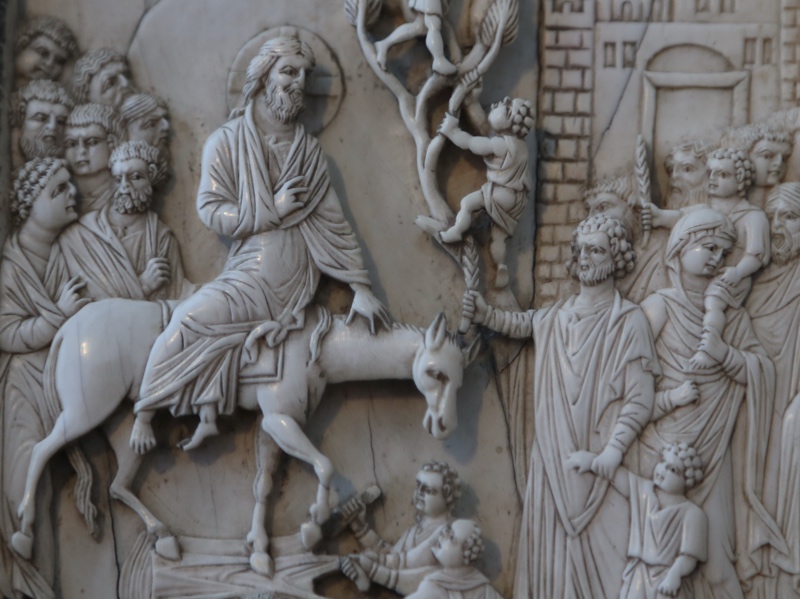
In his rather short third post on the kingdom of God, Joel Green begins by asking what we can learn about God’s royal rule by examining how the expression is used in the Gospels. He summarises the various contexts: the kingdom of God is entered, proclaimed, possessed, has drawn near, etc. Then he makes the important point that, contrary to much contemporary talk, the kingdom of God does not depend on what people do. “Humans do not create, build, construct, extend, or make present the kingdom. The kingdom is God’s” (emphasis removed).

The conceptual priority given to entrance into the kingdom of God suggests that it must be understood as a “container” or “place,” which makes little sense if the kingdom is “all-pervasive and eternal.” So better to think of it as a sphere or field of divine influence or activity.

Read more...
On The Gospel Coalition site Phil Thompson asks what Paul means when he says, “Now I rejoice in my sufferings for your sake, and in my flesh I am filling up what is lacking in Christ’s afflictions for the sake of his body, that is, the church” (Col. 1:24). How could anything be lacking in Christ’s… ( | 6 comments)
Andrew Bunt provides a quick and lucid overview of the argument of Oren Martin’s book Bound for the Promised Land: The land promise in God’s redemptive plan (2015). I have not read the book. Martin thinks—assuming that Bunt has understood him correctly—that the land of Canaan was ()
I have been reading Eric Mason’s book Woke Church: An Urgent Call for Christians in America to Confront Racism and Injustice. It’s not the book I was expecting it to be. It’s an honest, heartfelt attempt, written from within the black community, to connect modern imperatives of racial… ( | 5 comments)
Following on from the discussion of whether Paul includes Jesus in the divine identity in 1 Corinthians 8:6, let’s consider the claim that Paul identifies Jesus with YHWH when he says, “Shall we provoke the Lord to jealousy (parazēloumen)? Are we stronger than he?” (1 Cor. 10:22). ( | 5 comments)
A lot of scholars think that Paul includes Jesus in the “divine identity” when he says that “for us there is one God, the Father… and one Lord, Jesus Christ…” (1 Cor. 8:6). Richard Bauckham, for example, notes that it is now “commonly recognized” that Paul has generated here a Christianized version… ( | 17 comments)
Matthew Hartke describes himself on Twitter as a “Post-Christian Bible nerd endlessly fascinated with the historical Jesus and the origins of Christianity.” I had a bit of a debate with him a few years back in an Unbelievable podcast about whether Jesus was a failed apocalyptic prophet. I have some… ()
Here are three missional challenges that the modern evangelical church needs urgently to get to grips with: 1) resist the extreme individualism and narcissism of western culture; 2) tell a compelling, up-to-date-and-beyond story about the living God, the communities that serve him in the name of… ( | 4 comments)