The author critiques Jason Staples’ claim that Paul’s overarching aim is the restoration of “all Israel,” including lost northern tribes assimilated among gentiles. Focusing on Romans 1:18–32, the author argues that Paul targets Greek idolatry and moral disorder, not Israel itself. While Staples reads the passage as covertly indicting Israel, the author contends this misreads Paul’s use of Jewish polemic, overlooks key distinctions between covenantal Israel and pagan nations, and weakens Paul’s eschatological narrative. Paul addresses Jews and gentiles as known groups, not lost Israelites hidden among Greeks.
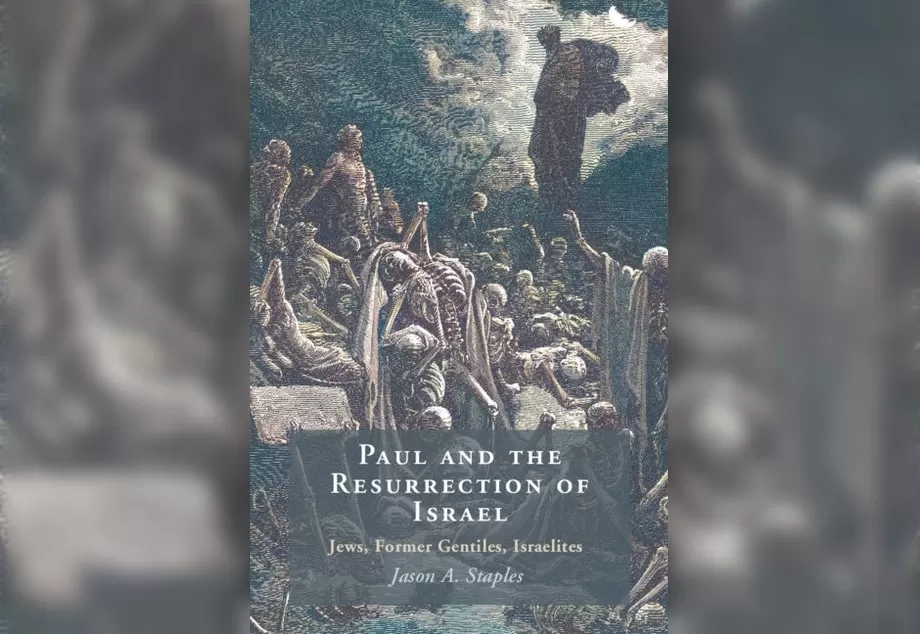
There is much to like about and much to learn from Jason Staples’ book Paul and the Resurrection of Israel: Jews, Former Gentiles, Israelites, but I have serious doubts about the central thesis, which is that Paul’s overarching goal is the regathering and restoration of all Israel, including the tribes of the northern kingdom lost among the nations:
Paul argues that the incorporation of gentiles into the eschatological assembly is the necessary means for the reconstitution and restoration of “all Israel,” an entity not only including Jews but also non-Jewish Israelites restored from the nations among which northern Israel had assimilated. (45)
An immediate obstacle to the thesis would seem to be presented by Paul’s discussion of idolatry and its consequences in Romans 1:18-32.
Traditionally, this passage has been understood as a critique of the impiety, sexual depravity, and social disorder of all non-Jewish humanity, followed in chapters 2-3 by a corresponding condemnation of the Jews.
Staples recognises that “gentiles” are in view in some capacity but thinks that Paul’s real target is Israel. I’m not sure this is strictly necessary for his thesis, but downplaying the polemic against Greek religion and ethics helps him to keep the focus on the future restoration of all Israel. I’ll outline his arguments and give my reasons for disagreeing with him. The page numbers are from the Kindle edition and may be inaccurate.
Gentiles don’t know God
The group condemned in Romans 1:18-32 is said formerly to have known God and then to have rebelled against him: “although they knew God, they did not honour him as God or give thanks to him” (21). Staples thinks that this cannot apply to gentiles: “Since when has the knowledge of God been revealed among the pagans? Is not the knowledge of God granted through the Torah the very thing that has set Israel apart?” (250).
- Paul’s argument, first, is that since the creation of the world, the understanding has been available to all people, from the created order, that true divinity is invisible and transcendent. It cannot be accessed through manufactured images. Staples is right to stress the universal scope of the statement in verse 18.
- It is not knowledge of God simply that is at issue but knowledge of the invisibility of God. That is a critical distinction, which I don’t think Staples makes.
- But Paul’s argument in what follows is directed not against humanity in general but against “the Greek” (1:16; 2:9). What we have here is a specific instance of how the wrath of God is revealed against the “impiety and unrighteousness of people who possess the truth in unrighteousness” (1:18*). The wrath of God against this particular civilisation is made evident in the fact that he has given them over to the extreme sexual and social consequences of the original religious error. The behaviour of the Greeks—as observed empirically by the Jews from the moral high ground of the synagogues—is a concrete sign that the creator God has given up on them and has consigned them to an eventual judgment “by a man whom he has appointed” (Acts 17:29-31; cf. Rom. 2:16).
- True, the Greek is not named in 1:18-32, but the civilisational frame is naturally carried over from 1:16 (“to the Jew first and also to the Greek”) and is picked up again in 2:6-11. The Greeks in Paul’s field of mission in the eastern Mediterranean possessed the philosophical truth that God is transcendent (Plato, Aristotle, et al.) but the insight was lost in the religious and ethical confusion that stemmed from the error of idolatry.
- The prominent position given to homosexual sexual behaviour in the analysis strongly points to a focus on Greek culture.
- In the Jewish literature of the period, Greece and the Greeks are commonly referenced as the religious, political, and cultural context with which Judaism struggles to co-exist. For example, Zechariah expects YHWH to raise up the sons of Zion “against the children of the Greeks” (Zech. 9:13 LXX); Antiochus Epiphanes exhorts the seven devout Jewish brothers: “Enjoy your youth by embracing a Greek way of life and changing your mode of living” (4 Macc. 8:8). There is no reason to think that Paul does not have this same real and adverse environment in mind.
- Staples notes that in Wisdom 13:1 gentile idolaters are said to be “empty by nature,” “ignorant of God,” and “unable to know the one who is” (249). So Paul must be talking about someone else. There is some force to this, but the writer nevertheless concedes that these people may have been “seeking God and wishing to find him” (13:6): “For being conversant with his works, they make their search and are persuaded by the sight, because the things that are seen are beautiful” (13:7). This is not so far from Paul’s line of thought in Romans 1:20-21 and rather close to the argument of Luke’s Paul in Athens that the nations were made in the expectation that they would “seek God, and perhaps feel their way toward him and find him” (Acts 17:26-27).
- Besides, it is not the case that the Greeks were never credited with an ancient knowledge of the true nature of God. We see in the following passage from Sibylline Oracles 3 that, at a civilisational turning point—fifteen hundred years earlier, to be exact—the Greeks in error abandoned the face of the great God, began to worship the idols of dead gods, taught their children to “think vain things,” and so became liable to the eventual wrath of God. The parallels with Paul’s argument are extensive.
Greece, why do you rely on mortal leaders who are not able to flee the end of death? To what purpose do you give vain gifts to the dead and sacrifice to idols? Who put error in your heart that you should abandon the face of the great God and do these things? Revere the name of the one who has begotten all, and do not forget it. It is a thousand years and five hundred more since the overbearing kings of the Greeks reigned, who began the first evils for mortals, setting up many idols of dead gods. On account of them you have been taught vain thinking. But when the wrath of the great God comes upon you, then indeed you will recognize the face of the great God. (Sib. Or. 3:545-557)
- Why is it so hard to accept that Paul says “the Greek” because he means “the Greek”?
- Conversely, it is never a criticism of Israel that it abandoned an intuition of the transcendence of God for the worship of idols. What Israel forsakes is the covenant relationship with the God who revealed himself in a burning bush to Moses, who brought the descendants of Abraham out of Egypt, and who gave them Torah. Israel’s knowledge of God is grounded in its vocation, not in philosophical reflection on the relation between divinity and things made.
They exchanged their glory for the likeness…
It has often been noted that Paul’s language at a number of points in this passage echoes Old Testament texts that condemn Israel’s idolatry. For example:
And they exchanged (ēllaxanto) their glory for the likeness (homoiōma) of a grass-eating ox. (Ps. 105:20 LXX)
And they exchanged (ēllaxan) the glory of the immortal God for the likeness (homoiōma) of an image of mortal humanity and of birds and quadrupeds and creeping things. (Rom. 1:23)
So Staples concludes that “Paul remarkably puts Israel itself forward as the chief illustration of impiety” (254).
- The first point to make is that Psalm 105 LXX perfectly illustrates the covenantal framework of Israel’s rebellion: “And they exchanged their glory for a likeness of a bull calf that eats grass. They forgot the God who was saving them, who did great things in Egypt” (105:20-21 LXX).
- The argument with respect to the Jews is not that Israel knew the God revealed in nature but chose instead to worship idols. It is invariably that Israel had Torah but failed to keep the commandments—for example, by worshipping foreign gods. Staples quotes Philo’s disapproval of Jews who disregard the sacred laws and pursue “polytheistic opinions” (Rewards 162) (252). But the thought here is not that these Jews began with a natural perception of the transcendence of God; it is that they were schooled in Torah “from their earliest life.”
- Paul does not accuse the Jews of idolatry in chapter 2; he says that they abhor idols but rob temples (2:22). That’s a massive problem for Staples. Nor does he charge them with engaging in the sort of unnatural sexual practices described at length in 1:26-27—and significantly, neither does any other Jew of the period, to the best of my knowledge. Staples admits as much, but then obfuscates some crucial distinctions by making this somehow a general assessment of the human condition:
The point is not that the actual or implied addressees of the letter actively worship creepy-crawly images or engage in sexual immorality but rather that scripture testifies that all humanity—Israel foremost of all—has engaged in impiety and injustice and is therefore subject to God’s wrath. Contemporary Jews may not be actively worshiping idols but are still subject to the circumstances resulting from Israel’s historical impiety and idolatry, still awaiting the renewal of God’s covenantal favor, as it is written, “Our ancestors sinned and are no more, and we bear their misdeeds” (Lam 5:7). (266-67)
- If Paul has used Israel’s idolatry as a template for the Greeks’ exchange of the “glory of the immortal God for the likeness of an image” of mortal creatures, it remains a statement about the Greeks, not about Israel. Jeremiah 2:11 LXX shows that the language is readily transferred to the gentiles: “Will nations change (allaxontai) their gods? And these are no gods. But my people have changed (ēllaxato) their glory for one from which they will not profit.”
- Further attempts to underpin the application of the argument to Israel are flimsy, to say the least. For example, the “knowledge” that should have been preserved by the priests is knowledge of the commandments not of the transcendence of the invisible God (Mal. 2:7); and failing to “give glory” to the name of God (2:2) is not the same as failing to acknowledge the glory of the creator revealed in creation (256).
- Paul says that the Greeks “became futile” (emataiōthēsan) in their thinking (Rom. 1:21). Staples observes that this precise form is found in the Septuagint only with reference to Israel (2 Kgs. 17:15; Jer. 2:5). But this tells us very little. The language of “futility” is widely used with reference to pagan worship (e.g. Wis. 13:1; 15:8; Sir. 34:5). It may be used of apostate Israel because in the first place it applies to the religious life of idol-worshipping peoples.
The just statute of the Law
The people who are the object of Paul’s polemic in this passage are said to have known the “just statute” (dikaiōma) of God that “those who do such things are worthy of death” (1:32). This must be a reference to Torah, which alone makes idolatry and homosexual acts capital offences, so Paul must really be thinking about Israel rather than humanity generally.
- The Greeks know the decrees of God because the Jews have made them known. The synagogues were witnesses to a contrary religiosity: worship of the creator, abhorrence of homosexual acts, right deeds according to the Law. The Jews knew the will of God because they were instructed in the Law; so they were (supposedly) guides to the blind, a light to those in darkness, instructors of the foolish (2:17-20). This would have been public knowledge; therefore the Greeks could be said to have known the seriousness of the offences.
- No? Why not?
- The Greeks, Paul concludes, not only do all these reprehensible things, they “give approval to those who practise them” (1:32). Staples thinks that this “hearkens back to strong prophetic condemnations of the wicked in Israel who not only commit injustice but also suppress the truth they were appointed to deliver and teach others to do evil” (259). But in the next verse it is the person who does not approve but judges others who is censured (2:1). Here, I think, Paul quite clearly turns to address some hypothetical Jew who presumes to condemn Greek behaviour as observed in the cities of the eastern Mediterranean while himself falling a long way short of the glory of God. The person who approves of the sins of idolaters cannot be the person who judges idolaters.
- And how are Jews of the diaspora supposed to differentiate between the idolatrous Greek who is a Greek and the idolatrous Greek who is a lost Israelite? If they are indistinguishable, the whole argument becomes otiose.
So where does that leave us?
In Staples’ view, Romans 1:18-32 is ostensibly a piece of classic Jewish invective against sinful non-Jews but rhetorically serves the purpose of implicating the Jews in the fundamental corruption of humanity. “The form is therefore that of a traditional Jewish polemic against gentiles, but the voice is that of Jacob’s infidelity.”
There is, however, no substantive reason to include Israel in the indictment, and I rather think that the linguistic echoes are accidental, not of any great rhetorical significance.
The argument that Paul collapses the “distinction between Israel and the nations with respect to sin” curtails his eschatological narrative. The culmination will be wrath against the Greek and the establishment of the rule of a crucified Jewish messiah over the nations of Greek-Roman oikoumenē (cf. Rom. 15:12). But first God must judge his own people as a demonstration of his rightness.
I take the view, for now, that Paul is concerned only with the Jews as a currently existing people group, in the land and in the diaspora. He makes no programmatic or eschatological distinction between the Jews and the lost northern kingdom. I don’t expect Staples to persuade me otherwise, but you never know….
Andrew, thanks for researching this and putting this together… more grist for the mill. A response from Jason Staples on this would be interesting.
Thank you, Andrew. This is intriguing and quite above my head.
I do wonder whether there is anything to be made of Paul’s language of “the Jew” — which, at least etymologically, seems to refer to present day Judeans (in the land and in the diaspora) of orthodox Israelitish religion — in chapter 1 in contradistinction to the seemingly broader category “all Israel” of Romans 11.
I recall that NT Wright thought it significant that OT prophecy of restoration of Israel/return from exile was regarded in 2nd Temple period to be a problem in the eyes of covenant-faithful Judeans. I intuit that Staples is digging in the same general direction.
Hi Andrew, so would you align more with Richard hays and echoes of scripture in what Paul is doing with Gentiles rather than what staples proposes?
I do wonder why paul would use such new covenant language about restoration and the Northern Kingdom, the spirit, new heart etc which are only promised to isreal but apply it all to Gentiles…
Recent comments