The piece critiques contemporary church responses to Christmas, politics, and immigration. It argues that Archbishop-designate Sarah Mullally’s appeal to Jesus as refugee and servant is clichéd and theologically thin, ignoring the fuller, often offensive, New Testament narrative. The author contrasts this with Lord Glasman’s historically grounded argument that England’s “civic peace” arose from Christian renunciation of violence, though rejecting his call to restore Christendom. While dismissing nostalgic civilisational renewal, the author values Glasman’s narrative framing. The essay concludes that neither platitudes nor restoration suffice; instead, the church needs a renewed prophetic vision shaped by historical wreckage and oriented toward a different future.
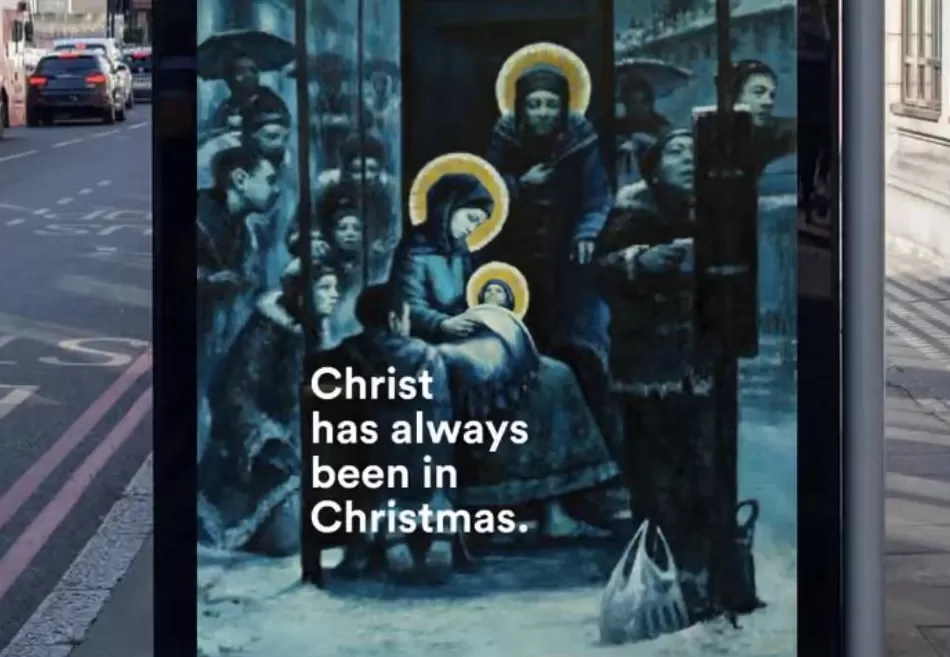
The debate about Christmas and politics goes on. Reflecting on Tommy Robinson’s campaign to “put Christ back into Christmas,” soon-to-be Archbishop of Canterbury, Sarah Mullally, is quoted in an interview. She says that the use of Christian symbols to oppress—in this case the migrant and refugee—and to cause offence is “absolutely wrong.”
This should not happen. If you look at the symbols Jesus used, it’s foot-washing, sitting alongside the outcast and the stranger. He was a refugee at birth, born in a place because of the generosity and hospitality of others.
Two things bother me about this.
First, it feels like a rather glib and clichéd response to what is the product or symptom of some massively complex destabilising forces. Apart from the belated and condescending acknowledgment that native communities are finding it difficult to adapt, the church seems stuck in a moral rut. It’s not, on the face of it, a bad moral rut, but it’s a rut.
Secondly, Mullally’s appeal to the symbols Jesus used doesn’t tell even half the New Testament story. The circumstances of the nativity were difficult but only because Joseph saw fit to have the family registered in the city of David. The family fled to Egypt, but they were not “refugees,” they were not “asylum seekers,” they were not there for very long. Jesus sat alongside Israel’s outcasts and was reluctant to allow strangers to eat the crumbs that fell from the table. Foot-washing was an intra-communal action.
And of course, the symbols Jesus used caused great offence: eating with the lost sheep of the house of Israel; taking a whip to the merchants and money-changers in the temple; telling vivid parables of crisis and judgment; cursing a fruitless fig tree; identifying himself with Daniel’s suffering “son of man” figure; and more.
We find a much better sense of narrative context in a comment piece by the British Labour peer Lord Glasman, who is an Orthodox Jew. His argument is that Jews in this country have benefited from a “civic peace” which has been a “civilisational achievement led and shaped by the English church over a millennium.”
Whereas for Israel “Violence is now the mode of coexistence between its peoples,” in England the “church door was the gate of asylum from the mob.”
Glasman does not believe that Jesus was the messiah—he does not expect any sort of apocalyptic solution to the world’s problems. But he does believe that we have a political inheritance that has the “renunciation of civic violence” at its heart, and that this is what is meant by “The Kingdom.” Therefore, he can say, as an Orthodox Jew, that “in politics, Christ is King, that in honouring God we honour his creation, incarnated.”
It’s a much better definition of the kingdom of God than we find in much of what passes for Christian theology.
He then goes on to complain that the Church of England has lost its voice, that it has become a “ghost, haunting its own churches” (very nice!), that it has renounced its vocation, that it has become estranged from its own people—and that this has been a major reason for the current social disorder and instability.
Therefore, in Glasman’s view, “the restoration of the body of Christ into the body politic of our nation is a vital aspect of our revival.”
I don’t agree with that. I don’t think that the mission of the church in the West is the renewal of a bygone civilisation. At least, I don’t think it’s going to happen.
The Jews hoped for the restoration of a glorious Davidic nationhood after the return from exile, and what ensued was five hundred inglorious years of political-religious chaos, culminating in the destruction of Jerusalem and the temple by Rome.
But Glasman has at least framed the problem in a narrative-historical fashion.
The “civilisational achievement” that he celebrates had its origins in the apocalyptic conviction of the followers of Jesus that this crucified messiah would judge and rule over the nations of the Greek-Roman world in righteousness. Out of the catastrophic failure of the post-exilic order—condemned with such symbolic violence by Jesus in the temple—emerged something radically new.
And now that something new has disintegrated, and the church has been driven into a voiceless exile.
So what comes next? What is needed is not well-intentioned but short-sighted platitudes. What is needed is the renewal of a prophetic vision that must always draw on the past but must imagine a very different future. That will be because of the wreckage, not despite the wreckage.
Happy Christmas!
You are right to fault the easy sentimentalism that reduces Christmas to a generic ethic of niceness. The infancy narratives are not Hallmark cards; they announce the advent of a king in a time of danger. Still, to oppose sentimentalism is not to collapse the Gospel into a narrow, intra-Israel polemic that licenses indifference to today’s migration convulsions or that treats hospitality as a merely optional, intra-communal courtesy. We can and should make three claims at once: first, Scripture discloses a universal horizon for charity even as it unfolds within a concrete, Jewish narrative; second, the Church’s authoritative reception of that Scripture binds Christians to the works of mercy while refusing open-ended political utopias; third, the political common good requires borders, hierarchy of loves, and prudent limits, and none of that is a betrayal of the Gospel.
Begin with the Christmas texts. Yes, Matthew and Luke are about royalty and peril: Davidic sonship, Herodian paranoia, the homage of the nations prefigured by the Magi, and a flight that is brief and purposeful. But royalty in Israel is never morally inert. The king represents God’s rule that “judges the poor with justice” and “defends the cause of the needy.” The angelic euangelion in Luke does not negate love; it situates love under the advent of judgement and peace. To say “Christmas is about kingdom” as if love were absent is to force a dichotomy foreign to the canon; the King who comes is the Shepherd whose reign is recognized by the care of the weak. The traditional liturgy’s orations during Christmastide hold both truths together without embarrassment.
The Johannine correction you propose misfires for similar reasons. John certainly centers the mutual love of Father and Son and its diffusion among the disciples. But it is precisely that love which is given “for the life of the world.” John’s universal claims are not decorative: the Baptist points to the Lamb who takes away the sin of the world; the Shepherd has “other sheep” not of this fold; Jesus says he will draw “all” to himself; the High-Priestly Prayer is for those who will believe through the apostolic word; and the First Epistle speaks of propitiation “for the whole world.” That the Church’s mission of love does not begin as a generic humanitarian program does not mean it has no public, outward face. The Church’s caritas is theological and ecclesial in origin; it is not, therefore, less binding or less expansive.
Reducing Jesus’ ethics to intra-Jewish relations also under-reads the Synoptics. The command to love the neighbor, retrieved from Leviticus, is universalized by Jesus’ own exegesis. The Samaritan becomes the exemplar of neighbor-love precisely because he stands across boundary lines; he is not a device to educate Israel alone but a moral judgement on the perennial temptation to restrict mercy to one’s in-group. Jesus’ encounters with Gentiles—the centurion, the Canaanite woman, the Gerasene region—are admittedly few and qualified within his stated priority to Israel, but they are not the rhetorical afterthoughts of a teacher guarding ethnoreligious exclusivity. They are the first cracks through which the apostolic mission explodes in Acts, and Catholic tradition reads them that way with reason. The Great Commission’s scope is not a late invention of post-Easter ecclesial fantasy; it is already seeded in the Gospel’s rhythm of particularity opening toward universality.
On Matthew 25, your restrictive reading—identifying “the least of these my brothers” solely with itinerant missionaries—describes a plausible scholarly option. But two points must be kept in view. First, even on that reading the judgement of the nations turns on the treatment of visibly vulnerable Christians wandering among them; the act being judged is a civic work of hospitality, not a disembodied affection. Second, the Church’s authoritative reception of this text, enshrined in the corporal works of mercy and the Catechism’s teaching on almsgiving and hospitality, does not mistake the Lord’s intention when it envisages Christ encountered in the hungry, the naked, and the stranger. Development here is not distortion; it is the ordinary maturation of doctrine under worship and practice. One may debate the exegetical center of gravity without evading the ascetical and social obligations the Lord has placed on his people.
Turn now to the Old Testament sojourner. You are right that the gēr was not a modern immigrant vested with a full catalogue of egalitarian rights. He occupied a liminal status, protected in justice yet bounded by Israel’s cultic identity, often economically precarious, sometimes only temporarily present. Precisely for that reason, the legal protections are striking: one law for native and sojourner in matters of justice; the sabbath extended beyond Israelite households to the stranger within the gates; tithes for the gēr alongside widow and orphan; access to cities of refuge; and repeated commands to love the sojourner “for you were sojourners in Egypt.” That the sojourner paradigm “cuts both ways” is not an argument for closing the modern ear; it is a reminder that biblical hospitality is not the denial of borders and identities but a disciplined virtue exercised by a people conscious of its own debts to providence. A Catholic need not mythologize Israel’s political order to learn the habit that the Torah enjoins: justice for the stranger because God’s people themselves live by mercy.
At this point the traditional distinctions of Catholic moral theology become decisive. There is the order of charity, by which love radiates out from God to those most closely entrusted to us—family first, then fellow citizens, then more distant neighbors—without collapsing the claims of the farther for the nearer. There is the virtue of piety as a species of justice, which binds us in gratitude to parents and patria and forbids us to disassemble the cultural conditions that sustained the faith we profess. There is the difference between the Church’s works of mercy, which are addressed to all according to need, and the state’s duties, which are addressed to the political common good—public order, civic peace, the protection of the weak from predation, the maintenance of a shared moral and legal framework, and the integrity of institutions tasked with assimilation. There is, finally, the state’s right and duty to regulate migration for the common good and the reciprocal duty of migrants to respect the laws and ethos of the community they seek to enter. These are not concessions to “nationalism.” They are the plain lines of Catholic doctrine.
From those lines an immigration-critical platform follows that is neither sentimental nor cruel. A nation has the right to a border that functions and the duty to enforce it without instrumentalizing the innocent. It has the right to set numerical limits, to prefer those likeliest to integrate, to prioritize the persecuted, to refuse entry to those who reject constitutional order or seek to import hostile political-religious projects, and to remove, swiftly and justly, those with no legal claim to remain. It has the duty to keep families together where possible, to provide humane conditions when detention is necessary, to process claims promptly so that mercy and justice are not stretched on bureaucratic racks, and to target trafficking and criminal exploitation rather than rewarding it with de facto amnesty. None of this nullifies the Christian’s personal duty to clothe, feed, and shelter those whom proximity places in his care; none of it forbids the parish or diocese from generous local hospitality. It simply refuses to baptize a political program of demographic transformation under a thin coat of biblical proof-texts.
You are also right to push back against a Churchly rhetoric that seems blind to the social fracture native communities endure. Charity that refuses to see the neighbor who already dwells beside me is not charity but ideology. Catholic social doctrine imposes on rulers a preferential concern for those already entrusted to them—the poor at home, families under economic strain, neighborhoods frayed by disorder, the elderly priced out of life, children whose horizons are shrinking. It is neither xenophobia nor hardness of heart to ask how mass migration, especially when rapid and culturally dissonant, affects civic trust, religious liberty, wage floors for the least skilled, schooling, crime, and the possibility of genuine assimilation. Indeed, to neglect those questions is to fail in the very virtue of prudence that must guide statesmen.
None of this requires us to deny the sacrificial logic at the heart of the Cross or to privatize it into a sectarian ethic. But the Cross is not a slogan to hang on any movement, whether the activist who wishes to dissolve borders in the name of compassion or the polemicist who wraps the Gospel in a flag. The passion was offered first “for the many” within Israel’s story; Catholic orthodoxy also confesses, with the evangelists and Paul, that the same oblation reconciling Jew has the world as its horizon. From that mystery the Church’s caritas springs; from that same mystery the Church learns to resist using persons as means—migrants included. Thus the refusal of family separation as deterrence, the insistence on the works of mercy, and the demand for order at the border belong together within a single moral vision.
The practical question is whether the Christian commonwealths of the West can recover the courage to live that integrated vision. A Catholic answer is not to resurrect a confessional state by fiat, nor to outsource the Gospel to a humanitarian bureaucracy, nor to concede one’s nation to a permanent revolution in the name of universal love. It is to rebuild, locally and nationally, the cultural Leitkultur in which the faith can be confessed and transmitted; to expect from newcomers genuine assimilation to that order of life; to calibrate admissions to what can actually be integrated without rupture; to privilege rescue over relocation when that better serves both migrants and host communities; to relieve pressure on flows by strengthening neighboring safe havens and regional processing; and to equip the Church’s own institutions to shoulder more of the concrete burden of mercy so that a politics of spectacle does not dictate the meanings of Christmas.
If we put Christ back into Christmas in this way, we will not be trading compassion for cynicism or kingdom for kindness. We will be returning to the Catholic grammar that has always joined the royal advent to works of mercy, and both to the stewardship of a people’s common good. The Holy Family’s flight does not write our statutes, but it judges every regime that toys with the vulnerable. The Magi do not draft a migration bill, but they remind nations that their glory is to kneel before the true King, not before ideologies that make either open borders or closed hearts an absolute. And the Child in the manger, who is Lord, teaches rulers and pastors alike that ordered love is the only antidote to our age’s twin temptations: an indiscriminate empathy that dissolves peoples, and a frightened self-assertion that forgets the poor.
See also:
Recent comments