Jesus’ apocalyptic teaching in Matthew links the coming judgment of the Son of Man to the crisis of Jerusalem’s destruction. Within a generation, disciples must remain faithful, as they face judgment, reward, or exclusion. Matthew 25 portrays a judgment of “all the nations” based on how they treat Jesus’ emissaries. The essay rejects the view that these “nations” are scattered Israel, arguing instead that ethnē consistently refers to gentile peoples. Drawing on biblical and Second Temple texts, it concludes that Jesus envisages a symbolic judgment of gentile nations, allowing for righteous non-Jews to share in God’s renewed rule through their response to his disciples.
Immediately after the catastrophe of the war against Rome, Jesus tells his disciples, the Son of Man will be seen coming with the clouds of heaven (Matt. 24:29-30). Certain things will then ensue. The angels will gather those whom he had chosen and sent out to the ends of the earth with the message of the kingdom of God (24:31). The delayed marriage of the bridegroom and the bride will be celebrated (25:1-13). The master will return home to settle accounts with his servants (25:14-30).
The disciples are assured that “all these things” will happen within a generation, but they cannot afford to be negligent or complacent: they risk being swept away in the judgment coming on Israel, they risk being excluded from the celebration, they risk not being rewarded.
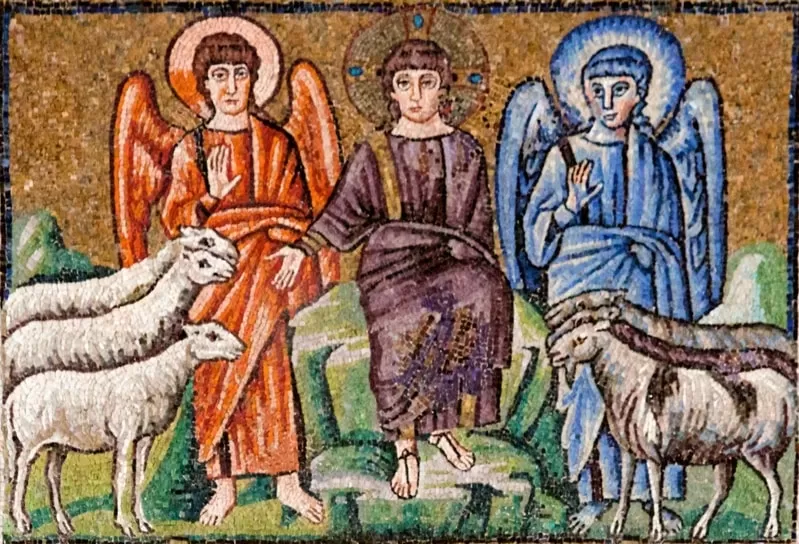
Also at this moment, the Son of Man will sit in judgment over “all the nations” (panta ta ethnē) bringing into his kingdom the righteous who attended to the needs of his suffering emissaries, but excluding the unrighteous who showed no compassion towards “the least of these” (25:31-46).
This is a judgment according to the works—or the absence of works—done for the benefit of the disciples whom the risen Jesus will send among the nations with the good news of the coming kingdom of God. It is part of the resolution of the impending crisis, centred on the destruction of Jerusalem and the temple, depicted in the “apocalyptic” discourse (24:1-28).
Are the nations scattered and lost Israel?
It is sometimes argued that the “nations” or “gentiles” (ethnē) who are judged and saved in the New Testament are not “gentiles,” as normally understood, but Israel of the dispersion, submerged among foreign peoples, perhaps specifically the lost tribes of the northern kingdom of Israel.
So we may wonder whether the judgment of the nations in Matthew 25:31-46 should be understood in the same way. After all, it is said that YHWH would make Abraham the father of a “multitude (hamon) of nations” (Gen. 17:5-6), and that the descendants of Ephraim would become a “fullness (meloʾ) of nations” (48:19*).
Also, the separation of the sheep from goats in Jesus’ account of the judgment of the nations may recall the judgment of Israel in Ezekiel 34:17: “As for you, my flock, thus says the Lord GOD: Behold, I judge between sheep and sheep, between rams and male goats” (Ezek. 34:17).
The assumption would be that the risen Christ sends his disciples out into the world to instruct the Israelites—in the broadest sense—scattered and lost among the gentiles, in the period leading up to the disastrous end of second temple Judaism (Matt. 28:19). This would be an extension of the sending out of the twelve to proclaim the kingdom of God only to the lost sheep of the house of Israel (10:5-15).
The towns and villages of geographical Israel will be judged according to whether they receive or reject the disciples. The Israelites/Jews of the dispersion will be judged according to whether they showed practical compassion towards the disciples when they ended up hungry, destitute, or imprisoned.
An attractive interpretation, but…
In some ways this is an attractive interpretation, but I think that the difficulties with it are insuperable.
1. The first problem is that I have nowhere seen presented an explicit and unequivocal instance of ethnē being used for the tribes or “nations” of Israel in the literature of second temple Judaism, including the New Testament. If someone can supply one, I would happily consider it.
2. I think the idea beyond “multitude of nations” is more likely an imperial one. Assyria is described as a cypress tree:
All the birds of the air nested in his limbs, and underneath his branches all the animals of the plain gave birth; in his shade all the multitude of nations (plethos ethnōn) lived. (Ezek. 31:6 LXX)
So the expectation behind the promise that the patriarchs would be the fathers of a “multitude of nations” is that Israel would in the end have a regional political status comparable to that of Assyria or Babylon—or finally Rome.
3. In fact, we have some explicit and unequivocal statements in the Septuagint that differentiate between scattered Israel and “all the nations”:
…you gave us over to plunder and exile and death, and for an illustration of reproach to all the nations (pasin tois ethnesin among which we have been scattered. (Tob. 3:4)
…he will gather us from all the nations (pantōn tōn ethnōn) among whom you have been scattered. (Tob. 13:5)
That seems an obvious way to make the distinction.
4. Not only that but we have in a late first / early second century Jewish text a judgment of the nations on similar terms. After certain “signs” of war, earthquake, fire, and famine, the time of the Anointed One will come, and he will call all the nations for judgment. The nations which have oppressed Israel will be destroyed, the nations which have let Israel alone will live.
After the signs have come of which I have spoken to you before, when the nations are moved and the time of my Anointed One comes, he will call all nations, and some of them he will spare, and others he will kill. These things will befall the nations which will be spared by him. Every nation which has not known Israel and which has not trodden down the seed of Jacob will live. And this is because some from all the nations have been subjected to your people. All those, now, who have ruled over you or have known you, will be delivered up to the sword. (2 Bar. 72:2-6)
5. It’s also hard to make sense of ethnē as a reference to scattered and lost Israel elsewhere in Matthew.
- The phrase “Galilee of the nations” in Matthew 4:15 likely refers to the annexation of Galilee by the Assyrians in 732 BC (cf. 2 Kgs. 15:29; Is. 9:1).
- When Jesus tells his disciples not to go “in the way of the gentiles” or into Samaritan towns but only to the “lost sheep of the house of Israel” (Matt. 10:5-6*), he appears to have nearby peoples in view—presumably towns and areas within the geographical scope of his mission that had predominantly non-Jewish populations.
- Jesus then says that they will be delivered over to courts and flogged “in their synagogues, and you will be dragged before governors and kings for my sake, to bear witness before them and the Gentiles” (10:17-18). I take this to mean that they will suffer in Israel in the same fashion as he suffered: opposition from local synagogues and trial before governors and kings to bear witness before the Jews and their Roman overlords. This is strongly suggested by his later statement:
the Son of Man will be delivered over to the chief priests and scribes, and they will condemn him to death and deliver him over to the Gentiles to be mocked and flogged and crucified (20:18-19)
- I don’t see how the statement that “the rulers of the nations lord it over them, and their great ones (hoi megaloi) exercise authority over them” (20:25*) can be understood as a reference to the scattered and lost “nations” of Israel.
- Management of the vineyard of Israel will be taken from the current elites and given to a singular “people” (21:43), not to the plural peoples or nations who will be gathered before the Son of Man.
- The disciples will hear of “wars and reports of wars,” and “nation will rise against nation, and kingdom against kingdom” (24:6-7*)—a reference, I take it, to the coming war against Rome.
6. When the “sign of the Son of Man” is seen in the heavens following the catastrophe of the fall of Jerusalem, the “tribes of the land” will see the Son of Man coming with authority in fulfilment of Daniel 7:13-14 and they will mourn (Matt. 24:30; cf. Zech. 12:10-14). This seeing is what Jesus is referring to when he tells the high priest that the leadership in Jerusalem will “see the Son of Man seated at the right hand of Power and coming on the clouds of heaven” (26:64). So he appears to think of the eschatological fullness of Israel not in terms of the Israelites of the diaspora but as the people of the land who will directly experience the disaster of the war.
7. It is not the lost “nations” of Israel who are regathered at the parousiai but the “elect” whom he will send to the four corners of the earth to proclaim the coming rule of YHWH over his people (24:31; cf. 24:14; 28:19).
8. The making disciples of “all the nations” (panta ta ethnē) is intended as the means by which the dominion given to the “one like a son of man” in Daniel 7:13-14 will be implemented. As the Son of Man, Jesus has been given “all authority (exousia) in heaven and on earth,” just as Daniel’s representative of the persecuted righteous in Israel is given “authority” (exousia) so that “all the nations (panta ta ethnē) of the earth according to race and all glory” will serve him (Dan. 7:14 LXX*). The eschatological rule of YHWH over the peoples currently governed by Rome will come about through the witness and discipling (mathēteusate) of his elect emissaries.
The judgment of the sheep and goats presupposes this narrative. The Son of Man comes symbolically to earth, having received the authority to judge and rule over the nations given to the representative of the suffering righteous in Israel in Daniel 7:13-14. Jesus’ language is a reworking of that vision, not a literal prediction. One element of the eschatological resolution will be a judgment of the nations with regard to their response to the suffering of Jesus’ disciples. As Paul does in Romans 2, Jesus allows for the possibility that some righteous gentiles—not members of the “elect” or of the covenant people—will have a positive part to play in the transformation and renewal of the ancient world.
Thanks for taking the time and putting this together Andrew, I really appreciate it.
Just by way of clarification… I’m not advocating that ‘the gentiles’ carte blanche were actually long lost Northerners, but that “some of those gentiles” responding positively to the gospel could likely have been of Hebraic heritage, whether knowingly or not, can’t be known, so as far as not taking a carte blanche position goes, I agree with a lot of your assessment.
I’m just thinking, there seems to me some credence to the proposition raised by Jason Staples regarding all this, and just as you rightly observe elsewhere that much of what has been missed of the ‘historical narrative’ that just gets “universalised,” might it be similar in that the NT is far more Israel-centric than otherwise appreciated?
It was the eschatological “tribes of the land” (Mt. 24:30) that prompted some of my thinking.
I don’t know if you saw my post a little while back following one of Elliot’s comments, where I provided some quotes from Staples’ book, but I’ll share the link again as Staples explains this far better than I can.
Recent comments