Wright and Bird argue that Colossians presents Christ’s defeat and reconciliation of the “powers” as the foundation of new creation and global unity. The author counters that Colossians concerns kingdom rather than cosmic renewal: Christ establishes a new political order in which divine and earthly rule are reconciled. The “powers” are governing authorities, and Christ’s victory transforms human government, culminating historically in Christendom. Likewise, Isaiah’s vision of wolves and lambs living peacefully symbolises just rule and social harmony under the Davidic messiah, not a renewed creation. Paul’s use of Isaiah 11 in Romans 15 therefore points to righteous international governance, not cosmic restoration.
In chapter three of Jesus and the Powers, N. T. Wright and Michael Bird explain how they understand the “powers” of the book’s title. They are “what we would call ‘earthly’ or ‘political’ rulers and what we might call any ‘non-human’ or ‘supernatural’ quasi-personal ‘forces’ that stand behind the ‘earthly’ rulers” (51).1
They focus, appropriately, on the “great poem” about Christ in Colossians 1:15-20, because it makes reference to the “powers”—“visible and invisible, whether thrones or dominions or rulers or authorities”—and leads to the final defeat of the “rulers and authorities” through the cross (2:14-15).
The argument in Colossians according to Wright and Bird
The “poem” in Colossians 1:15-20 brings together the two major themes of creation and reconciliation. Christ as wisdom is both Israel’s messiah and the “living embodiment of Israel’s God.” He is the one through and for whom all things were created, “including all the ‘powers’ of the world.” He is the “image-bearing human” in whom “God incarnate has come to take up” the “rightful role” of the wise government of the world.
Why did creation need to be reconciled? Because the “principalities” and “powers” had “accrued terrible power to themselves through human idolatry, and were now on the rampage through creation, wreaking havoc with people’s lives and with God’s world” (57).
Even the regulations of Torah had been subverted by these malevolent powers, to the effect that the Jews were doing their best to keep Gentiles out of the people of God (cf. 1 Thess. 2:16).
But now the powers have been defeated by the death of Jesus (Col. 2:13-15) and can no longer use Torah to prevent the forgiveness of Gentiles, allowing the “larger purposes” of God to be fulfilled. So humans are free at last to be the “‘royal priesthood’ through whom God’s wise, healing justice would be brought into the world, resulting in new creation in the ultimate future and advance signs of that new creation even in the present” (59).
The principalities and powers had brought about division. Jesus’ triumph over them, therefore, brought about the reconciliation of the multiple subcategories of humanity: Jew and Greek, slave and free, male and female, etc.
Perhaps surprisingly, finally, the powers themselves have been “reconciled” (Col. 1:18-20). They were created through Jesus, defeated on the cross, and thereby reconciled to God. Why? Because the world still needs government: “just as humans, liberated from sin, can take their rightful place as the royal priesthood, so the structures of governance, the tendons and ligaments of complex human society, are in principle reconciled” (60, original emphasis).
Wright sums up by speaking of a “radical transformation” that has occurred through the death and resurrection of Jesus, consisting of three elements: first, a shift from the Jews to a “worldwide Jew-plus-Gentile family”; secondly, new creation realised in the “formation of believing communities made up of people of every kind”; and thirdly, the radical idea that the ultimate victory would “consist not in violence but in suffering love” (61).
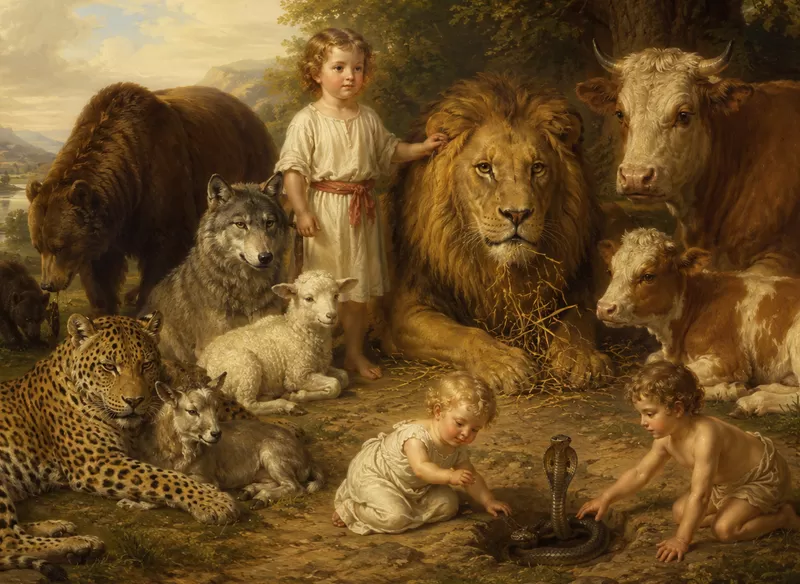
When Jews and Gentiles worship the creator God with one voice, they “embody in advance the prophetically promised new creation in which the wolf and the lamb will lie down together, living at peace under the wise and healing justice of the Messiah.”
There are two parts to my response to this. First, the Colossians passage is not about new creation but about kingdom—about the government of nations. Secondly, yes, Paul alludes to Isaiah 11:10 in Romans 15:12: ‘And again Isaiah says, “The root of Jesse will come, even he who arises to rule the Gentiles; in him will the Gentiles hope.”’ But the description of wolves dwelling with lambs, etc., found in the Isaiah passage depicts just government, not new creation.
The kingdom of his Son
My basic point, therefore, as before, is that Wright and Bird confuse new creation with kingdom, the cosmic event with the political event. For a much more detailed discussion of the Colossians passage, see my book In the Form of a God: The Pre-existence of the Exalted Christ in Paul.
- The scope of the passage is set by the statement in Colossians 1:13-14: believers have been transferred from one kingdom to another. A kingdom is much smaller than creation; a kingdom exists among other kingdoms. Very rarely is “kingdom” a metaphor for the providential management of the created order.
- The “beloved Son” (1:13) is perhaps the embodiment of Israel in the first place (cf. Jer. 31:20; 4Q475 f1:7) or the persecuted righteous Jew (cf. Pss. Sol. 13:9; 18:3-4), but in this context he is more likely the Davidic king who will inherit and rule over the nations (Ps. 2:7-9; cf. Acts 13:33; Rom 1:4; 15:12; Heb 1:5; 5:5; Rev 2:27; 12:5; 19:15).
- That he is “an image of the invisible God” also signifies kingship, I think: “When people could not honour them in their presence because they lived far off, they imagined their appearance from afar and made a visible image of the king whom they honoured…” (Wis. 14:17). Jesus images the rule of the invisible God in heaven.
- There is ample biblical evidence for the idea that God deposes and installs kings—and that he has installed Jesus as the Son at his right hand to judge and rule over his own people and over the nations. It makes little biblical sense, on the other hand, to say that God became incarnate in an “image-bearing human.”
- Christ is “firstborn of every creature” (prōtotokos pasēs ktiseōs). This is also a kingship motif: “He shall call upon me, ‘My Father you are, my God and supporter of my deliverance!’ And I will make him a firstborn (prōtotokon), high among the kings of the earth” (Ps. 88:27-28 LXX).
- Christ is the remaking of all things in the same way that the birthday of the most divine Caesar was considered “equal to the beginning of all things, if not in terms of the natural order, then in terms of practicality; when everything was falling apart and passing into disarray, he restored order and gave another aspect to the whole world” (OGIS 458.4-9*).
- What has been “created through him and for him” is not heaven and earth, light and darkness, sea and dry land, lights in the heavens, vegetation, and living creatures. It is a whole new political order, a new set of power structure, both visible and invisible—“thrones or dominions or rulers or authorities”—as an act of divine wisdom.
- Most importantly, in this new political order, rule in heaven and rule on earth would be reconciled: the chasm between the kingdom of God and the kingdom of Caesar would be overcome.
- The churches were the means by which the reality and benefits of this impending unified government would be made known in advance to the “rulers and authorities in the heavenly places” (Eph. 3:10)—and, of course, to rulers and authorities on earth. The churches of the Greek-Roman world were “advance signs” of a very different Greek-Roman world to come.
- So we may reasonably argue that this “hope” was fulfilled when, three hundred years later, the kings and peoples of the Roman Empire abandoned their old gods to worship one God and confessed one supreme Lord, seated at the right hand of God, “far above all rule and authority and power and dominion, and above every name that is named, not only in this age but also in the one to come” (Eph. 1:21). In practical, historical terms, Christendom was the age to come, when all “powers” on earth and in heaven would be reconciled to God.
Now the bit about the wolf and the lamb….
The wolf will dwell with the lamb, figuratively speaking
Paul’s argument in Romans 15:8-12 is very important. Wright is correct to say that it is too often overlooked. Jesus became a servant to the Jews in order to confirm the promises made to the patriarchs. The nations have heard about this very Jewish event and are now praising YHWH for his mercy towards his people, as anticipated in the Jewish scriptures. But they not only praise Israel’s God, they now also harbour the hope that they too will be governed by Israel’s messiah, this “root of Jesse.”
The last quotation is from Isaiah 11:10, but Wright maintains that the whole context in Isaiah is relevant. Since the passage includes the prophecy that the wolf and the lamb will happily cohabit, etc., it is taken to be an account of the sweeping renewal of creation.
But that’s not what Isaiah is getting at.
There is more to the context than predators and baby animals living happily together and children playing with snakes.
Assyria is the rod of God’s anger against idolatrous Israel (10:5-11), but God will also punish the “arrogant heart of the king of Assyria,” the destroyer of nations (10:12-19). When he ruins Assyria, a remnant of Israel will return to YHWH (10:20-23). So God now tells the residents of Jerusalem not to be afraid of the Assyrians because shortly his wrath against them will end, and “my anger will be directed to their destruction”; the great forest of Assyria will be chopped down (10:25-34).
But just at that time, a new shoot will come “from the stump of Jesse,” from what is left of the house of David, and “a branch from his roots shall bear fruit.” The Spirit of YHWH will be upon him; he will judge and rule righteously, defending the cause of the poor in Israel and destroying the wicked “with the breath of his lips” (11:1-5).
The depiction that follows of savage beasts coexisting with helpless and vulnerable creatures belongs to this narrative. The point is clear: dangerous animals will no longer “hurt or destroy in all my holy mountain”—that is, in Jerusalem—for the land will be “full of the knowledge of the LORD as the waters cover the sea” (11:6-9).
This is not new creation. Israel has been punished for unrighteousness and injustice. A new Davidic king will restore righteousness and justice in Jerusalem with the result that there will no longer be the exploitation and brutalisation of the weak by the predatory wicked. The strong and powerful will no longer hurt and destroy. The pastoral image, therefore, is a figure for social justice. “Powerful, predatory animals like the wolf can also stand for the arbitrary and unjust exercise of power….”2
Her princes in her midst are like wolves tearing the prey, shedding blood, destroying lives to get dishonest gain. (Ezek. 22:27)
Her officials within her are roaring lions; her judges are evening wolves that leave nothing till the morning. (Zeph. 3:3)
Even if we suppose that Isaiah was thinking of real animals, the cessation of enmity between destructive beasts and specifically young creatures, including a human infant, is confined to God’s holy mountain; it is not a universal phenomenon.
Finally, this “root of Jesse,” this righteous king, who brings social justice to Jerusalem, will stand as a signal for the peoples; the nations will seek him out, and he will receive great glory (11:10).
So I would conclude that when Paul quotes Isaiah 11:10 at the climax of this important passage, he has in mind not new creation but a new kingdom—a change in the government of the nations that fell within the scope of his mission. For that reason, he prays that the “God of hope” would empower believing gentiles in Rome and elsewhere to persevere in just this hope that Jesus, descended from David according to the flesh would in due course rule over the nations (Rom. 1:3; 15:13).
Recent comments