The passage critiques Wright and Bird’s account of Christendom and the Christian message. It argues that while Christendom produced both harms and benefits, their interpretation becomes overly theological rather than historically grounded. The author questions claims that Christianity originally taught universal human equality or centered on God’s love for all, suggesting instead that the New Testament message was primarily eschatological and political: God would judge Israel and the nations through Jesus. Early Christian teachings on weakness and suffering addressed a specific historical crisis, not a timeless social ethic. Consequently, Christendom was not accidental but the intended political outworking of proclaiming God’s kingdom.
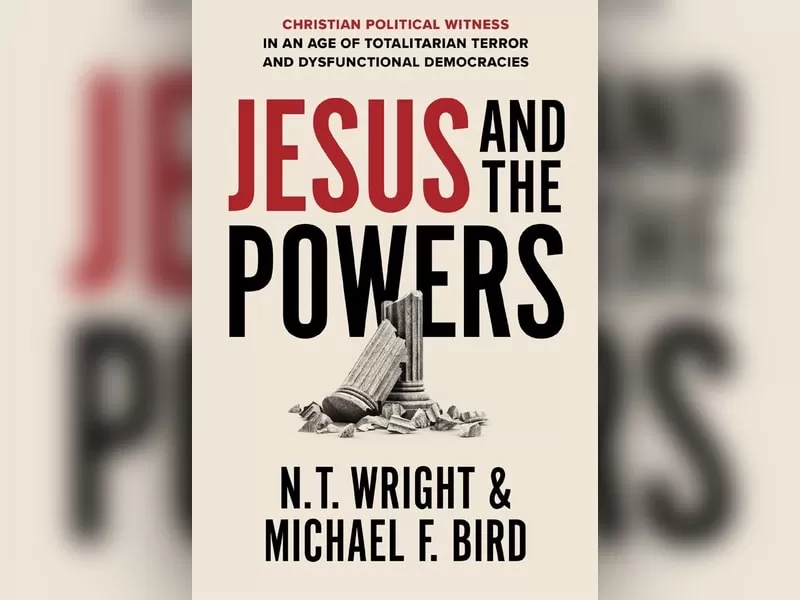
At the end of chapter one of their book Jesus and the Powers: Christian Political Witness in an Age of Totalitarian Terror and Dysfunctional Democracies, Wright and Bird make—or one or the other of them makes—the important point that the end of one story is also the beginning of another one (24). So the end of the story of the resistance of the early church to empire was the beginning of the story of the church residing in the empire “as a privileged guest.”
Chapter two, “The Church between Jesus and Caesar,” deals with the “problems and complications” that inevitably arose. The argument is that Christendom was a mixed bag. The church brought great benefits but was corrupted in the process. It’s a revisionist, Tom Holland sort of argument: the evils of Christendom were many and inexcusable, but “there were genuinely positive and ultimately revolutionary changes for human civilisation” (26)—“schools, academies, universities, hospitals, the Enlightenment, the rise of science, and notions of universal human rights” (34).
As in the previous piece, I applaud the determination not to give in to the prophetic, anabaptist, post-colonial—and indeed modern pentecostal-evangelical—cancellation of Christendom and instead to track the Jewish-apocalyptic narrative through the New Testament into the history of the early Greek-Roman church.
But a couple of statements in the chapter struck me as questionable, mainly because they veer towards a more or less generalised and theological construal of the overall story. Usual problem. The crosswinds of theological tradition are powerful. We find it difficult to walk the straight line of historical interpretation.
Is the Christian message that all people “reflect the image of God”?
For the Christian message is that all human beings reflect the image of God: God loved the world so much that he sent his Son to save it, and the cross proves that true power is found in weakness, greatness is attained in service, revenge only begets greater evil, and all victims will be vindicated at God’s judgement seat. (28)
Is this historical or theological interpretation of the “Christian message”? Or perhaps better: to what extent is this historical, to what extent theological interpretation?
What leads us to say that the Christian message is that all humans “reflect the image of God”? The Bible? Tradition? Cultural pressures?
And why—in a chapter on the church “between Jesus and Caesar”—put John 3:16 at the centre of the message rather than, say, Mark 1:15 or Romans 1:3-4?
It’s certainly a biblical idea that humanity as male and female was created in the image of God (Gen. 1:26-27), but I doubt that this originally entailed the very modern thesis that all individuals are equal in worth and standing: “Whereas recognition of the inherent dignity and of the equal and inalienable rights of all members of the human family is the foundation of freedom, justice and peace in the world…,” etc.1 Rather, humanity as a species in the image of God, distinct from all other creatures, exercises a God-like dominion over the earth and all life in it.
Beyond the institution of capital punishment for murder (Gen. 9:6), the Old Testament shows no interest in the social or ethical implications of the concept.
Jesus does not defend his association with tax collectors, prostitutes, sinners, lepers, the unclean and demon-possessed on the grounds that they were made in the image of God. They are of eschatological significance because they are descendants of Abraham (e.g., Matt. 3:9), not because they are in the image and likeness of Adam (cf. Gen. 5:1-3).
The “Christian” message in the New Testament is that the God of Israel will judge and rule over both his own people and the nations of the Greek-Roman world through the agency of his Son. Ethnic and social distinctions presented no barrier to full, active participation in the Spirit-inspired, eschatological community of those who believed in this new future:
For as many of you as were baptized into Christ have put on Christ. There is neither Jew nor Greek, there is neither slave nor free, there is no male and female, for you are all one in Christ Jesus. And if you are Christ’s, then you are Abraham’s offspring, heirs according to promise. (Gal. 3:27-29)
Paul speaks of the man and not the woman as “image of God” (1 Cor. 11:7) and of Christ as the “image of (the invisible) God” (2 Cor. 4:4; Col. 1:15), but the association with glory, visibility, and prominence in these texts suggests that he is not drawing on the creation passage. Otherwise, believers are in the “image of Christ” insofar as they suffer, die, and are raised with him.
A gospel of the love of God for the world?
Modern versions of the gospel invariably downplay the eschatological dimension of the core New Testament message: we are all in the image of God; God loves all of us so much that he sent his Son to die for our sins. These ideals may be grounded in Christian thought:
Over the centuries, the Latin West and the Greek East became increasingly shaped by a Christian vision of God’s love for the world and the place of Christian virtues in societies where few restraints on evil and exploitation existed. (26)
But they are not the original historical message.
Jesus put forward a deeply counter-intuitive strategy for his followers because he understood that the salvation of Israel would be achieved only by turning Israel’s current modus operandi on its head: the meek would inherit the land, the persecuted would gain the kingdom of heaven, those who took up their own cross and followed him would be vindicated, the least would be the greatest, the last would be first, and so on.
The apostles believed that through his death Jesus had triumphed over the brutal powers that opposed him and them, even the power of death.
But this was a programme for negotiating a hazardous eschatological transition, not a manifesto for the settled life of a community.
Wright and Bird are over-idealistic—and technically muddled—when they say that the characteristic values of the New Testament have been “wired into the moral compass of Western civilisation.” Paul taught the churches to imitate Christ in his weakness and suffering because that was how their testimony would be sustained in the face of sometimes intense persecution. If they were not built on the foundation of Christ, who died and was raised, they would not survive the coming dreadful day of fire (1 Cor. 3:10-15).
But Paul also believed that powerful governing authorities had been appointed by God to maintain justice and punish wrongdoing, by the sword if necessary, on God’s behalf (Rom. 13;1-7).
Today, in most areas of life, we do not think, by and large, that social stability, national security, economic and technological development, cultural achievement, etc., are attainable through powerlessness. We are dependent on, and play our part in, multiple overlapping hierarchies. We have more faith in strong than weak leaders. We pay for strong judicial systems to defend the poor and punish the wicked.
Paul taught the church in Rome not to avenge themselves against their enemies, but he likewise expected them to pay taxes in order to ensure that the “wrath of God” was carried out by the authorities (Rom. 12:19; 13:1-7).
Was a “Christian political order” ever the goal of the church?
It is fair to say that the creation of a Christian political order was never the Church’s purpose. The political order that became Christendom was simply the result of the success of the Church’s mission to proclaim God’s kingdom. (30-31)
I disagree with this.
The gospel was always a political message, in two parts. It had in view, first, God’s judgment of unrighteous Israel and the installation of a new régime; then secondly, God’s judgment of the idolatrous and immoral Greek-Roman world, resulting in the widespread worship of one God and confession of his Son as Lord.
In this new regional state of affairs, the churches would take over the function of the old pagan priesthoods. The chastened kings of the earth would not have absolute power but would be answerable to the righteous “King of kings and Lord of lords” seated at the right hand of God.
That is a “Christian political order.”
To say that the “political order that became Christendom was simply the result of the success of the Church’s mission to proclaim God’s kingdom” is incoherent. If you proclaim a kingdom, you expect a “political order” to ensue.
Christendom was not the accidental by-product of some other agenda—such as the moral and spiritual transformation of large numbers of individuals. The apostolic mission led with the political-religious message about impending régime change, and personal salvation and transformation followed.
To be sure, Christendom happened because “converted rulers wanted to place their realm under the reign of Christ,” but calling it the “reign of Christ” underlines the fact that the proclamation was political from the start.
Wright and Bird make the point that “the resulting product… was far from perfect,” and then say that “Christendom did not make the world the kingdom of heaven” (31). But I think that is a misunderstanding of “kingdom of heaven.” The kingdom of God is not an ideal place, it is God having his way dynamically in history—defending the downtrodden, defeating their enemies, saving his people, restoring his reputation or “glory” among the gentiles.
At the end of history, there is no more need for kingdom. When the last opponent of God and of his people has been destroyed, the Son abdicates, relinquishes authority, so that “God may be all in all” (1 Cor. 15:24-28).
So I would argue that in the overarching political-religious narrative envisaged in the New Testament, the kingdom of God is God establishing his people as an effective priesthood for the nations of the dominant oikoumenē—the Roman Empire, in effect.
The Jews as a Torah-based people in the land and in the diaspora had failed in this vocation and faced the wrath of God, not least in the form of the destruction of Jerusalem and the temple and their “final” expulsion from the land. But the faithfulness of Christ had opened up a radically new path to the conversion of the empire and the rule of YHWH over the nations through the Son at his right hand.
This is exactly what is celebrated in the encomium of Philippians 2:6-11.
- 1
Universal Declaration of Human Rights, Preamble.
Recent comments