In his rather short third post on the kingdom of God, Joel Green begins by asking what we can learn about God’s royal rule by examining how the expression is used in the Gospels. He summarises the various contexts: the kingdom of God is entered, proclaimed, possessed, has drawn near, etc. Then he makes the important point that, contrary to much contemporary talk, the kingdom of God does not depend on what people do. “Humans do not create, build, construct, extend, or make present the kingdom. The kingdom is God’s” (emphasis removed).

The conceptual priority given to entrance into the kingdom of God suggests that it must be understood as a “container” or “place,” which makes little sense if the kingdom is “all-pervasive and eternal.” So better to think of it as a sphere or field of divine influence or activity.

Read more...
The standard simplified evangelical understanding of New Testament eschatology is that Jesus will “come again in glory to judge the living and the dead,” the world will be brought to an end, all evil and death will be destroyed, and there will be a new heaven and new earth, “his kingdom will have… ( | 5 comments)
Jesus’ parable of the wedding feast in Matthew 22:1-14, like the two parables preceding it, is directed against the chief priests and elders of the people who questioned his authority to pronounce judgment on the temple (Matt. 21:23-27). The leaders of Israel are those who refuse to attend the… ()
The Hebrew word shalom features prominently in “missional church” discourse. John Franke says, for example, in his Missional Theology: An Introduction: “The restoration of peace or shalom, the all-embracing blessing of the God of Israel and Jesus Christ, may be the simplest, most… ()
This is a story of our times, surely: a person I know slightly, trapped a while back in an evangelical Reformed seminary, drawn to the narrative-historical argument but not sure what to do with it, has now abandoned his faith, identifying as someone who is at best sympathetic to the ( | 3 comments)
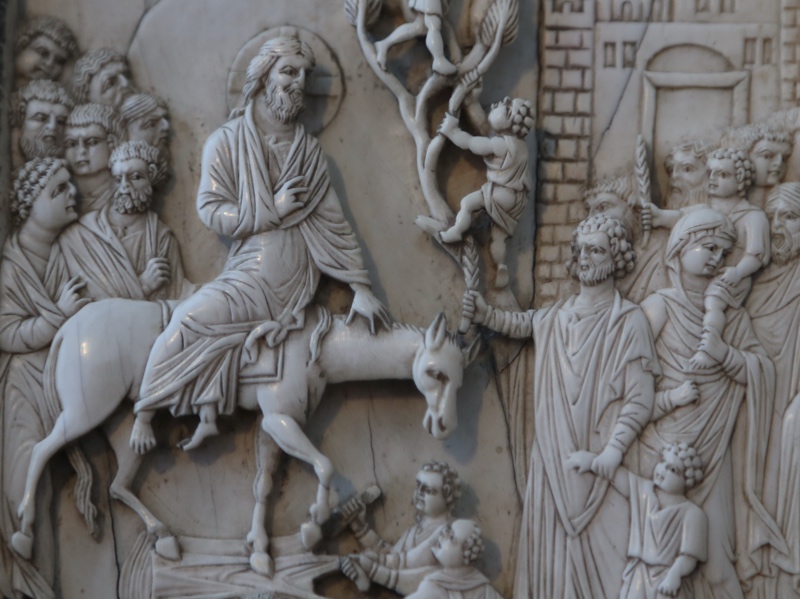
I have Daniel Hoffman to thank for this little aperçu. Jesus is riding on a young horse (pōlon), perhaps awkwardly on a young donkey, descending the Mount of Olives towards Jerusalem (Lk. 19:37). There is no explicit reference to Zechariah 9:9, but presumably the allusion was not lost on… ()
The books I’ve been reading on “missional church” have a couple of key objectives in common: to describe the progress of the Western church towards a new “missional” paradigm, and to map that paradigm on to an expansive reading of the biblical narrative. It’s an obvious, perhaps inevitable,… ( | 6 comments)
A significant tranche of missional church thinking centres on the APEST paradigm. The argument is that if the church is to become a movement again after the sclerotic institutionalism of the Christendom era, it needs urgently to reactivate the gifts of apostle, prophet, and evangelist. Shepherds… ( | 2 comments)