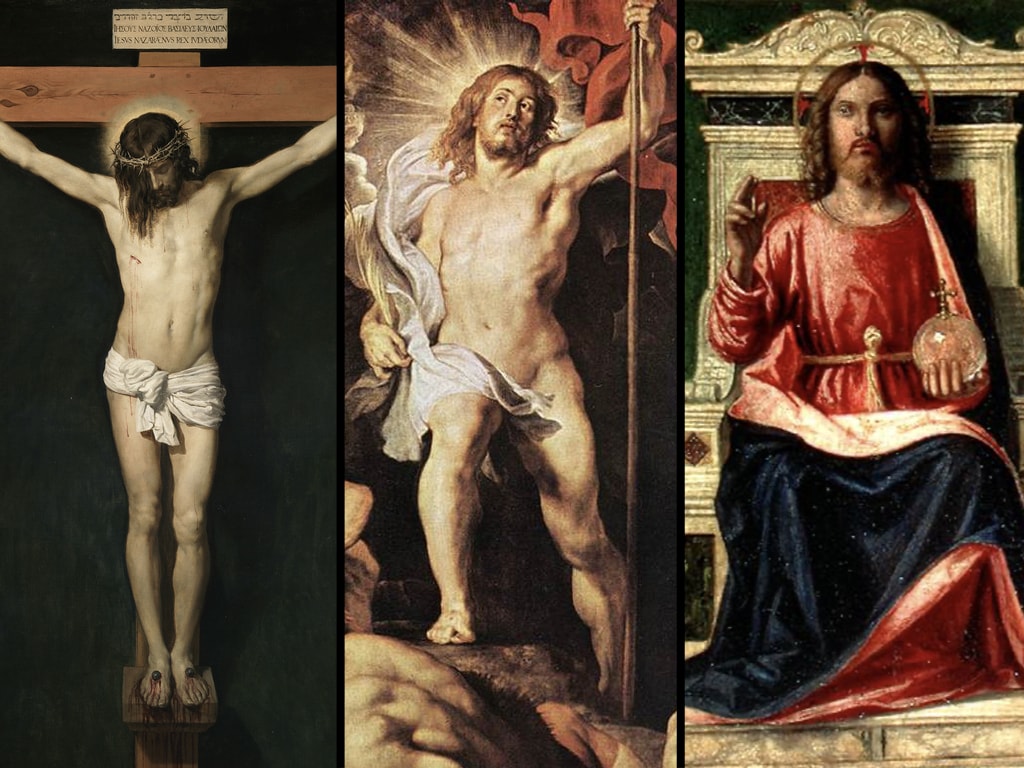
If we think that the resurrection of Jesus is the climactic event in the testimony of the early church, constituting the triumph of life over death for all humanity, we are missing the point.

At the beginning of an extensive discussion of resurrection, Paul recapitulates the “gospel” which he had proclaimed in Corinth:

Now I would remind you, brothers, of the gospel I preached to you, which you received, in which you stand, and by which you are being saved, if you hold fast to the word I preached to you—unless you believed in vain. For I delivered to you as of first importance what I also received: that Christ died for our sins in accordance with the Scriptures, that he was buried, that he was raised on the third day in accordance with the Scriptures…. (1 Cor. 15:1-4)

There are two principal ways in which the later Easter tradition has got this wrong, I think.

1 comment | Read more...
Craig got in touch with a couple of questions. He wants to know, first, what P.OST stands for. That’s straightforward and not very exciting. I ran a “collaborative” site called Open Source Theology from about 2002 to 2009. It was associated with the self-consciously postmodern rethinking that went… ( | 1 comment)
I’ve been preparing some material for a workshop on Theology and Future Church for a group of church planters, and as often happens, my mind ran off in a rather impractical direction. But the point is this. Too often practitioners look for a theology that will directly support or enhance or defend… ( | 3 comments)
Paula Gooder talked about heaven at a Theos event last night in London, with passion, verve, an impressive grasp of the details (the gentleman behind me was certainly impressed), and a robust determination not to let theological tradition get in the way of honest biblical interpretation.Her leading… ( | 1 comment)
I have been closely following recent exchanges among a set of notable scholars regarding Mark’s christology. All good stuff, a model of civilised online debate. On one side we have those who argue that in subtle, ambiguous, indirect, and covert ways Mark presents Jesus as a figure who in some… ( | 15 comments)
In a comment Peter asks about Acts 10:42: “So it seems you would say that Jesus’ role as judge of the living and the dead… already happened at the parousia (70 AD). Is this correct? If so, in what way did he judge the dead?” The main texts have to do with Peter—confusing, I know (… ()
I have been getting a kick out of Albert Schweitzer’s 1930 book The Mysticism of Paul the Apostle. What’s so refreshing about the book is that Schweitzer attempts consistently to frame Paul’s thinking eschatologically. The book’s dated in many ways, and a lot of exegetical water has passed… ()
One of the most serious exegetical-hermeneutical-theological failings of modern evangelicalism has been to take soteriology out of eschatology, to disconnect the saying about the Son of Man giving his life as a ransom for many from the expectation that the Son of Man will be seen coming in glory on… ()