The West is a civilisation shaped by Christianity, fractured by internal divisions, modernity, and war, and now facing an identity crisis. Some seek renewal in Christianity: scholars emphasise its cultural legacy, while populists demand a conservative Christian nationalism. Peter Lynas’s analysis distinguishes between U.S. and U.K. contexts, questioning whether the church should fuel grievance or model reconciliation. Early Christianity was deeply political, proclaiming Jesus as Lord above all powers, which resonates with aspects of today’s nationalism. Yet history moves forward: the church’s prophetic task now is to embody life with God amid global social and ecological upheaval, not revive Christendom.
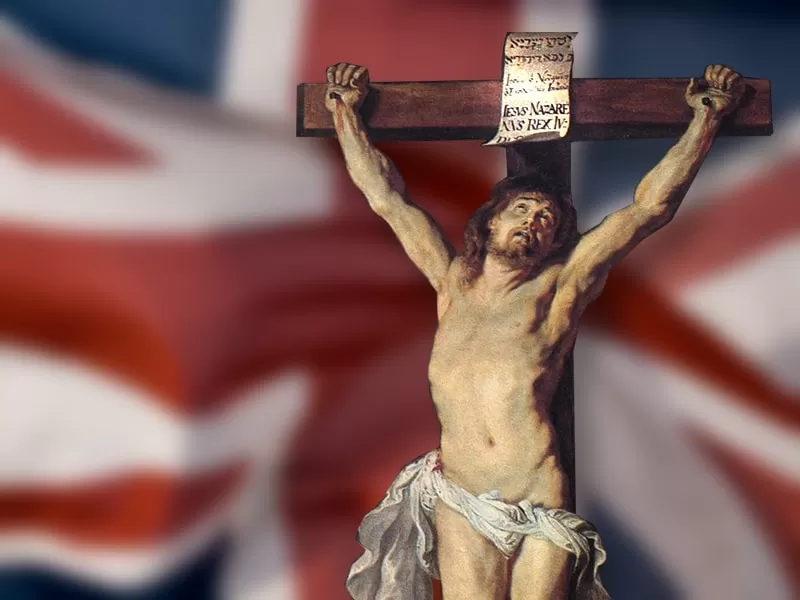
The “West” is a complex civilisational phenomenon. It is pagan Europe converted to Christianity, divested of Eastern Orthodoxy, intellectually reinvigorated by the Renaissance, violently split between Protestantism and Catholicism, expanded by Colonisation, empowered and enriched by the Industrial Revolution, disenchanted by Modernity, shattered by the Great Wars of the twentieth century, and now deeply fractured by a Crisis of Identity at all levels of society. What does it mean to be white? What does it mean to have been so privileged? What does it mean to be female or male or whatever? What does it mean to have this history? What does it mean to be human?
One quite recent response to the crisis has been an attempt to recover the Christian value system that for long shaped the West’s identity and sense of moral superiority. This has been done by well-mannered philosophers and historians who have drawn attention to the fact that the West is still, by and large, the product of its Christian past. But far more media coverage has been gained by the bad-tempered and noisy populists who argue that only the restoration of a thorough-going, conservative Christian national identity will save Western societies from disintegration.
Peter Lynas has written a rather good analysis of Christian nationalism in the UK for the Evangelical Alliance. He differentiates helpfully between the American and UK contexts and offers a neat categorisation of the forms that Christian nationalism takes.
He then attempts to define the “prophetic task of the church.” How should the church in the UK shape public life—by feeding “grievance and exclusion” or by bearing witness to the “reconciling power of the gospel”?
Is this the best way to frame the controversy?
Let’s consider Jesus here.
There is a great deal of grievance and exclusion in the Gospels. Jesus came not to bring peace to the land of Israel but a sword:
For I have come to set a man against his father, and a daughter against her mother, and a daughter-in-law against her mother-in-law. And a person’s enemies will be those of his own household. (Matt. 10:35-36)
He provoked intense resentment in certain quarters. He expected many Jews, perhaps most Jews, to be excluded from the restoration of national Israel, confined to an outer darkness, where there would be wailing and gnashing of teeth.
There is some ambiguous engagement with the odd gentile, but his mission is to the lost sheep of the house of Israel. It is lost Jews who must be found, not the sojourner or the foreigner. It is alienated Jews who must be reconciled—not to God but to Abraham. The parable of the Good Samaritan is a critique of the Jerusalem establishment in the light of an extraordinary historical incident, not a simple morality tale about loving neighbours.
Jesus was executed as “king of the Jews”—not as king of the Samaritans or of the gentiles or of the world.
Peter declares to the “men of Judea and all who dwell in Jerusalem”—disregarding, it would appear, the multitudes of diaspora Jews in the city during the festival—that God has “made him both Lord and Christ, this Jesus whom you crucified” (Acts 2:36). The bad news was that this “crooked generation” of Judeans would suffer a devastating day of the Lord. The good news was that those who repented and were baptised in the name of this crucified Lord would be forgiven their sins and would be saved from the coming, real-world destruction.
This narrow, Jewish-nationalist programme is superseded, of course, when the story about God and Israel is told among the gentiles. Lynas is on more solid ground when he says:
At its core, the Christian confession is not Christ is King as a political slogan, but Jesus is Lord as a radical reordering of allegiance. When we proclaim Jesus as Lord, every other loyalty—nationality, ethnicity, political ideology, even family—finds its place beneath His rule.
But the statement is still misleading.
Undoubtedly, the ancient confession required a “radical reordering of allegiance” from both Jews and gentiles. It required the recognition that Israel’s crucified messiah had been granted a status and authority above all other powers, all other commitments, in heaven and on earth—nationality, ethnicity, political ideology, family.
But the radical reordering of allegiance was for the sake of a future outcome, and that determined the prophetic task of the churches: “There will be the root of Jesse, the one arising to rule over nations, in him will nations hope” (Rom. 15:12*; cf. Is. 11:10 LXX). The nations have been given to him as his heritage; he will shepherd them with a rod of iron (Ps. 2:7-9; cf. Rom. 1:4; Acts 13:33; Heb. 1:5; 5:5; Rev. 2:27; 12:5; 19:15). He will rule over his people in the midst of hostile nations (Ps. 110:1-2, 5-6; applied widely to Jesus in the New Testament).
So both in Israel and beyond, in the Roman world, the prophetic slogan “Jesus is Lord” was understood from the start to have profound and transformative implications for the political-religious life of nations and civilisations.
Contemporary Christian nationalism is in some respects closer to the outlook of the New Testament than we may be willing to admit. It can reasonably be seen as an attempt to recover the eschatological dynamic that drove the early Christian movement, culminating in the confession of Jesus as Lord not merely by individual Christians but by nations, by kings, by a culture, by an empire.
But that doesn’t make modern Christian nationalism right.
History only moves forwards, we cannot put it into reverse; and the prophetic task now, I think, is to imagine the relation between church and society after Christendom, after the Christian nation state, after the triumph of the pervasive secular-humanist worldview.
That means that the New Testament vision is not our vision. New Testament eschatology is not our eschatology except insofar as we share a final hope—beyond history, at the outer margins—for a new heaven and a new earth.
The sort of old fashioned evangelicalism represented by the Evangelical Alliance has already tacitly, unwittingly, conceded the point. The church prefigures not the parousia, not the rule of Christ over the nations, not Christendom as a regional political-religious entity, but a happy, transnational society in which “ethnic, social, generational and cultural differences” are overcome.
Yes, there is a belated recognition that globalisation adversely impacts native communities in the West: “While welcoming the refugee, we must create space for honest conversations about the impact of and limits to immigration.” But it still strikes me as a naïve, over-optimistic, idealised vision of the future that takes no account of the traumatic change that the world is going through.
What the church needs to be now, in America, in the UK, pretty much everywhere, is a prefiguring of what it means to live in the presence of the living God under immense social and ecological stress. The framework for the prophetic task is the disruptive arrival of the Anthropocene in all its Godless, costly, crushing glory. Christian nationalism will not serve that purpose.
This article makes some legitimate points, but it assumes that the church has read the New Testament properly. The early church was a messy place, with various understandings of the implications of both Old Testament prophecies and of Jesus’ own words. Since Constantine there has been a marked tendency for state forms of Christianity to predominate, and white Christian nationalism is merely a yearning in the descendants of those empire-friendly traditions to make the US just such a government.
@Charles Gilmer:
OK. So where does that leave us? There have also been successive reactions against Western state sponsored Christianity—from Eastern Orthodoxy, through the Anabaptists, etc., to the various independent church movements of the modern era, including the soft evangelicalism of the Evangelical Alliance. All of these were driven by concerns that overlap with the biblical accounts only to a limited degree.
And then there’s the—also very modern—endeavour to recover a more precisely and narrowly historical understanding of what was going on in the New Testament. That’s been my project but for the purpose of redefining the role of the church now in historical continuity with all that has gone before.
That perhaps seems a more plausible enterprise from the European than from the American perspective at the moment. We are not in quite such a state of denial.
You are right that populist sloganeering is a poor substitute for Christian political theology, but the remedy is not to abandon the New Testament’s public claims or to declare the age of Christian peoples permanently closed. The Catholic tradition has never reduced “Jesus is Lord” to an interiorized piety. The confession dethrones rival sovereignties, orders temporal authority to the true common good, and obliges rulers—within the limits of prudence and justice—to acknowledge the Kingship of Christ. That is precisely why the Church has taught, from Augustine through Aquinas to Leo XIII and Pius XI, that political life cannot be hermetically sealed from the truths about God and man. “Christendom” was not a mistake to be repented of in principle; it was an historically contingent but theologically intelligible attempt to conform law, culture, and institutions to the natural and divine law. That it was often imperfect or sinful is an indictment of men, not of the thesis that public life must be subordinated to truth.
The assertion that “history only moves forwards” is a philosophical claim, not a Christian one. Providence is not Whig inevitabilism. The Church believes in development of doctrine, not in an irreversible secularization of the saeculum; she has seen whole civilizations apostatize and others convert. Appeals to the Anthropocene as the new organizing horizon merely exchange one eschatology for another, and a thin one at that. Stewardship of creation is real, but it is a derivative moral claim within an anthropological order in which man—image of God, not planetary irritant—pursues temporal peace as a foretaste of eternal peace. Ecological stress does not suspend the perennial tasks of building families, shaping laws in accord with reason and revelation, and forming peoples whose worship is true and whose customs are humane.
Your reading of the Gospels as narrowly “Jewish-nationalist” proves too much and too little. Too much, because it threatens to provincialize the very royal claims that set Jesus over Caesar and the nations; too little, because it cannot account for the apostolic mandate to “disciple all nations,” the psalmic expectation that kings will serve the Lord, or the Pauline logic by which the gentiles’ obedience of faith entails the overthrow of idolatrous cult and the reconstitution of public life under the living God. The earliest Christians did not confuse the Church with the empire, but neither did they imagine a faith permanently privatized. When the martyrs confessed Christ before tribunals, they were not lobbying for a neutral space; they were witnessing to a sovereignty higher than Rome and, in time, transformative of Rome.
On this point the Catholic tradition supplies what “Christian nationalism” often lacks: an ordered account of loves and loyalties. Patriotism is not a totem but a species of pietas: gratitude and duty toward the concrete community that nurtures us, subordinated to God and bounded by justice. Subsidiarity resists both statism and the globalized abstraction that dissolves peoples into interchangeable units; solidarity forbids chauvinism and commands the works of mercy, including just hospitality. Immigration, borders, and economic policy belong to prudence, but prudence is not neutrality toward ultimate ends. A polity that teaches children that man is self-made, that family is malleable, and that worship is optional is already a catechism—just not a Christian one. To labor for laws and institutions that recognize the true ends of man is not grievance politics; it is charity in the order of the common good.
It is also unnecessary to pit “post-Christendom” pastoral creativity against public witness to Christ’s rule. Parishes, schools, guilds of craftsmen and professionals, local economies that privilege households, and municipal life suffused with the liturgical year are not fantasies about the past; they are the ordinary instruments by which culture is re-evangelized and law eventually reforms. The Church does not need a romance of empire to say again, with sober confidence, what Quas Primas once insisted: societies, no less than individuals, flourish when they acknowledge the Lordship of Christ. In the Anglo-American world that will mean persuasion, patient institution-building, and legal work that establishes space for the true and the good to endure; it will also mean refusing the fiction that the liberal state is a neutral umpire. It is not. It forms souls.
Where your critique is salutary is in warning against baptizing resentment. The Church must not trade the Beatitudes for ballot boxes. Yet it is equally dangerous to retreat into an apolitical “spirituality” that leaves the marketplace, the university, the courthouse, and the border to be governed by anti-human dogmas. The New Testament’s “radical reordering of allegiance” remains ours, and it still has public consequences. We should neither resurrect a caricature of Christendom nor acquiesce to a future in which the best we can offer is therapeutic community under a managerial regime. The task is older and more exacting: to conform the temporal order to reason ennobled by grace, to love our own peoples without contempt for others, to welcome the stranger without dissolving the duties we owe our neighbors, and to make laws that tell the truth about man.
If some wish to call that “Christian nationalism,” the label is less important than the substance. The tradition names it more precisely: the social Kingship of Christ and the ordered pursuit of the common good. That claim was not exhausted in the first centuries, and it is not obviated by the Anthropocene. It remains the Church’s enduring political wisdom—and, in a time of civilizational drift, her mercy to the nations.
@X. József:
Thank you. An excellent piece of writing.
I am not suggesting that we should abandon the New Testament’s public claims. Quite the opposite. The Protestant tradition has mostly taken that course as an act of self-preservation, but that needs to change. What I am saying is that the public claims cannot be made in the same way that they were during the period of Western Christendom.
I agree that Christendom was not a mistake, but it was historically contingent, as you say, and the fact is that rulers in the West no longer acknowledge the kingship of Christ. (I would explain Christendom biblically, only secondarily as a “theologically intelligible attempt to conform law, culture, and institutions to the natural and divine law.”)
The assertion that “history only moves forwards” is a philosophical claim, not a Christian one.
I disagree with this. The self-understanding of Israel in the Old and New Testaments is constructed narratively and historically. Pretty much everything we read has to do with historical processes and reactions to it. We can’t talk about eschatology without invoking history. The New Testament climaxes penultimately in wrath against pagan Rome.
I would say that the appeal to the Anthropocene is theological and eschatological. It amounts to a global crisis for which the only biblical antecedent is the flood. The whole notion of stewardship and the pursuit of shalom is derelict, at best suspended. Far more appropriate are those grim passages in the prophets that describe the suffering of the land or earth as a result of human sin, for which the solution is not virtuous industry but divine judgment. Why not see ecological stress, building to ecological catastrophe, as an outworking of the judgment of the creator God against profligate modern humanity?
Too much, because it threatens to provincialize the very royal claims that set Jesus over Caesar and the nations; too little, because it cannot account for the apostolic mandate to “disciple all nations,” the psalmic expectation that kings will serve the Lord, or the Pauline logic by which the gentiles’ obedience of faith entails the overthrow of idolatrous cult and the reconstitution of public life under the living God.
My view is that the story about Jesus in the Synoptic Gospels is indeed “provincial” and “Jewish-nationalist,” albeit in a subversive fashion. There is a consistent biblical logic that disconnects the salvation of Israel from the astonishment and transformation of the onlooking pagan nations. I think Romans 15:8-12 is paradigmatic: Jesus becomes a servant to the circumcised “to confirm the promises given to the patriarchs,” the gentiles praise YHWH for his mercy towards his people and then conceive the hope that they too will be ruled by this powerful and righteous “root of Jesse.”
So the one who is declared “Lord and Christ” by Peter, in whose name some Jews will be saved from the “historically contingent” fate coming upon a “crooked generation” of Judeans, subsequently is proclaimed as future Lord of the nations of the Greek-Roman world—an eschatological outcome that gave us Christendom.
On this point the Catholic tradition supplies what “Christian nationalism” often lacks: an ordered account of loves and loyalties.
This is all very good, but can it be sustained, and in what form can it be sustained? It’s not inconceivable that the West will circle back to such a vision of the common good, but it’s not inevitable. More likely, it seems to me, our societies will continue to work at devising a new definition of what it means to be human. We are doing what the church fathers did 1700 years ago—messily cobbling together a new civilisation out of the wreckage of the old world.
I am less optimistic than you are about the re-evangelisation of our cultures. Does that reflect our different cultural contexts? Our different religious affiliations? Our different views of history? I certainly do not expect Western societies explicitly and programmatically to confess Jesus as Lord again. There is no reason—biblical or theological—why they should.
The task is older and more exacting…
Just to be clear again, I am not at all interested in an apolitical spirituality. But there are two ancient and exacting tasks. One is culture or civilisation building—it’s what Israel did when it took over the land from the Canaanites; it’s what the churches did when they took over the empire. The second is adaption to exile, interpreted through prophecy, which is what we see in the exilic prophets, in the literature of Hellenistic Judaism, and in the early phases of the New Testament narrative.
I don’t think that civilisation building is an option for us, other than in some residual, nostalgic, trivial sense. What the church has to come to terms with is historical “progress”—not as improvement but as moving forwards, and not merely “drift.” That will mean, among other things, finding a credible prophetic voice, grappling with new contingencies, letting go of some old securities, etc.
So, as in the Bible, it is the political aspect of the church’s own corporate life that must be addressed first. If we are living in the past, we cannot expect to function well in the present, or embody a relevant new future within our own pressing eschatological horizons.
@Andrew Perriman:
Thank you for the generous engagement. You are right that we cannot simply reprise the rhetoric or juridical arrangements of Western Christendom as though the intervening centuries had not happened. Forms are historically contingent; ends are not. The Catholic claim is modest and steady: because human nature abides, the teleology of politics abides—public authority remains ordered by natural and divine law to the common good under the Kingship of Christ. That rulers do not now acknowledge Him tells us about their defect, not about a suspension of the norm. Prudence adapts means to time and place; it does not relativize the end.
On “history moves forwards,” the Catholic answer distinguishes development from determinism. Scripture certainly narrates God’s work in history; but neither Israel’s self-understanding nor the Church’s eschatology licenses a philosophy of irreversible secularization. Historical motion does not alter the basic measures: the first principles of practical reason, the natural law, and the supernatural end of man. A later society can be more decayed than an earlier one; a future confession of Christ by rulers would be restoration, not regression. The fact that Christendom arose within concrete contingencies does not make its animating thesis—a public order conformed to truth—obsolete. It means only that our tactics must be different.
Your invocation of the Anthropocene as a kind of flood-level horizon rightly refuses complacency, but it risks mistaking a severe moral disorder for a new metaphysic. Judgments fall in history; that does not abrogate stewardship, law, or culture-building. In classical terms, the crisis is anthropological before it is climatological: a disfigured view of man and of his ends has produced disordered dominion and rapine. The remedy is conversion that restores measure—chastity to desire, justice to exchange, temperance to consumption, fortitude to governance—and law that once again tracks the real, not managerial fatalism. To say so is not to preach apolitical piety; it is to bring the virtues back to the forum and the workshop.
I grant your reading that the Synoptics narrate a mission first to Israel. But the royal claims are not parochial in scope. The same Jesus who confines His earthly circuit “to the lost sheep of the house of Israel” also declares, risen, “all authority in heaven and on earth has been given to me,” and on that basis commands the discipling of the nations. Paul’s “obedience of faith among all nations” and his citation of Isaiah’s “root of Jesse” are not mere reportage of gentile astonishment; they anticipate subjection to a just scepter. Christendom, then, was not a theological aberration but a historical instance of an abiding expectation: that peoples, not only private souls, come under the rule of the true King. That our epoch is post-confessional does not erase the claim; it alters the pedagogy.
You ask whether the ordered account of loves and loyalties can be sustained. Not by slogans—and here your skepticism is useful. But it can be sustained the way the Church has always sustained anything durable: by generating forms. The family ordered to worship and work; parishes whose sacramental life bleeds into schools, charities, and guild-like professional fraternities; jurists and legislators who recover the grammar of the common good and the limits of state power; municipalities that relearn subsidiarity; entrepreneurs who subject technique to justice and the dignity of labor. These are not nostalgic trifles; they are the seedbeds from which public acknowledgments grow again, whether or not they ever take the exact form of ancien régimes. The alternative is to concede the temporal order to a catechism of unreality and then wonder why preaching cannot find traction.
You divide our task into civilizational construction and exilic adaptation. The tradition will not let us choose. The Church is at once peregrina and societas perfecta: she sojourns under hostile skies, yet she already is a rightly ordered polis in embryo, with her own law, worship, and authority proportioned to man’s final end. In seasons of exile, she becomes the “creative minority” that keeps human things human and holy things holy; in seasons of favor, she leavens the whole. Either way she cannot renounce her indirect care for the temporal order—cura animarum entails speaking and acting where temporal arrangements impede or aid salvation. To surrender civilization-building as “residual” would be to deny the Church’s generative power in history and to leave the definition of the human to those who reject both nature and grace.
You contend there is “no reason—biblical or theological—why” Western societies should ever again confess Jesus as Lord. From a scholastic vantage, there are two. First, the order of truth itself: rulers and peoples, as rational agents, owe God acknowledgment and worship; that is not a private duty only. Second, the order of beatitude: law that accords with the truth about man conduces to temporal peace, which is ordinate to eternal peace. Whether any given nation will return is contingent; that nations ought to return is not. Our hope is not naiveté about near-term probabilities; it is the theological virtue that refuses to treat apostasy as destiny.
So yes: we must find a credible prophetic voice in a ravaged landscape. That voice will not be a reprise of imperial swagger, and it must repent of grievance. But neither will it be a chaplaincy to managerial liberalism or an eschatology of ecological despair. It will be the old voice speaking in a new key: that Christ is King; that law must tell the truth about man; that the ordo of charity binds us to our own in justice while commanding mercy to the stranger; that households and altars, workshops and city halls can once again be brought under a gentle yoke. If we live that polis now, we will both endure exile and—so far as secondary causes and grace permit—begin again to build.
@X. József:
It seems God has abandon his creation with no guidance.
Recent comments