Is this how Paul thought “all Israel” might be saved in practice?

Under what circumstances did Paul imagine that “all Israel” would be saved? How did he think it would come about? I want to look at two passages here that point to national disaster as the circumstances and means by which such a reversal might happen. The second is the obvious one:

Read time: 7 minutes

Who would be rewarded on the day of God’s wrath against the Jew and the Greek?

Paul makes reference in Romans 2:7 to people who “by patience in well-doing seek for glory and honor and immortality” (ESV). Who are they, what are they seeking, and what do they get on the day of God’s wrath? I ask because the question came up in an X/Twitter exchange, and I want to take the opportunity to clarify how I think this passage needs to be read.

Here’s my translation of the passage. I have translated aphtharsian “imperishability” rather than  “immortality” for reasons which I will get to.

Read time: 6 minutes

Psalms of Solomon and Romans 1:1-17: The “Son of God” and the identity of Jesus

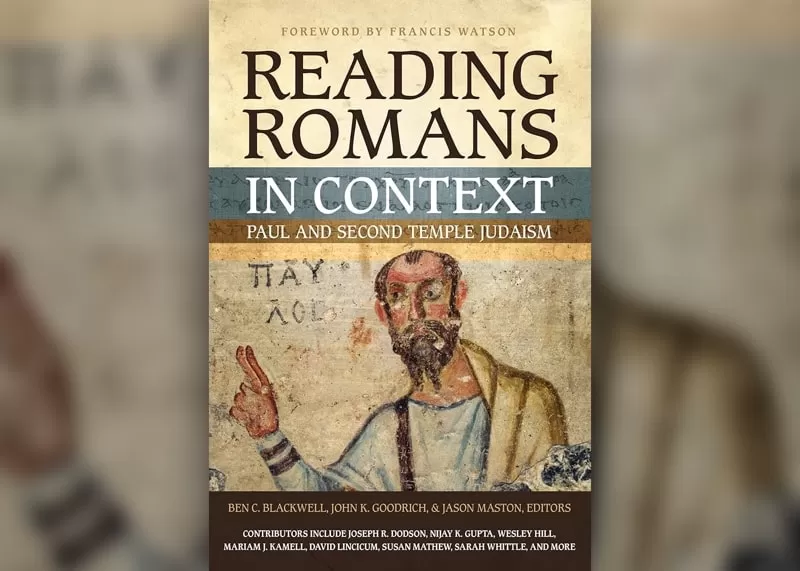
I really shouldn’t be going on about this, but I keep running into the same issue, and it is irksome. Reading Romans in Context: Paul and Second Temple Judaism (2015), edited by Blackwell, Goodrich, and Maston, ought to be a useful, if elementary, resource for exploring the abundant literary contexts for the letter. It is written from a cautious evangelical perspective, for Christians—the sort of people who listen to John Piper—who “remain suspicious of extracanonical literature and its value for biblical interpretation” (19). So it seems unlikely that the real potential for illuminating Paul’s thought will be realised, and the first chapter does nothing to dispel that suspicion.

Read time: 5 minutes

Jesus and empire, state and church

There is an obvious contradiction—at least in the popular imagination—between the values of Jesus and the practices of Christendom, and it is not surprising that what is left of the Christendom church in the West now largely views its past with horror and shame. Surely, the conversion of the Roman Empire was just a ghastly mistake, a betrayal of the gospel, an insult to the memory of Jesus the pacifist, the lover of enemies, the friend of tax collectors and prostitutes, the anti-establishment prophet and social revolutionary?

Read time: 8 minutes

Am I a trinitarian or a unitarian? Not if I can help it…

I am writing this in hope of offering some encouragement to Liam, who is planning to go to university in September to study theology but is worried that he may be wasting his time.

Liam is caught on the horns of a classic dilemma and at risk of falling torn and bruised between them. One horn is the traditional trinitarian understanding of the relation of Jesus to the Father; the other is a historical reading of the New Testament that constructs its christology in quite different terms.

Read time: 10 minutes

A different sort of missional theology from Paul’s address to the “men of Athens” in Acts 17

Paul is in Athens, waiting for Silas and Timothy to join him. His spirit is troubled by the profusion of idols in the city, and he gets into lively disputes about the phenomenon with Jews and God-fearing gentiles in the synagogue on the Sabbath and for the rest of the week with philosophers and other layabouts in the agora. This is the real Paul—not the letter writer so much—of whom we get no more than a glimpse in Acts and in the reconstruction of his quarrels with the Jews in Romans.

Read time: 8 minutes

Why is there no eschatological pilgrimage of the gentiles in Paul?

The idea of the “eschatological pilgrimage of the Gentiles” to a rebuilt temple and restored Zion is well attested in Isaiah especially but is found in other Old Testament and Hellenistic-Jewish writings. Here are three examples, but we could add Isaiah 56:6-7; 66:18-20; Zech. 14:16; Mic. 4:1-2; Sibylline Oracles 3:715-19; 772-75, and no doubt others.

Read time: 5 minutes