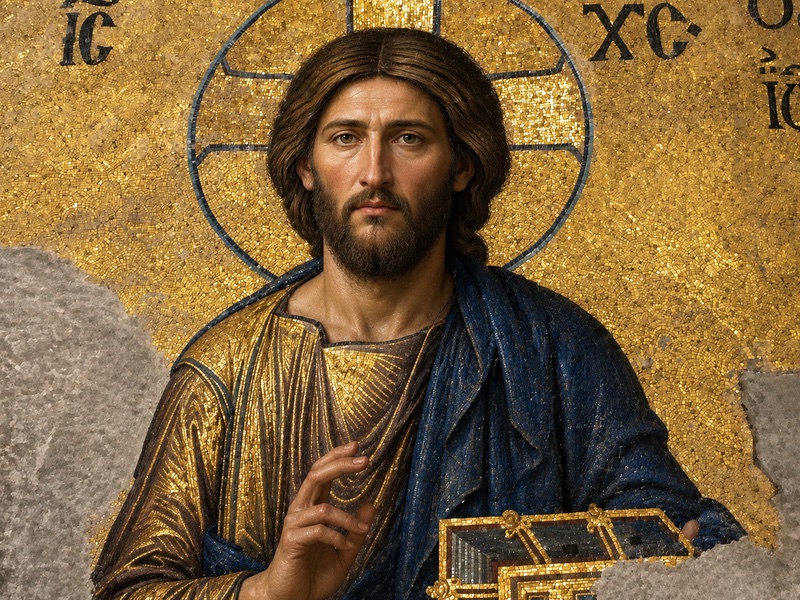
In a Substack post, Brian Zahnd looks at four key theological “entities” and warns of the “theological mischief” that happens when the “critical distinction” between them is not properly respected. The Church, the Bible, and the religion of Christianity are all good and important things, but not as good and important as Jesus. “The moment we try to nudge the Church or the Bible or Christianity toward equality with Christ we are headed down a theological path that leads to confusion and real-life trouble.”

My objection to this sort of analysis is two-fold. First, it relies on a flawed understanding of the categories if they are meant to be fundamentally biblical and not the product of later theological rationalisation. Secondly, it is an outdated analysis of “Christianity”: it deals with problems of the past, not of the future.

Read more...
This is a story of our times, surely: a person I know slightly, trapped a while back in an evangelical Reformed seminary, drawn to the narrative-historical argument but not sure what to do with it, has now abandoned his faith, identifying as someone who is at best sympathetic to the ( | 3 comments)
I have Daniel Hoffman to thank for this little aperçu. Jesus is riding on a young horse (pōlon), perhaps awkwardly on a young donkey, descending the Mount of Olives towards Jerusalem (Lk. 19:37). There is no explicit reference to Zechariah 9:9, but presumably the allusion was not lost on… ()
The books I’ve been reading on “missional church” have a couple of key objectives in common: to describe the progress of the Western church towards a new “missional” paradigm, and to map that paradigm on to an expansive reading of the biblical narrative. It’s an obvious, perhaps inevitable,… ( | 6 comments)
A significant tranche of missional church thinking centres on the APEST paradigm. The argument is that if the church is to become a movement again after the sclerotic institutionalism of the Christendom era, it needs urgently to reactivate the gifts of apostle, prophet, and evangelist. Shepherds… ( | 2 comments)
It is clear from reading recent books on missional church that a missional theology needs to extend in two directions. It needs to extend in a social direction to encompass the existence of churches as communities interacting with societies; and it needs to give an account of the… ()
If you’re looking for a primer on missional theology, John Franke’s Missional Theology: An Introduction is not a bad option. It’s clearly presented and to the point, with just five chapters on “Missional God,” “Missional Church,” “Missional Theology,” “Missional Multiplicity,” and “… ()
John Franke’s Missional Theology: An Introduction starts with the idea associated with Karl Barth and the missiologist Karl Hartenstein that the biblical God is in his very nature a missional God. Mission is not primarily what the church does; it is what God does, expressed most fully in… ()