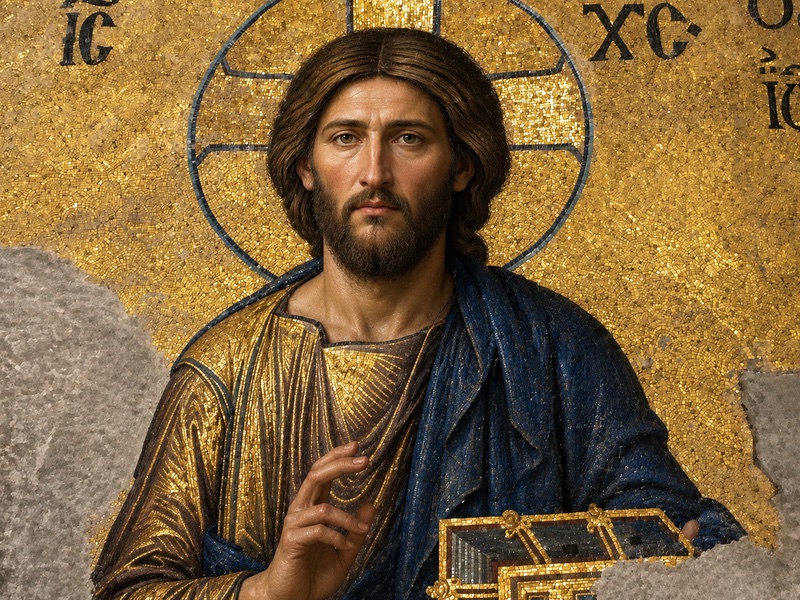
In a Substack post, Brian Zahnd looks at four key theological “entities” and warns of the “theological mischief” that happens when the “critical distinction” between them is not properly respected. The Church, the Bible, and the religion of Christianity are all good and important things, but not as good and important as Jesus. “The moment we try to nudge the Church or the Bible or Christianity toward equality with Christ we are headed down a theological path that leads to confusion and real-life trouble.”

My objection to this sort of analysis is two-fold. First, it relies on a flawed understanding of the categories if they are meant to be fundamentally biblical and not the product of later theological rationalisation. Secondly, it is an outdated analysis of “Christianity”: it deals with problems of the past, not of the future.

Read more...
The two most important commandments, according to Jesus, are to “love the Lord your God with all your heart and with all your soul and with all your mind” and to “love your neighbour as yourself” (Matt. 22:37-40). Add to this his teaching about love for enemies, while perhaps quietly sidelining the… ()
The standard argument about the “image of God” is that 1) humanity was created, male and female, “in the image, according to the likeness” of God; 2) this “image” somehow encapsulates the essential nature and dignity of humanity; 3) the image was broken or lost in the “fall”; 4) it was reinstated… ( | 4 comments)
We are probably stuck with the distinction between “church” and “mission.” I attend a church in Westbourne Grove. I work informally with a mission organisation. But in biblical terms there is something odd about our obsession with mission. The word occurs only four times in the… ( | 1 comment)
What we call “Christianity” is the religion of the formerly Christian West. It survives residually in both the historic and modern churches, and globally as a result of both historic and modern missionary expansion. It is defined by diverse, overlapping systems of belief and practice, which… ( | 2 comments)
At the Communitas staff conference in Malaga last week, there was a lot of discussion around two related topics: human sexuality and the surprising interest shown by young people in Christianity in the last few years, which sometimes goes under the label “quiet revival.” ()
We will be doing some sessions on Philippians at the Communitas staff conference in Malaga next week. Here, by way of preparation, is a quick explanatory synopsis of the letter as a historical document, by which I mean that it emphasises the restricted outlook and experience of Paul and of… ()
I have long held the view that Babylon the great in Revelation 17-18 is the city of Rome as the capital of a decadent imperial power. Jason Staples used to think the same, but in a recent Substack post he explains why he has adopted the minority position that the lurid and dissolute woman… ( | 2 comments)