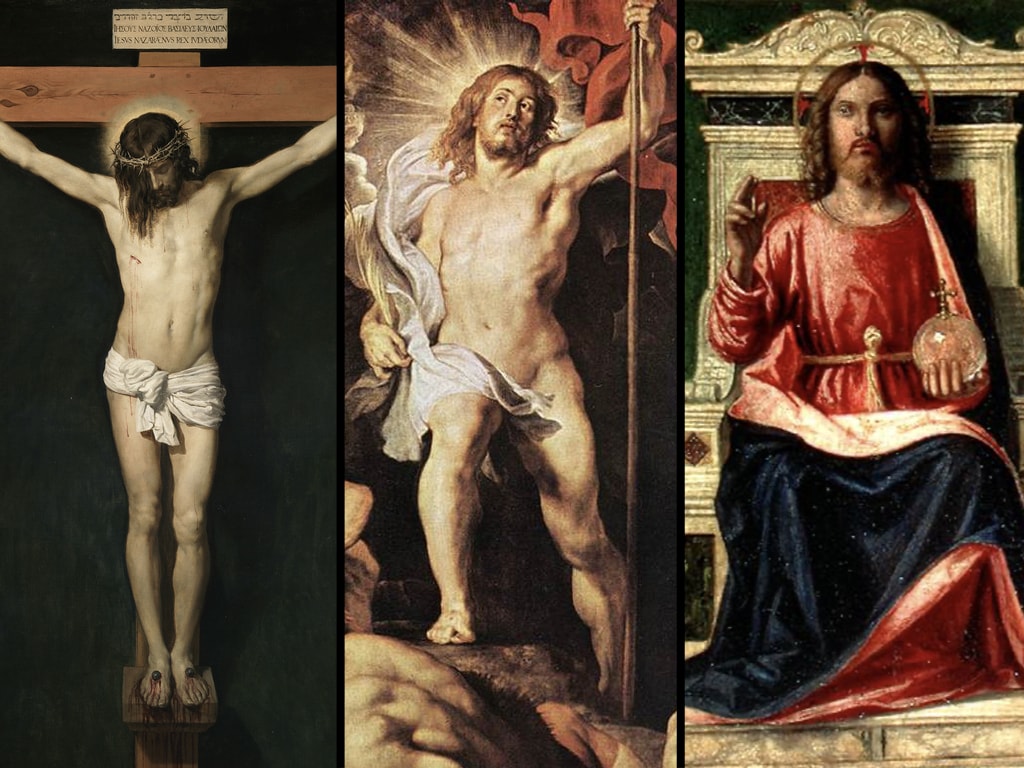
David has provided a very nice commentary on my previous post about the resurrection of Jesus on the third day. He has made it clear that he gets the main contention about the historical framing: “Too often we read the New Testament as if it dropped out of the sky rather than emerging from a real story, rooted in Israel and moving outward into the world.” But he pushes back at a number of points. He insists that the resurrection of Jesus in the New Testament is treated not merely as a moment in Jewish history but as an event of universal human significance. I have highlighted his main concerns and responded.
A comment by Chris Jones in response to something I said about the difference between the coming of the kingdom and the (supposed) redemption of the cosmos has had me looking at the sequence of events at the end of Revelation again.My view hitherto was that after judgment on Rome we have a thousand… ( | 6 comments)
Some recent conversations around the theme of theosis have directed me to Michael Gorman’s book Inhabiting the Cruciform God: Kenosis, Justification, and Theosis in Paul’s Narrative Soteriology. Gorman’s thesis about theosis runs something like this: i) Jesus is a… ( | 4 comments)
Someone got in touch recently asking about how we square the circle of justification by faith and judgment according to works in the New Testament. We are told all the time that we’re saved by faith and not by works—don’t you dare lift a finger to try and save yourself! But there’s no shortage of… ( | 4 comments)
Michael Bird’s Euangelion blog is a constant source of intriguing biblical studies, etc., miscellanea. Yesterday it was Byzantine Star Wars iconography, today it’s Carl Mosser explicating the biblical basis for the supposed doctrine of theosis—roughly the idea that believers, if they stick… ( | 10 comments)
On the Gospel Coalition site Gavin Ortlund has summarily restated J.I. Packer’s response to annihilationist arguments. Here I restate my arguments against the arguments against annihilationism, while noting at the same time that annihilationism as a reading of New Testament eschatology is… ( | 8 comments)
Christian soteriology works on the assumption that Jesus’ death was a unique saving event. The only real antecedent considered is the suffering of Isaiah’s servant, upon whom the Lord has laid “the iniquity of us all”, understood not as referring to a historical figure or community in Isaiah’s… ( | 4 comments)
Rikk Watts has kindly responded to my reflections on his argument about the high christology of Mark 1:2-3. I’m not trying to pick a fight here—and I say, as before, that this is an argument for the kingdom narrative rather than against a high christology. But the issue is an… ( | 2 comments)
Recent comments