Stone Chapel podcast with David Capes
I did a couple of podcast episodes recently with David Capes for The Stone Chapel Podcasts, talking about my book In the Form of a God: The Pre-existence of the Exalted Christ in Paul.
It is easy to visualise the traditional interpretation of Philippians 2:6-11 as a downward parabola or u-bend: Christ existed in heaven from eternity “in the form of God”; he descended into the world, becoming man and dying on the cross; then he is raised from the dead and restored to his position in heaven. Here again is that “cosmograph” for the who missed it the first time round.
This is a dull, and frankly unnecessary, technical note on the genitive construction with a preposition en morphēi theou (ἐν μορφῇ θεοῦ) in Philippians 2:6. I’ve had to look at this a bit more closely following a rather disjointed conversation with someone on Twitter who had different grammatical objections to John Baumberger to my translation “in the form of a god.” The following summary is based on Daniel Wallace’s Greek Grammar: Beyond the Basics (1996).
John Baumberger has a question about my translation of en morphē theou in Philippians 2:6 as “in the form of a god.” He takes issue with the indefinite construction on a couple of grounds:
1. The word theos ‘without the definite article almost always refers to God himself (and not “a god”) throughout scripture.’
2. The article with theos in verse 9 refers back to the theos of verse 6; therefore, en morphē theou in verse 6 must be translated “in the form of God.”
The famous passage about Christ in Philippians 2:6-11 is usually described as a “hymn,” and is usually taken to celebrate the inverted parabola of Christ’s descent from heaven, his incarnation as man, the nadir of his death on the cross, followed by his return to heaven and exaltation to a position equal to or perhaps higher than the one he left.
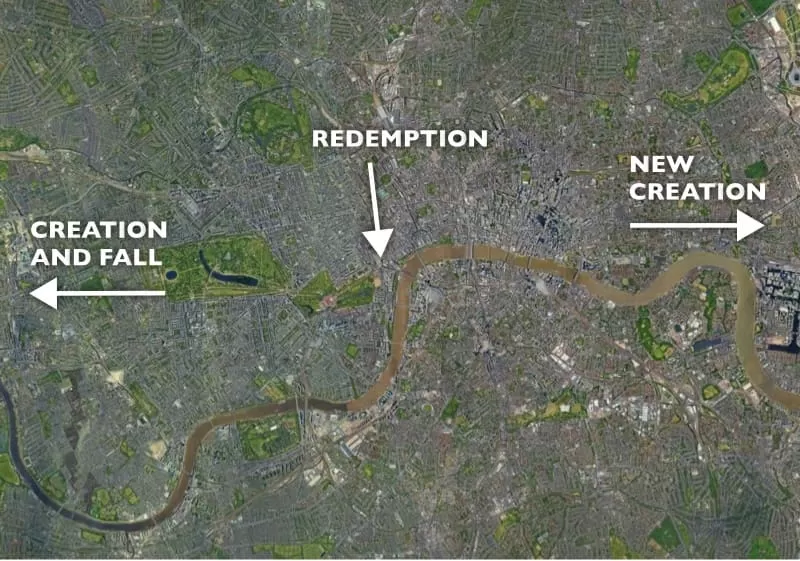
Just for the sake of completeness, here is one final visual representation of the two-part significance of Easter. It’s now getting a bit overloaded, I know—two storylines, four landing points, and an unexpected back-reference to the flood; but I don’t want to give the impression that history has completely exhausted the meaning of Easter.
This is a brief addendum to the earlier post this week about the two meanings of Easter. A bit of an exchange on Facebook suggested to me that modern theologies of Easter are a striking inversion of what we find in the New Testament. I have tried to represent this graphically.
Recent comments